Renting a Car in South Africa – Routes, Tolls, and Road Rules
South Africa is, in many respects, built for the self-drive traveller. The road network is among the most developed on the African continent. The signposting, though inconsistent in rural areas, is generally adequate on major routes. Petrol stations appear at reliable intervals. The scenery is extraordinary, and much of the best of it exists along roads that no tour bus schedule has any reason to follow.
Renting a car in South Africa and driving yourself from one destination to the next is also considerably cheaper than joining an organised group tour, and it offers something that no tour can replicate: the freedom to stop when something catches your eye, to take a detour through a small town because it looked interesting from the road, or to sit at a viewpoint for twenty minutes longer than anyone else’s itinerary would allow.
This guide covers everything you need to know to do it properly: the requirements for renting, the rules of the road, the tolls you will encounter, the insurance questions you need to answer before you sign anything, and the routes that make the effort worth it.

Before You Pick Up the Keys
Documents and Age Requirements
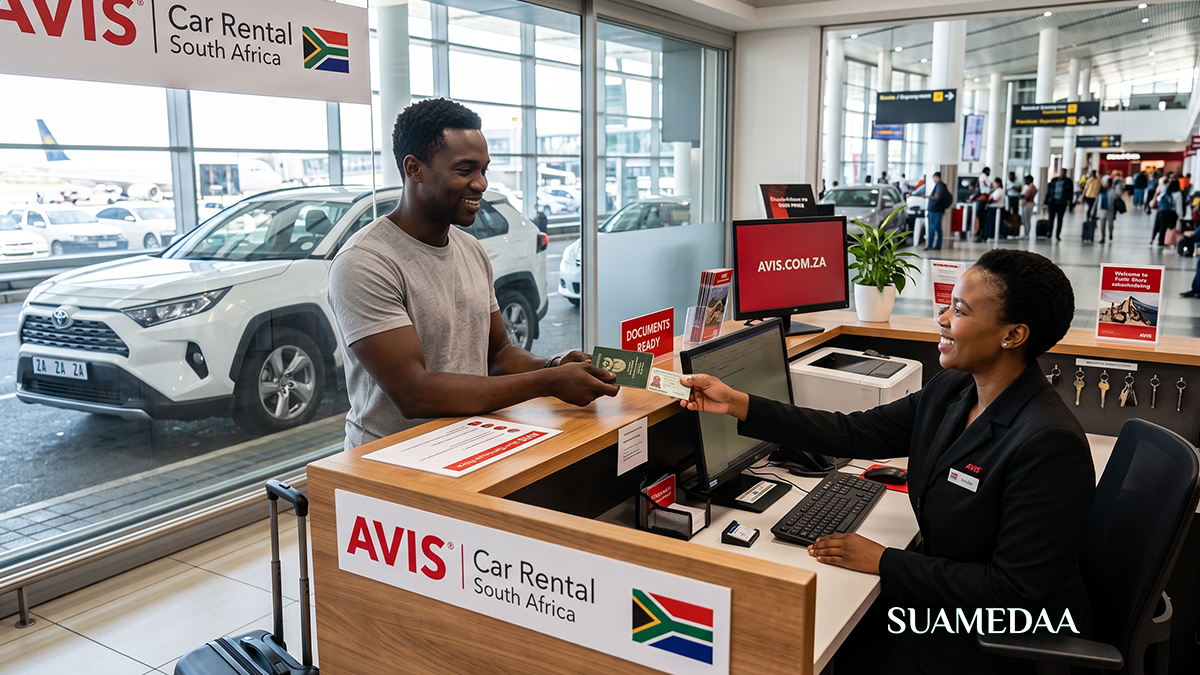
South Africa’s car rental companies have a specific and non-negotiable list of requirements for rental customers. Understanding these before you arrive avoids problems at the counter.
You need a valid driver’s licence. If your licence is issued in English, you may use it directly. If it is in another language, you will need an International Driving Permit obtained in your home country before departure. The IDP is not available in South Africa, and no rental company will accept a licence they cannot read without one. Your licence must carry both a photograph and a signature, and it must remain valid through your rental return date.
Most major rental companies require drivers to be at least 23 years old, though some set the minimum at 25. Drivers under 25 typically incur a young driver surcharge of between ZAR 100 and ZAR 200 per day on top of the base rental rate. The upper age limit is usually 75. Your licence must also have been held for at least one year, and many companies require two years.
You will need your passport, the credit card you are using for the deposit, and in some cases a pre-printed colour copy of your driving licence, which some companies request in advance of collection.
The deposit held on your credit card at collection is typically around ZAR 5,000, covering both the vehicle security deposit and any GPS or Wi-Fi equipment included with the rental. This is a hold, not a charge, and is released when the vehicle is returned in the agreed condition.

Insurance: The Decision That Matters Most
The insurance conversation is the most important part of renting a car in South Africa, and it is the area where underprepared travellers most often face expensive surprises.
Every rental comes with some form of basic insurance, but the collision damage waiver included in most standard rental rates leaves you liable for what is called the excess, or deductible: the amount you pay toward any damage before the insurance contributes. In South Africa, this excess can reach ZAR 15,000 to ZAR 30,000 depending on the vehicle and the company. A minor scrape in a parking lot, a stone chip on the windscreen from a gravel road, or a kerb scuff can trigger a damage claim that leaves you paying thousands of rands for an incident that felt trivial at the time.
The solution is to take the super-CDW (super collision damage waiver), an additional daily charge, typically between ZAR 250 and ZAR 500 per day, that reduces or eliminates your excess liability. For a ten-day rental, this adds perhaps ZAR 3,000 to ZAR 5,000 to your total cost. It is almost always worth it, particularly for drivers unfamiliar with South African roads, urban traffic, and the gravel sections that appear on some of the more interesting rural routes.
Tyres and windscreens require attention: they are almost universally excluded from standard CDW coverage, which means a tyre blow-out or a cracked windscreen leaves you fully liable unless you have taken a separate tyre and windscreen waiver. On gravel roads, which you will encounter if you venture beyond the main tarmac routes, stone chips and tyre damage are a realistic possibility rather than an unlikely scenario. The waiver for tyre and windscreen cover typically costs between ZAR 80 and ZAR 120 per day.
Cross-Border Travel
South Africa’s rental cars can, in most cases, be taken across borders into neighbouring countries. The neighbouring countries covered by most major companies include Botswana, Namibia, Lesotho, Eswatini, Zimbabwe, and Mozambique. Zambia is covered by some companies but not all.



The critical point is that cross-border permission must be arranged at the time of booking, not when you collect the vehicle. If you decide at the last minute that you want to drive to Lesotho or Mozambique without having arranged the permit in advance, the rental company will not be able to help you. The cross-border fee varies by destination, typically between ZAR 500 and ZAR 1,500, and includes a permission letter that you will need to present at the border alongside the vehicle documents.
Photograph Everything at Collection
Before you drive a rental car anywhere, walk around it slowly and photograph every panel, bumper, wheel arch, and piece of glass, with your phone’s timestamp visible in the images. Note every existing scratch, dent, and mark on the condition report, however small, and ensure the company representative signs to confirm they have seen it. This record protects you when you return the vehicle and the person inspecting it claims that a scratch you did not make was not there at collection. The claim that a returning renter was responsible for a mark that existed before collection is among the most common disputes in South Africa’s car rental industry.
Vehicle Selection
The choice of vehicle depends on your route. For driving the Western Cape on tarred roads, a standard compact car is entirely adequate and costs considerably less than a larger vehicle. For routes that include gravel roads, switchback mountain passes, or mixed terrain, a mid-range SUV is worth the additional cost. A true 4×4 is rarely necessary in South Africa for the routes that tourists typically drive, with the notable exception of the Sani Pass, which requires four-wheel drive in either direction.
The Toyota Fortuner appears frequently as the recommended rental vehicle for trips that span multiple terrain types. It is high enough to handle gravel road debris comfortably, provides a better view of the road, and accommodates luggage for two people without difficulty.
The Rules of the Road
Left is Right
South Africa drives on the left side of the road, with right-hand drive vehicles. For drivers from left-hand traffic countries like the United States, most of continental Europe, and much of West Africa, this requires a conscious adjustment that takes roughly a day to become instinctive. The moments most likely to catch you out are when turning from a junction or pulling out of a petrol station: the instinct in a left-hand drive country is to pull into the near lane, which in South Africa is the wrong lane.
Give yourself an extra margin in the first few hours. Avoid complex urban junctions in a busy city until you have driven at least thirty minutes on quieter roads and built confidence with the left-hand pattern.
Speed Limits
Speed limits in South Africa are metric:
120 km/h applies on major national highways (identified by the N prefix, as in N1, N2, N3). Note that from July 2025, the Road Traffic Management Corporation has enforced stricter penalties for exceeding highway limits: fines for driving more than 90 km/h on highways where the limit is 120 km/h have been set at ZAR 7,500 on the spot.
100 km/h applies on secondary and rural roads outside built-up areas.
60 km/h applies within built-up areas and towns.
40 km/h applies in residential areas and inside national parks.
Speed cameras operate in and around most major cities. Traffic officers also conduct speed enforcement on national highways, and fines issued by traffic officers are handed to the rental company, who will charge them to your card after the fact, often with an administration fee. Driving at a pace where you can respond to road conditions, livestock, pedestrians, and the general unpredictability of South African road traffic is also simply wise.
The Four-Way Stop
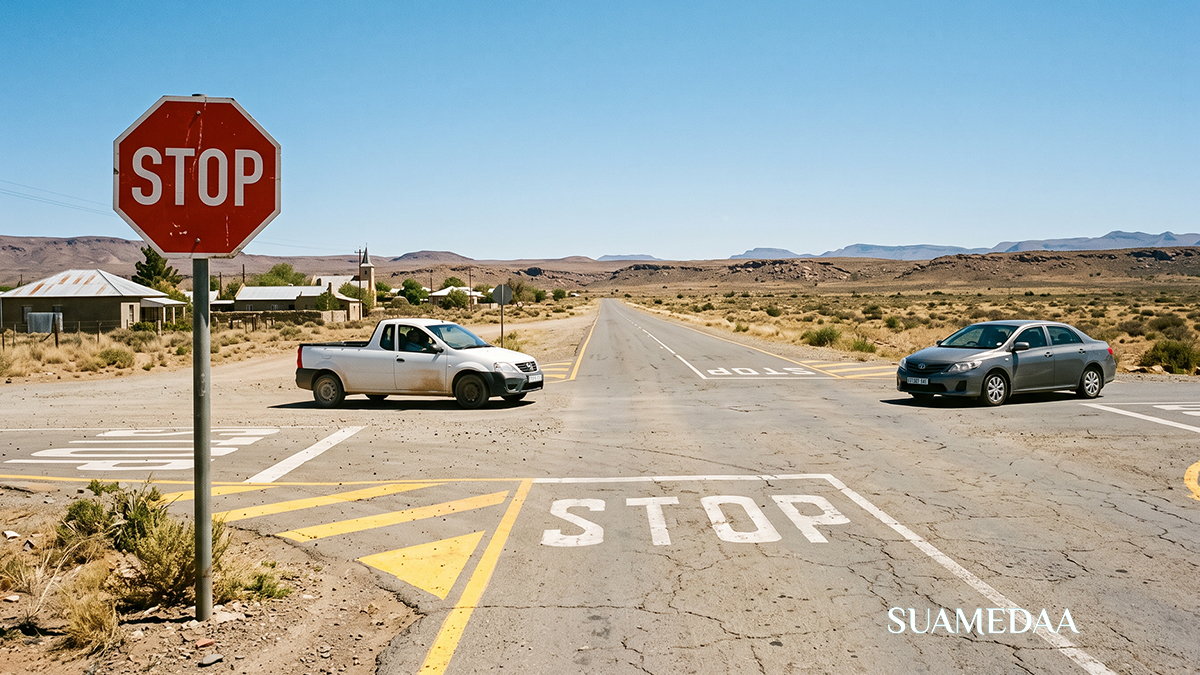
The four-way stop is one of the defining features of South African road infrastructure, and it operates differently from the roundabout or priority-road systems common in many other countries. At a four-way stop, all vehicles stop completely, and proceed in the order in which they arrived. If two vehicles arrive simultaneously, the vehicle on the left yields to the vehicle on the right. If multiple vehicles arrive at the same time, the convention is to make eye contact, wave, and sort it out through courtesy.
Understanding the four-way stop matters because it is everywhere, and South African drivers navigate it with a combination of the rules and a certain informal negotiation that seems chaotic until you understand it. The main principle is simple: stop fully, look for vehicles that arrived before you, and proceed when it is clearly your turn.
Roundabouts, by contrast, operate on a yield-to-the-right principle, meaning traffic already in the roundabout has priority over traffic entering. Be aware that in Johannesburg particularly, drivers sometimes treat roundabouts as four-way stops rather than following the yield rule, which creates its own particular dynamic.
Minibus Taxis
Minibus taxis are the primary form of public transport for a significant proportion of South Africa’s urban population, and they operate under conventions that differ substantially from private cars. A minibus taxi will stop to collect or discharge passengers wherever the passengers happen to be, including mid-road, at corners, or at the top of an incline. The indicator for a taxi stopping is not always used, and when it is, the stop may happen immediately rather than at a safe distance from the signal.
Treat minibus taxis the way you would treat an unpredictable element in the traffic environment: give them significant space, do not assume they will indicate, and do not assume that a stopped taxi will remain stopped. This is not a criticism; it is the practical reality of driving in South African traffic.
Hazard Lights as Thank You
One of South Africa’s more charming road conventions is the use of hazard lights as a signal of thanks. When a vehicle flashes its hazard lights twice or three times after being allowed past or after someone has given way, it is saying thank you. This requires no response on your part, but you will see it constantly and should understand what it means.
Night Driving
Avoid driving at night outside urban areas. This is not excessive caution. South African rural roads frequently lack lighting and line markings, and pedestrians, often without any reflective clothing, walk along roadsides. Livestock also cross roads unpredictably in rural and peri-urban areas. The combination of these hazards in darkness makes night driving in unfamiliar rural terrain genuinely risky. Inside national parks such as Kruger, driving after dark outside the designated rest camps is prohibited and carries heavy fines.
Petrol Stations
South Africa operates on a full-service petrol station model. You do not pump your own fuel. An attendant will fuel the vehicle, check the oil if you ask, and clean the windscreen. Tipping the attendant between ZAR 5 and ZAR 10 is standard and expected. Petrol is sold in litres, and the fuel type you need, 95 unleaded petrol or diesel, should be confirmed at vehicle collection: misfuelling with the wrong type creates a mechanical problem that is not covered by insurance and results in substantial repair costs.
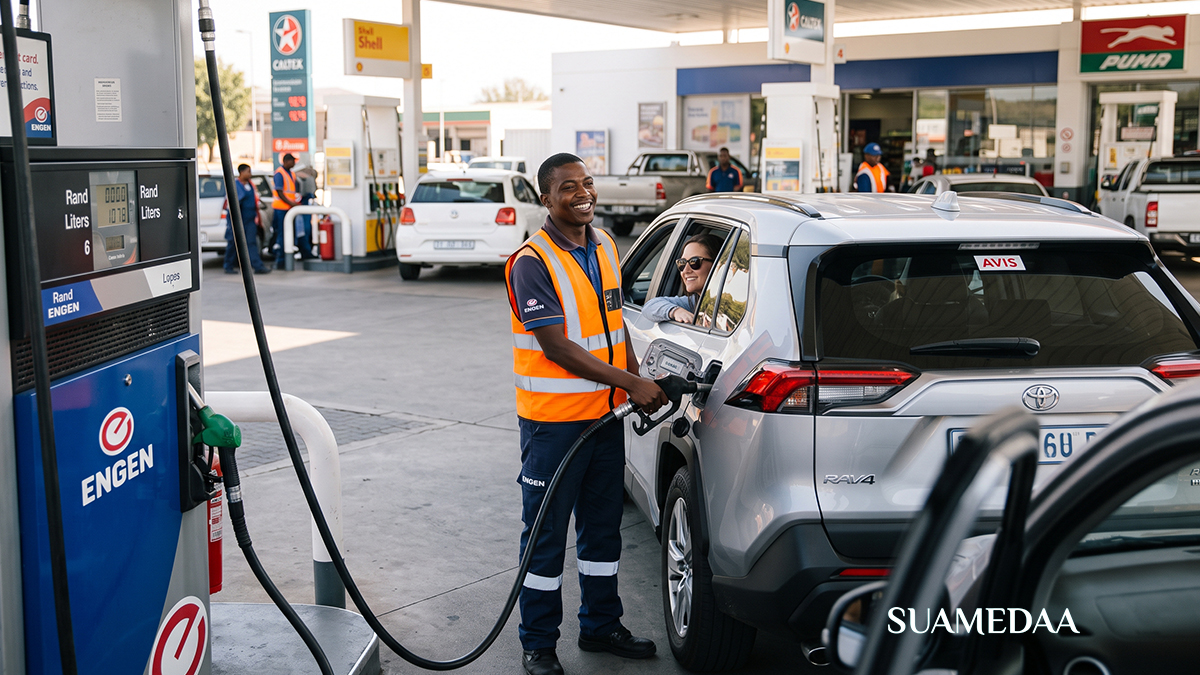
In rural and more remote areas, fill up whenever you see a petrol station rather than waiting until the tank is low. Stations can be far apart on certain routes, and running out of fuel in the Karoo or along the Wild Coast is an inconvenience of a particular order.
Keep cash available. Most petrol stations accept cards, but connectivity failures happen, and cash ensures you can always refuel.
Tolls: What You Will Pay and Where
South Africa has an extensive toll road network, and understanding it before you drive saves you both confusion and the mild irritation of realising you owe several hundred rand you had not budgeted for.
The toll system operates on a cash and card payment model at physical toll plazas. Most plazas accept credit and debit cards, but having small amounts of cash available for toll booths is a sensible backup. Regular South African drivers use an e-tag, a device fitted to the windscreen that communicates with the toll plaza electronically, providing discounts of between 10 and 15 percent and avoiding the cash lanes. Short-term visitors renting a car are unlikely to need an e-tag, but rental companies sometimes include one in the vehicle, in which case the tolls are charged to your card through the rental company at the end of the rental.
The major toll routes and approximate cumulative costs for a complete traverse, as of 2025:
Johannesburg to Durban (N3): The N3 Toll Concession manages the highway between Johannesburg and Durban, one of the country’s busiest freight and passenger corridors. Multiple toll plazas stagger through the route. A complete one-way trip from Johannesburg to Durban accumulates approximately ZAR 350 in toll fees.
Johannesburg to Cape Town (N1): The N1 national route runs through the Karoo and into the Western Cape. The cumulative toll cost for the full Johannesburg to Cape Town route is approximately ZAR 257 one-way, payable at plazas distributed across the route.
Johannesburg to Komatipoort/Mozambique border (N4): The N4 runs east from Pretoria through Mpumalanga to the Mozambique border, passing through the corridor that serves the Kruger National Park region. Total tolls for the full route are in the range of ZAR 280 to ZAR 320.
Huguenot Tunnel (N1, Western Cape): On the N1 between Cape Town and Worcester, the Huguenot Tunnel passes through the Du Toitskloof Mountains. The toll is approximately ZAR 53 for a private vehicle. An alternative mountain pass route exists but is longer and requires more time.
Tsitsikamma (N2, Garden Route): On the Garden Route, the Tsitsikamma toll plaza charges approximately ZAR 71 for a private vehicle.
On most routes, an alternative non-toll road exists. These are almost always longer, slower, and more interesting than the toll highway, and if your schedule allows, driving the old roads through small Karoo towns or coastal villages rather than the direct toll highway is often the better experience.
The Routes Worth Driving
The Garden Route: The Classic
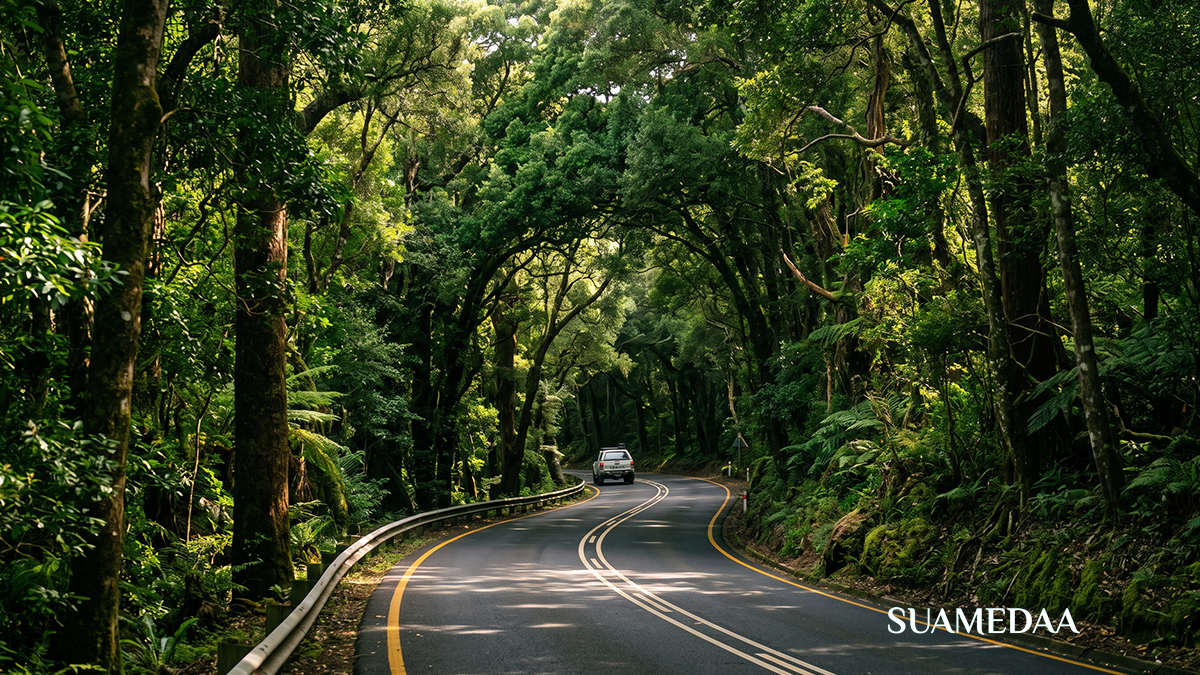
The Garden Route stretches approximately 200 kilometres along the N2 from Mossel Bay in the west to the Storms River Gorge in the east, passing through the towns of George, Wilderness, Knysna, and Plettenberg Bay. It is the most visited scenic drive in South Africa and one of the most visited in Africa, and its reputation is entirely deserved.
The landscape shifts continuously along the route: fynbos-covered hills behind Mossel Bay give way to indigenous yellowwood and stinkwood forests as the route moves east, the forest dense and ancient enough to feel like a different world from the open coastal scenery that preceded it. The Knysna Lagoon, protected by the famous Knysna Heads, is one of the most photographed landscapes in South Africa. Plettenberg Bay offers whale watching from the shore between June and November, when southern right whales come to the bay to calve. The Tsitsikamma section of the Garden Route National Park offers old-growth forest, the Storms River suspension bridge, and some of the finest coastal scenery on the south coast.
The route is fully tarred, comfortable to drive, and can be completed as a point-to-point journey from Cape Town to Gqeberha (Port Elizabeth), using the full length of the N2 as the spine and taking detours as interest dictates.
Chapman’s Peak and the Cape Peninsula
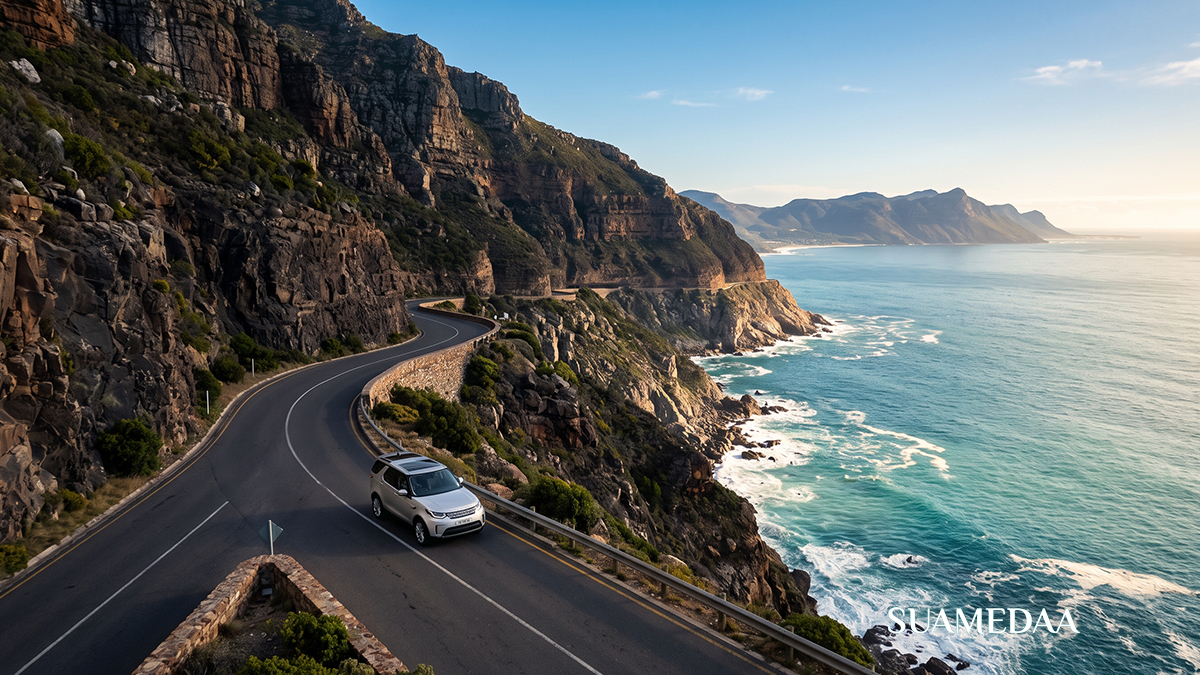
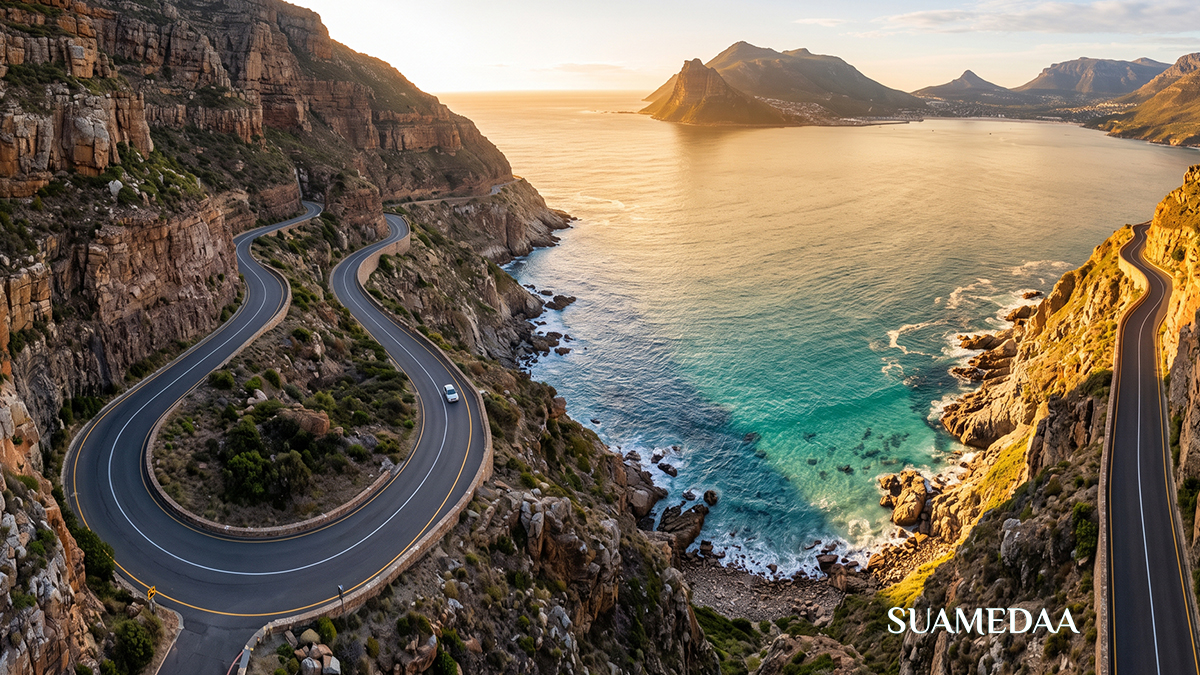
Chapman’s Peak Drive is a nine-kilometre road carved into cliff face on the Atlantic coast south of Hout Bay, with 114 curves and uninterrupted views of the ocean from heights that make the experience of driving it feel genuinely remarkable. It is not long, but it is one of the most spectacular short drives in the world, and combining it with a broader Cape Peninsula loop, Cape Point, the Cape of Good Hope, and the African penguin colony at Boulders Beach near Simon’s Town, creates a full day’s driving of sustained visual quality.
The peninsula route can be driven in either direction from Cape Town. From the city, take the Atlantic seaboard road through Sea Point and Clifton to Hout Bay, then drive Chapman’s Peak south to Noordhoek and around the peninsula to Cape Point. Return via the False Bay coastline through Simon’s Town, Muizenberg, and back to the city. This clockwise loop ensures you drive Chapman’s Peak in the more visually dramatic direction, approaching the cliff section from the Hout Bay end with the full Atlantic spread ahead of you.
Route 62: The Wine Road Through the Klein Karoo
Route 62 is South Africa’s long-distance wine route, running approximately 850 kilometres between Cape Town and Gqeberha and widely known as the longest wine route in the world. Where the N1 cuts through the Huguenot Tunnel and directly into the Karoo, Route 62 winds through the Cogmanskloof Pass, through Montagu, Barrydale, Calitzdorp, and Oudtshoorn, before eventually joining routes to the coast.
The drive through the Klein Karoo passes through semi-desert terrain that shifts between burnt orange and deep ochre depending on the light, with the Swartberg and Langeberg mountain ranges visible as context on either side. The towns along the route have a character particular to the Karoo: historic architecture, wine cooperatives, unusual food (Calitzdorp is South Africa’s port wine capital), and the general quietness of a South African hinterland that does not receive the same volume of visitors as the coast.
Oudtshoorn, near the eastern end of the Klein Karoo section, is the ostrich capital of the world and the site of the Cango Caves, one of the largest cave systems in southern Africa.
The Panorama Route: Mpumalanga’s Dramatic Interior
Mpumalanga, the province east of Johannesburg that borders Mozambique and lies adjacent to the Kruger National Park, contains the Panorama Route, a circular drive of approximately 160 kilometres that encompasses some of the most dramatic inland scenery in southern Africa.
The centrepiece is the Blyde River Canyon, the third-largest canyon on earth and the largest green canyon, the distinction coming from the fact that tropical vegetation covers its walls and floor rather than the bare rock of the Grand Canyon or the Fish River Canyon in Namibia. God’s Window, a viewpoint overlooking the canyon at approximately 1,730 metres above sea level, looks out over a panorama that extends in clear conditions to the Mozambique coastal plain. Bourke’s Luck Potholes, a geological formation at the confluence of the Treur and Blyde rivers where cylindrical potholes have been carved into red rock by centuries of swirling water, is one of those natural formations that does not look entirely real when seen in photographs and is even more striking in person.
The Panorama Route is most naturally combined with a visit to the Kruger National Park, which is accessible from the eastern edge of Mpumalanga and makes the region a natural two-part destination: the canyon country of the escarpment and the game-rich savannah of the Lowveld in the same trip.
The N3: Johannesburg to Durban
The N3 is primarily a working road rather than a scenic one: a four-lane national highway that carries heavy freight between the Gauteng industrial complex and the Port of Durban. But the section through the KwaZulu-Natal Midlands and the Van Reenen Pass is legitimately attractive, particularly in the late afternoon light, and the journey provides access to the Midlands Meander, a network of small studios, craft shops, and accommodation properties woven through the agricultural landscape between Mooi River and Pietermaritzburg.
Total distance from Johannesburg to Durban via the N3 is approximately 570 kilometres. With toll stops and comfortable driving, allow five to six hours for the journey.
Practical Notes on Driving in South Africa
Urban driving: Cape Town and Johannesburg have the same urban traffic dynamics as any major city, with rush hour congestion concentrated in the morning and evening peaks. Cape Town’s Cape Flats and Johannesburg’s inner city have areas that require the same caution you would exercise in the dense traffic of any large African city. Keep windows up at traffic lights in urban areas, keep doors locked, and do not leave anything visible on the seats.
Parking: Across South Africa’s cities and towns, informal parking attendants in fluorescent vests will wave you into spaces and watch your car while you are away. Tipping them ZAR 5 to ZAR 10 on return is standard and appreciated. Refusing to engage with them creates unnecessary friction; they are part of the city’s informal employment economy and are generally doing what they say they are doing.
Emergencies: In the event of a breakdown, contact the rental company’s 24-hour emergency line, which is provided at vehicle collection. Do not accept offers of help from strangers who pull over unbidden on highways. The roadside assistance scam, where a tyre is deliberately punctured and apparent helpers offer to assist while an accomplice removes bags from the vehicle, is a known risk on South African highways and particularly in Gauteng. If you have a flat tyre in an area that feels unsafe, keep driving slowly to the next petrol station or well-lit public area rather than stopping on the side of the road.
Gravel roads: Gravel roads in South Africa can be excellent or poor depending on maintenance and rainfall. Drive more slowly than you would on tarmac, give approaching vehicles a wide berth as stones thrown up by passing cars can crack windscreens, and confirm before leaving tarred roads whether your rental agreement covers gravel road driving (most do, but some contracts exclude it).
Fuel type: Confirm at collection whether your vehicle requires 95 unleaded petrol or diesel. Putting diesel in a petrol engine, or petrol in a diesel engine, creates a mechanical problem not covered by any rental insurance and results in a towing and repair bill that will significantly complicate your trip.
The Drive Itself
South Africa’s self-drive experience occupies a specific position in the world of road travel. The roads are good enough and the distances manageable enough that the driving is pleasurable rather than exhausting. The scenery is varied enough that the landscape holds your attention across thousands of kilometres. And the combination of genuine freedom, reasonable cost, and extraordinary destination range makes it one of the more compelling self-drive propositions available anywhere in the world.
The Garden Route in the south, the Panorama Route in the east, the Cape Peninsula in the west, and the Drakensberg ranges and Wild Coast in the interior all wait for the driver with a hire car, a full tank of fuel, and the confidence that comes from understanding the rules before the wheels start turning.