The Harmonized System Explained – How every Product gets a Code
Every year, approximately 17 billion tonnes of goods cross international borders. Crude oil from West Africa loads onto tankers bound for Asia. Cocoa from Ghana ships to chocolate factories in Europe. Electronic components manufactured in China arrive at assembly plants in Mexico. Pharmaceuticals, vehicles, textiles, agricultural produce, and thousands of categories of manufactured goods travel between countries whose customs authorities speak different languages, apply different tariff rates, and maintain different trade statistics.
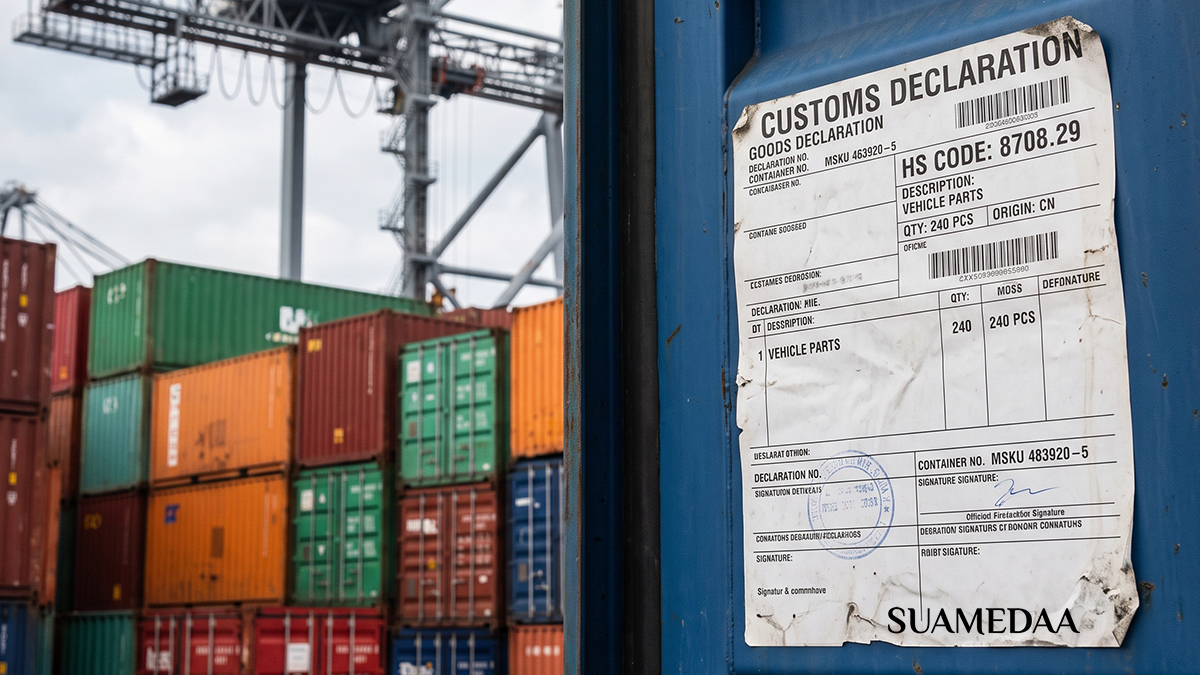
For all of them to clear customs, a question must be answered with precision: what exactly is this product?
The answer, in virtually every country on earth, is a number. Six digits, internationally standardised, that place every product within a classification system so comprehensive that it has a category for live horses, a separate one for frozen horse meat, and a further one for horse leather. It distinguishes between fresh mangoes and dried mangoes, between woven cotton fabric and knitted cotton fabric, between unused postage stamps and used ones. It is one of the most quietly consequential technical systems in the world economy, and most people who encounter it daily have never heard its formal name.
It is the Harmonized Commodity Description and Coding System, known universally as the Harmonized System, or HS. Understanding how it works is not merely an exercise in customs procedure. It is an introduction to the architecture of international trade itself.
Where It Came From
Before the Harmonized System, international trade classification was a problem without a clean solution. Individual countries maintained their own tariff schedules, and the nomenclatures varied enormously. What one country called electrical apparatus for telephony, another classified under telecommunications equipment, and a third split into components, finished devices, and accessories. Comparing trade statistics between countries was laborious. Moving goods across multiple borders required reclassification at each one. Customs authorities spent significant time simply trying to agree on what something was before they could decide what duty applied.
Several international organisations attempted partial solutions in the post-war decades, producing classification systems that covered some trade but not all, and that were adopted by some countries but not universally.
The World Customs Organization, based in Brussels, took up the task of building a truly universal system. The work took years and involved extensive negotiation among member customs authorities across dozens of countries. The result was the International Convention on the Harmonized Commodity Description and Coding System, which was concluded in 1983 and entered into force in 1988. From that year, the Harmonized System became the operational classification framework for international trade.
Today more than 200 countries, territories, and customs unions use HS codes as the basis for their tariff schedules, import and export declarations, trade statistics, and rules of origin determinations. The system covers approximately 98 percent of world merchandise trade by value. The WCO updates the nomenclature every five years. The seventh edition came into force in 2022, reflecting changes in technology, trade patterns, and the need to track new product categories that had not existed when earlier editions were written.

The Architecture of the System
The Harmonized System is built as a hierarchy, moving from broad categories to precise descriptions. Understanding the hierarchy means understanding how any product gets its code.
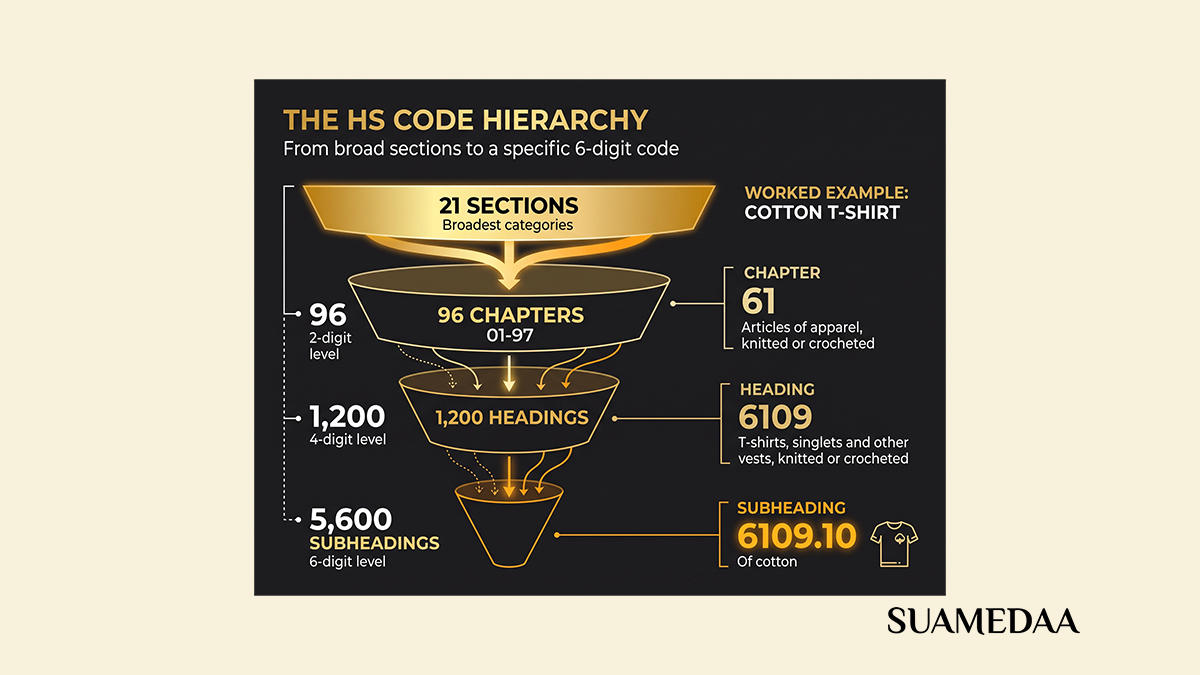
Sections are the broadest groupings. There are 21 sections, and they do not appear in the code itself. They are organisational containers that group related chapters together. Section I covers live animals and animal products. Section IV covers prepared foodstuffs, beverages, tobacco. Section XVI covers machinery, mechanical appliances, and electrical equipment. The section gives context but contributes no digits.
Chapters provide the first two digits of every HS code. There are 96 chapters, numbered from 01 to 97, with Chapter 77 reserved for future use. The chapter places the product in its broadest meaningful category. Chapter 01 covers live animals. Chapter 08 covers edible fruit and nuts. Chapter 61 covers knitted or crocheted clothing. Chapter 84 covers nuclear reactors, boilers, and machinery. Chapter 85 covers electrical machinery and equipment.
When you see an HS code beginning with 09, you know the product is in Chapter 09, which covers coffee, tea, maté, and spices. The first two digits alone narrow the field considerably.
Headings provide the third and fourth digits. The heading gives more specific identification within the chapter. Within Chapter 09, heading 0901 covers coffee. Heading 0902 covers tea. Heading 0904 covers pepper. There are approximately 1,200 headings across the entire system.
Subheadings provide the fifth and sixth digits. This is where the internationally standardised part of the code ends. The subheading makes the product identification precise. Within heading 0901, subheading 090111 covers coffee that is not roasted and not decaffeinated. Subheading 090112 covers coffee that is not roasted but is decaffeinated. Subheading 090121 covers roasted, not decaffeinated coffee. Each distinction carries a different code because it may attract a different tariff, require different documentation, or be tracked separately in trade statistics. There are approximately 5,600 subheadings in the HS.
Reading a Code: Three Worked Examples
Abstract explanation becomes concrete with examples.
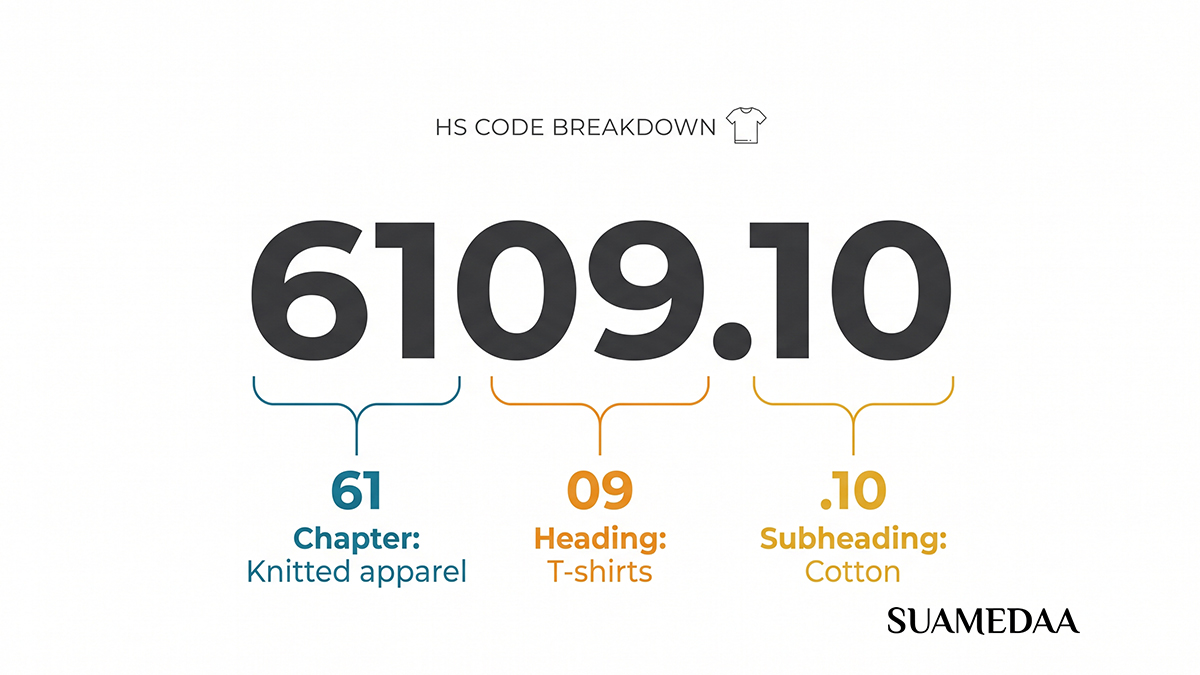
A cotton T-shirt is classified under HS code 6109.10.
The digits break down as follows. 61 places it in Chapter 61, which covers articles of apparel and clothing accessories, knitted or crocheted. The heading 6109 specifies T-shirts, singlets, and other vests. The subheading .10 identifies the material as cotton. A polyester T-shirt would be 6109.90, the subheading for other fibres. The material distinction is not cosmetic. Cotton and polyester T-shirts from the same country may attract different tariff rates, and some trade agreements apply rules of origin that depend on which fibre is dominant.


A smartphone classifies under 8517.12.
Chapter 85 covers electrical machinery, equipment, and parts. Heading 8517 covers telephone sets and other apparatus for the transmission or reception of voice, images, or other data. Subheading .12 identifies apparatus for wireless networks, which covers smartphones and cellular handsets. A corded landline telephone would sit under a different subheading within the same heading.
Fresh mangoes classify under 0804.50.
Chapter 08 covers edible fruit and nuts. Heading 0804 covers dates, figs, pineapples, avocados, guavas, mangoes, and mangosteens. Subheading .50 identifies mangoes and mangosteens specifically. Dried mangoes would sit in a different heading entirely, under Chapter 08’s provisions for dried fruit, because the product has been fundamentally transformed.
The Six Rules That Govern Classification
Knowing the structure of the code is only part of the system. Knowing how to assign a code to a product requires applying a set of rules. The WCO has established the General Rules for the Interpretation of the Harmonized System, a set of six rules applied in sequence. In practice, the vast majority of goods are classified by the first rule alone. The others handle the cases where the first rule does not produce a definitive answer.
- GRI 1 GRI 1 is the foundation. Classification is determined by the terms of the headings and any relevant section or chapter notes. If a product fits clearly and unambiguously within the wording of a heading, and no note excludes it from that heading, then it belongs there. Most products are straightforward enough that GRI 1 settles the question.
- GRI 2GRI 2 handles incomplete or unfinished products, and mixtures or combinations. An unfinished bicycle without wheels is still classified as a bicycle, not as miscellaneous parts, because the essential character of the finished product is already present. Similarly, a mixture of two substances that would each classify in different headings may be classified under the heading for the predominant component.
- GRI 3GRI 3 resolves conflicts when a product could plausibly belong in two or more headings. It applies three sub-rules in sequence.
a. – First, the most specific description takes priority over a general one. A heading for electric motors is more specific than a heading for machinery in general, so an electric motor classifies under the motors heading.
b. – Second, if specificity does not resolve the tie, the heading that covers the material or component that gives the goods their essential character prevails.
c. – Third, if that does not resolve it, the goods classify under the heading that appears last in numerical order in the tariff. - GRI 4GRI 4 provides a catch-all: goods that cannot be classified by the previous rules go under the heading most similar to them.
- GRI 5GRI 5 covers special cases for packing materials and containers supplied with the goods.
- GRI 6GRI 6 applies the same logic to the subheading level, once the heading has been determined.
The section and chapter notes are not supplementary guidance. They are legally binding parts of the system. They define terms, exclude certain products from chapters, and establish which heading applies to specific materials or processes. A note can override what might seem like the obvious classification based on a product’s description alone.
What Happens After Six Digits
The six-digit HS code is the internationally standardised level. At six digits, every country using the system applies the same code to the same product. Beyond six digits, countries diverge.
Most major trading economies extend the code for their own domestic purposes. The United States uses an eight-digit Harmonized Tariff Schedule for imports and a ten-digit Schedule B for exports. The European Union uses a ten-digit Combined Nomenclature. The United Kingdom uses a ten-digit commodity code. Ghana and other African countries using ECOWAS tariff schedules extend the six-digit code with additional digits to capture domestic tariff rates and statistical requirements.
These national extensions serve the domestic tariff structure. The additional digits allow a country to apply different duty rates to subcategories of a product without any other country being obliged to make the same distinction. A country might apply a reduced duty to a particular grade of steel that it does not produce domestically while applying a higher duty to grades it does produce, and it expresses this distinction through the digits beyond six.
For any exporter or importer, this means that classification must be verified twice: once at the universal six-digit level and once for the specific country of destination or origin. The six-digit code may be the same, but the full tariff code and the duty rate attached to it can differ between markets.
Why Classification Is Consequential
Getting the HS code right is not a bureaucratic formality. The classification of a product determines several things simultaneously, and each of them has real commercial value.
Tariff rates. The import duty on a product is a direct function of its HS code. A misclassification that places a product in a code attracting five percent duty when the correct code attracts twenty percent means significant underpayment of duty. Customs authorities can and do audit declarations, sometimes years after the fact. In most jurisdictions, they can look back three to five years, and in cases of fraud, longer. The result of an audit that finds systematic misclassification is an assessment for the shortfall, plus interest, plus penalties that can reach several multiples of the duty owed.
Trade agreements and preferential rates. Many of the preferential tariff rates available under bilateral and multilateral trade agreements are tied to specific HS codes. A product that qualifies for a zero-tariff rate under an agreement between its country of origin and the destination country does so because of what code it carries, not because of its general description. A misclassification can mean a company pays full duty when it was entitled to pay nothing, or conversely claims a preferential rate it was not entitled to, which constitutes an offence.
Import and export controls. Certain HS codes trigger additional requirements. Dual-use goods, which have both civilian and military applications, are often identified by specific codes that require export licences. Agricultural products may require phytosanitary certificates tied to their code. Chemicals may require hazardous goods documentation. A wrong code can result in a shipment crossing a border without the required documentation and being seized or refused entry when the discrepancy is identified.
Trade statistics. Every government’s trade statistics are built from the HS codes declared on customs entries. When Ghana’s Ghana Revenue Authority reports the value of cocoa exports or the volume of refined petroleum imports, those figures are aggregated from the codes on individual import and export declarations. Systematic misclassification distorts not only individual duty payments but the national trade data that informs economic policy, trade negotiations, and development planning.
The Cost of Getting It Wrong
Customs authorities around the world treat misclassification seriously, whether or not the error was deliberate. In the United States, the penalties are structured around culpability. A negligent misclassification where no duty was lost can still attract a penalty of five to twenty percent of the merchandise’s domestic value. A grossly negligent classification can attract twenty-five to forty percent. A fraudulent classification can attract fifty to eighty percent of the value of the shipment. Where duty was lost, the penalties are calculated as multiples of the duty shortfall: up to twice the shortfall for negligence, four times for gross negligence, and eight times for fraud.
The UK’s HMRC can impose penalties of up to 100 percent of the duty owed for deliberate non-compliance. The EU allows lookback periods of up to three years for straightforward errors.
Beyond financial penalties, repeated misclassification can cost a company its trusted trader or Authorised Economic Operator status, which in many countries entitles it to faster customs processing and reduced examination rates. Losing that status means every subsequent shipment takes longer and costs more to move.
The importer or exporter, not the supplier or freight forwarder, is legally responsible for the accuracy of the declaration. This matters because suppliers routinely provide HS codes with their commercial invoices, and those codes are sometimes wrong, sometimes coded for the supplier’s country rather than the destination country, and sometimes outdated following a revision to the nomenclature. Accepting a supplier’s code without verification is not a defence in a customs audit. It is simply a risk.
Binding Tariff Information: Certainty Before the Shipment
For products whose classification is genuinely uncertain, most customs authorities offer a formal mechanism for obtaining a definitive answer before the goods are shipped. In the European Union, this is called a Binding Tariff Information ruling. In the United States, CBP offers binding ruling letters. Similar mechanisms exist in most major trading economies.
A binding ruling is a formal written decision by the customs authority confirming how a specific product must be classified. It is binding on that authority for a defined period, typically three to five years, which means an importer who holds a valid binding ruling for a product cannot be assessed for underpayment of duty based on a different classification, even if the authority later decides the classification was wrong.
For new products, products that cross category boundaries, or high-volume importers whose duty exposure is large, seeking a binding ruling before the first shipment is a sound investment. The process takes time, requires a detailed product description and supporting documentation, and may result in a classification the applicant did not anticipate. But it removes uncertainty from every subsequent shipment of the same product.
The HS and Africa’s Trade Architecture
For African businesses and traders, the Harmonized System sits at the intersection of two structures that are increasingly important to economic development.
The African Continental Free Trade Area (AfCFTA), which entered into operational phase in 2021 and is progressively eliminating tariffs on intra-African trade, uses HS codes as the mechanism for identifying which goods qualify for preferential treatment under the agreement. Rules of origin under AfCFTA, which determine whether a product counts as African-made for the purpose of claiming preferential rates, are expressed in terms of specific HS chapters and headings. A Ghanaian manufacturer who wants to export to a fellow AfCFTA member at a reduced duty rate must demonstrate that the product’s HS code is one covered by the applicable schedule and that the good was produced in conformity with the origin rules for that code.
Similarly, Ghana’s access to markets under the African Growth and Opportunity Act with the United States, and under the Economic Partnership Agreements with the European Union, is expressed through HS-code-specific product lists. The difference between a product qualifying for preferential access and facing the standard tariff can be a single digit in the classification.
For customs authorities across the continent, including the Ghana Revenue Authority, the HS provides the foundation for import and export valuation, tariff collection, and trade data. The quality of that data, and the revenue collected, depends directly on the accuracy of classification decisions made at the border.
The Code Behind Everything
The Harmonized System is invisible in the finished transaction. When a container of cocoa powder arrives at a European port, the buyer and seller have agreed on price, quantity, and delivery terms. The logistics chain has moved the goods from origin to destination. What happens at customs, the classification, the duty calculation, the documentation check, is background infrastructure that most people in the transaction never directly see.
But it is also the mechanism by which the transaction is legally recognised, recorded in national statistics, and assessed for its contribution to public revenue. It is the common language that allows a customs officer in Hamburg and a customs officer in Tema to look at the same declaration and understand, from the same code, what product is being described.
That language was built over years of international negotiation, is maintained by a permanent international organisation, and is revised every five years to keep pace with what the world makes and trades. It is not glamorous. It is not well known outside the circles of customs practitioners, trade lawyers, and logistics professionals. But it is the silent architecture beneath every shipment, every import, every export, and every trade statistic that describes the global economy. Six digits. Every product. One system.