The New Rules of the Ghana Road -Everything You Should Know About Ghana’s L.I. 2519
On Ghanaian roads, the rules have changed. The Road Traffic Regulations, 2026, enacted as Legislative Instrument 2519, are now in force, and they represent the most comprehensive update to Ghana’s road traffic regulatory framework in over a decade. Whether you drive a private car, operate a commercial vehicle, ride a motorcycle for hire, or simply cross the street, L.I. 2519 has something to say about how you should do it, and what happens if you do not.
The instrument was promulgated under the Road Traffic Act, 2004 (Act 683), which was itself amended in 2025 to, among other things, formally recognise commercial motorcycle operations for the first time. L.I. 2519 replaces the previous Road Traffic Regulations, 2012 (L.I. 2180), and introduces a significantly expanded schedule of offences, fines, and prison terms that reflect both the complexity of modern Ghanaian road use and the government’s stated intention to enforce traffic law with greater seriousness.
This is not a minor technical update. It introduces jail terms for some offences that were previously treated as minor infractions. It creates a graduated system of penalties for camera-detected violations. It brings Okada operators, the commercial motorcycle taxi riders who move millions of Ghanaians every day, into a formal legal framework for the first time. And it extends regulation to conduct that has long happened on Ghanaian roads without any formal legal response. Every road user should understand what L.I. 2519 contains.



Understanding the Penalty Unit System
Before working through specific offences, it is important to understand how penalties are expressed in L.I. 2519. Fines are denominated in penalty units rather than fixed cedi amounts. This approach allows fines to be adjusted over time through changes to the unit value rather than requiring new legislation every time the cedi’s purchasing power shifts.
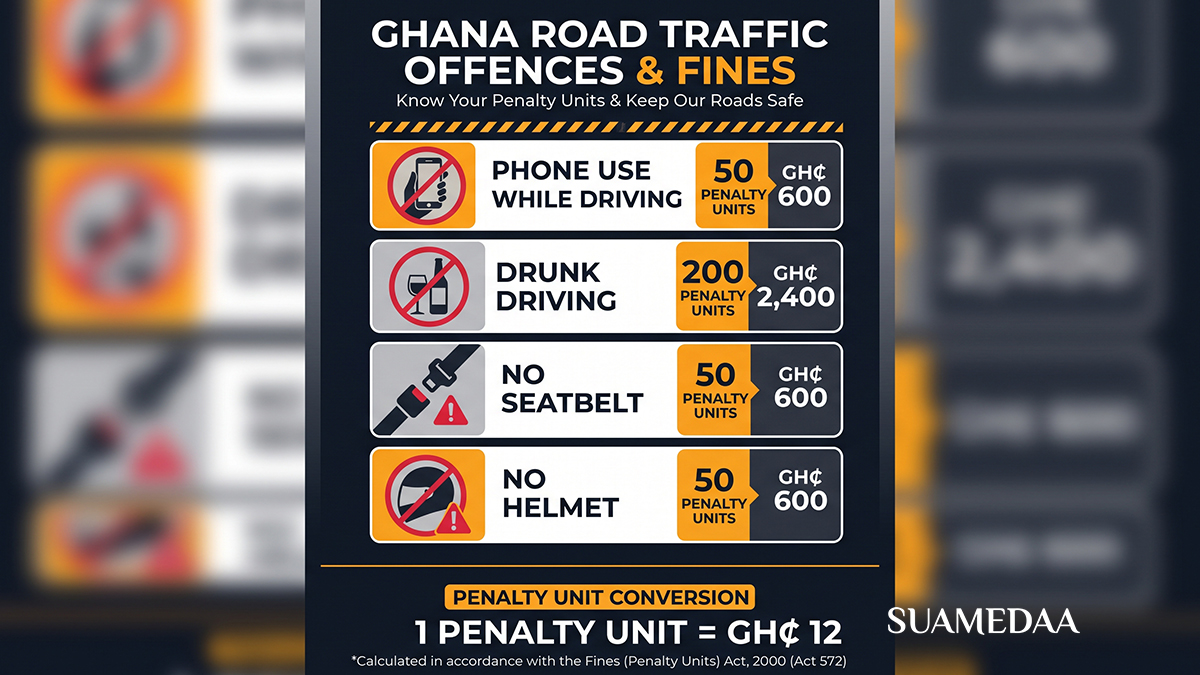
Based on reporting at the time of the regulations’ implementation, ten penalty units correspond to GH¢120. This means that a fine expressed as 25 penalty units would currently be GH¢300, and a fine of 50 units would be GH¢600. These values can be updated by order without amending the regulations themselves.
Many offences in L.I. 2519 carry alternative penalties: the fine or a prison term, or both, at the court’s discretion. This means that for some offences, a first conviction could result in a prison sentence rather than just a fine, depending on the circumstances and the severity of the conduct in the court’s assessment.
Offences That Could Land You in Prison
The introduction of custodial sentences for road traffic offences is one of the most significant shifts in L.I. 2519, and it signals a change in the seriousness with which Ghanaian law now treats certain categories of behaviour on the road.
- Drink and drug driving (Regulation 131)Drink and drug driving (Regulation 131) carries the most severe penalty in the regulations: a fine of 50 to 200 penalty units, a prison term of up to 40 months, or both. This is a substantial escalation from previous enforcement practice and reflects the disproportionate role that impaired driving plays in serious accidents on Ghanaian roads.
- Using a mobile phone while driving (Regulation 132)Using a mobile phone while driving (Regulation 132) can result in a fine of up to 50 penalty units, up to 3 months in prison, or both. The breadth of this provision matters. It applies to holding and operating a phone while behind the wheel, a habit that remains common across all categories of road users in Ghana.
- Failing to wear a seat belt (Regulation 144)Failing to wear a seat belt (Regulation 144) can result in up to 50 penalty units, up to 8 months in prison, or both. The inclusion of a custodial sentence for a seat belt offence will surprise many drivers, and it is worth stating clearly: in the most serious cases, this provision gives courts the discretion to imprison an unbelted driver.
- Failing to slow down in dangerous conditions (Regulation 213)Failing to slow down in dangerous conditions (Regulation 213) carries a fine of 50 to 100 penalty units and a prison term of 3 to 6 months, or both. This provision targets driving that is unsafe for prevailing road, weather, or visibility conditions, even when a driver is technically within the posted speed limit.
- Riding without a helmet or reflective clothing (Regulation 109)Riding without a helmet or reflective clothing (Regulation 109) can result in 25 to 50 penalty units, 1 to 3 months in prison, or both. This applies to motorcyclists and directly connects to the Okada provisions discussed below.
- Preaching or hawking in a moving commercial or public vehicle (Regulation 141)Preaching or hawking in a moving commercial or public vehicle (Regulation 141) carries 10 to 50 penalty units and up to 8 months, or both. This targets a practice common on long-distance buses and minibuses, where religious preachers and street vendors move through the vehicle while it is in motion, creating hazards for the driver and other passengers.
- Selling goods on or alongside roads (Regulation 142)Selling goods on or alongside roads (Regulation 142) carries up to 50 penalty units and up to 3 months, or both. This addresses the informal roadside trade that creates pedestrian and vehicle hazards at major junctions across Ghanaian cities.
- Parking in a disability bay without authorisation (Regulation 228)Parking in a disability bay without authorisation (Regulation 228) carries up to 25 penalty units and up to 8 months, or both. The unusually long custodial term for a parking offence reflects a deliberate policy signal about the treatment of spaces reserved for people with disabilities.
Moving Violations: Fines and Short Custodial Terms
A large category of offences under L.I. 2519 carries fines and the possibility of short custodial sentences of up to 30 days.



Speeding (Regulation 212) carries 10 to 25 penalty units and up to 30 days, or both. The regulations establish speed limits for different road categories, and enforcement through speed cameras at key locations on Ghanaian roads is explicitly anticipated in the automated enforcement provisions.
Street racing and speed competitions (Regulation 221) carry 10 to 25 penalty units and up to 30 days, or both. This covers organised and spontaneous drag racing on public roads.
Jumping a red light (Regulation 222(7) and (8)) carries 10 to 30 penalty units and up to 30 days, or both.
Failing to stop or yield at STOP or YIELD signs, or at pedestrian crossings (Regulation 222), carries 10 to 30 penalty units and up to 30 days, or both.
Overtaking at a pedestrian crossing, or failing to slow for one (Regulation 224), carries 10 to 25 penalty units and up to 30 days, or both.
Disobeying a traffic officer or a traffic control device (Regulation 226) carries 10 to 25 penalty units and up to 30 days, or both.
Railway crossing violations (Regulation 223) carry 5 to 25 penalty units and up to 30 days. Crossing a closed barrier at a railway crossing falls under this provision.
Using a television monitor on a vehicle’s dashboard while the vehicle is moving (Regulation 237) carries up to 25 penalty units and up to 30 days, or both.
Vehicle Condition Offences
L.I. 2519 places significant obligations on vehicle owners and operators regarding the mechanical condition and equipment of their vehicles.
Tinted front windscreens (Regulation 92) carry 25 to 50 penalty units and 1 to 3 months, or both. The tinted windscreen offence has been enforced sporadically under previous regulations, but its inclusion with these penalties gives enforcement agencies a clear legal basis to act.
Unsafe or worn tyres (Regulation 87) carry 25 to 50 penalty units and 30 days to 3 months, or both.
Absence of a fire extinguisher or first-aid kit (Regulation 94) carries 10 to 25 penalty units and up to 30 days, or both. These are required equipment for vehicles under the regulations.
Overloading (Regulation 118) carries 25 to 50 penalty units and up to 3 months, or both. This applies to both passenger overloading of commercial vehicles and cargo overloading of trucks and goods vehicles.
Commercial Transport Obligations
Operators of commercial vehicles, including buses, taxis, and minibuses, face a specific set of obligations under L.I. 2519.
Stopping or parking outside designated areas (Regulation 231) carries 10 to 25 penalty units and up to 30 days, or both. This addresses the persistent problem of commercial vehicles stopping to pick up and drop off passengers at unauthorised locations, contributing to congestion and accidents.
Using a bus stop or taxi stand without authorisation (Regulation 227) carries 10 to 25 penalty units and up to 30 days, or both.
Overcharging passengers (Regulation 180) carries 10 to 25 penalty units and up to 30 days, or both.
Failing to provide disability access facilities on public transport (Regulation 232) carries 10 to 25 penalty units and up to 30 days, or both.
Passengers also have obligations: boarding or alighting at unauthorised places (Regulation 204) carries up to 5 penalty units and up to 7 days, or both.
The Okada Framework: Commercial Motorcycles Finally Regulated
Perhaps the most structurally significant aspect of L.I. 2519 is the framework it establishes for commercial motorcycle, tricycle, and quadricycle operations. Regulations 164 to 177 create, for the first time in Ghanaian law, a comprehensive licensing and safety regime for what are known colloquially as Okada operators.
Commercial motorcycle taxis have operated in Ghana for years without a clear legal framework. The 2012 regulations (L.I. 2180) treated all motorcycles under the same provisions, and the commercial dimension of Okada operations existed in a grey area that enforcement agencies navigated inconsistently, sometimes ignoring operations entirely, sometimes using the ambiguity as an opportunity for arbitrary enforcement or extortion.
The 2025 amendment to the Road Traffic Act, 2004, brought commercial motorcycle use within the scope of the parent legislation. L.I. 2519 then operationalised this by creating detailed provisions.



Licencing requirements (Regulations 164 to 167): A commercial rider must hold a valid commercial rider’s licence from the Driver and Vehicle Licensing Authority (DVLA). To qualify, an applicant must be at least 21 years old, hold a valid National ID card, and be a member of a recognised commercial road transport organisation for motorcycles, tricycles, or quadricycles. Applicants must pass a medical examination, a theory test, a practical test, an in-traffic test, and any additional assessments the DVLA specifies. Commercial licences must be renewed every two years. The DVLA can suspend or revoke a licence after a conviction for reckless or dangerous riding, unlawful use, or if the licence is not renewed.
Vehicle registration (Regulations 168 to 170): Commercial motorcycles must be registered with the DVLA. Registration requires proof of ownership, a roadworthiness certificate, and payment of the prescribed fee. Roadworthiness checks include verification of tyres, indicators, shock absorbers, two functioning wing mirrors, and two crash helmets.
Safety obligations (Regulations 171 to 174): Operators must not carry more passengers than the DVLA’s authorised maximum. Riders must hold a valid licence, wear a helmet at all times, and provide a helmet to their passenger. Children under six years old may only ride if seated between the rider and an adult passenger, and all parties must wear helmets. Commercial motorcycles must not run red lights.
Penalties for non-compliance: Operators running commercial motorcycle services without authorisation face 50 to 100 penalty units and 8 to 24 months in prison, or both. Individual riders operating without authorisation face 25 to 50 penalty units and up to 8 months, or both.
This is a significant step toward bringing a large and previously unregulated sector of the transport economy within the rule of law. For the millions of Ghanaians who use Okada services daily, the framework offers potential improvements in safety standards and recourse when operators behave dangerously or unlawfully.
Automated Camera Enforcement: Escalating Consequences for Repeat Offenders
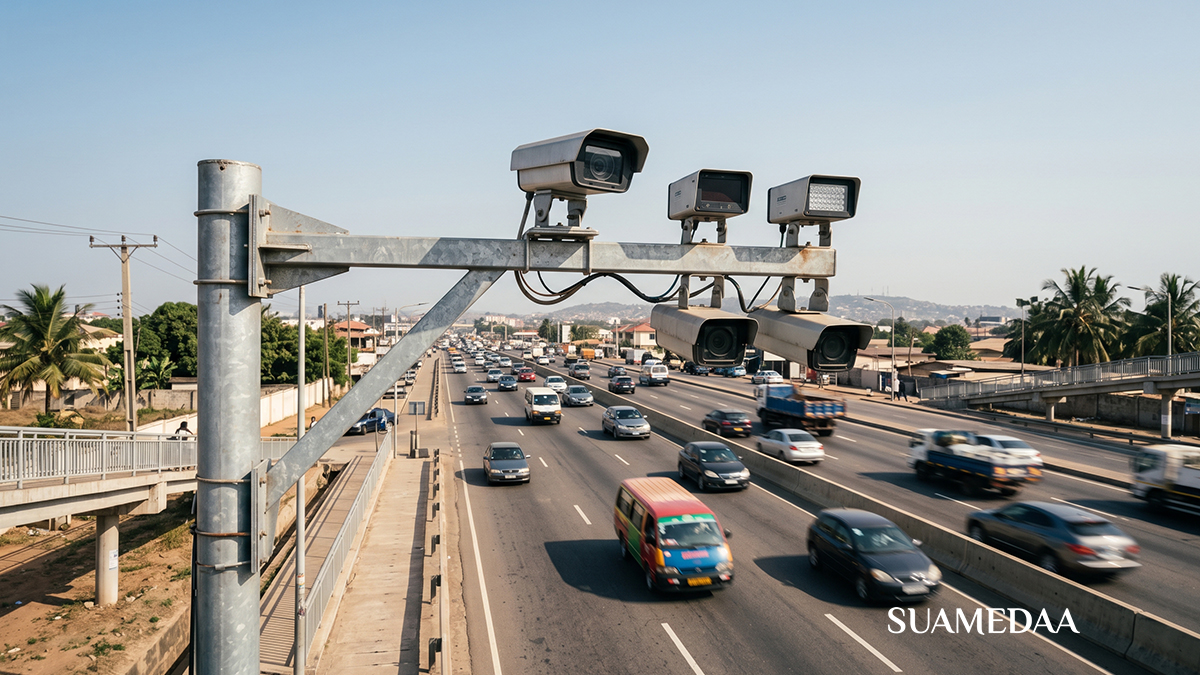
One of the genuinely new mechanisms in L.I. 2519 is the graduated penalty system for camera-detected offences (Regulation 242). This provision anticipates an expanded network of traffic enforcement cameras and creates a framework that escalates consequences for drivers who repeatedly commit detectable violations.
A first, second, or third offence detected by camera carries a fine of 10 penalty units, currently equivalent to GH¢120. A fourth offence within a defined period carries 15 penalty units (GH¢180). A fifth offence carries 20 penalty units (GH¢240). A sixth offence within any 24-month period can trigger a court application for licence revocation or suspension for a minimum of 12 months, accompanied by mandatory retraining and retesting before the driver is permitted to return to the road.
This escalating model reflects an approach to habitual traffic offending that goes beyond the transaction of paying a fine. After a sixth camera-detected offence, the driver faces the loss of their licence and a formal process of rehabilitation before they can drive legally again.
Pedestrians, Parking, and Roadside Conduct
L.I. 2519 also addresses the conduct of pedestrians and extends regulations to a range of roadside activities.
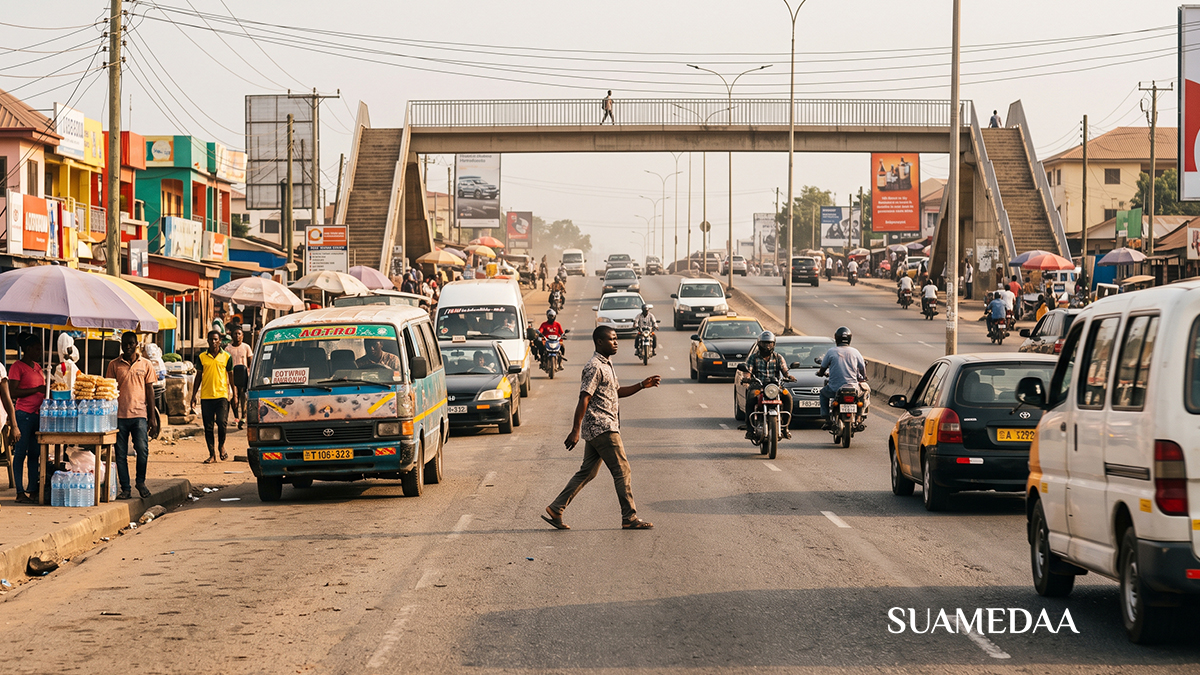
Jaywalking or failing to use an available pedestrian bridge (Regulation 203) carries up to 5 penalty units and up to 7 days, or both. The relatively light penalty reflects the pedestrian’s relatively minor degree of culpability compared to a motorist, but the provision makes clear that pedestrian behaviour on and near roads is subject to legal obligation.
Improper parking (Regulation 235) covers a comprehensive range of scenarios: parking against traffic signs, parking near junctions, blocking building entrances or exits, parking in prohibited zones (including loading areas, permit bays, slip roads, hard shoulders, and central reserves), double parking, and parking in bays reserved for other vehicle categories. Each carries 10 to 25 penalty units and up to 30 days.
Washing or repairing a vehicle on a public road (Regulation 139) carries up to 25 penalty units and up to 30 days.
Obstructive outdoor advertising (Regulation 236) covers signage and billboards that obstruct or interfere with traffic signs or control devices and carries 25 to 50 penalty units and up to 3 months.
Driving through a funeral or authorised procession (Regulation 230) carries 10 to 25 penalty units and up to 30 days.
Retraining as a Court-Ordered Penalty
Regulation 244 introduces a provision that goes beyond financial or custodial punishment. Courts may order any driver convicted of carelessness, recklessness, or wilful disregard of the regulations to undergo retraining, in addition to any other penalty imposed. This reflects a recognition that some dangerous driving is a skills and knowledge problem rather than simply a compliance problem, and that removing a driver from the road temporarily or fining them does not address the underlying behaviour.
A retraining order means returning to formal driver education, which is a meaningful inconvenience for most drivers and a significant disruption for professional drivers whose livelihood depends on their licence.
What It All Means in Practice
L.I. 2519 represents a statement by the Ghanaian state that road traffic laws will be taken seriously. The scale of the schedule of offences, the inclusion of prison terms for offences that many road users would not previously have imagined could lead to incarceration, and the formal regulation of commercial motorcycle operations together signal an intention to change the culture of enforcement.
For that intention to translate into changed behaviour, several things will be necessary. Enforcement must be consistent and must be seen to be consistent. The automated camera system whose operation is anticipated in the regulations must be deployed and maintained. The DVLA must have the administrative capacity to process commercial rider licence applications at the volume required by a sector that serves millions of commuters. And the judiciary must apply the regulations as written rather than treating road traffic cases as a category where fines are routinely substituted for the custodial sentences the law permits.
For drivers, riders, passengers, and pedestrians, the practical message is direct. Read the regulations, or at least familiarise yourself with the categories of offence and the penalties attached. Wear your seat belt. Put your phone down. Do not drink and drive. If you ride an Okada, get licensed. If you operate an Okada service, register your fleet and your riders.
The new rules of the road are here. They have teeth. And on Ghanaian roads, where the human cost of traffic collisions has been too high for too long, that may be precisely what was needed.