Beyond the License – Defensive Driving Skills That Save Lives
The driving licence is one of the most widely misunderstood documents in the world. For most people who hold one, it functions as proof that, at a specific moment in time, they demonstrated a sufficient minimum standard of vehicle control to satisfy an examiner. What it is not, despite the common assumption, is evidence of safe driving ability. It is evidence of testable driving ability, and those two things are very different.
The driving test, in most countries, is designed to assess whether a candidate can operate a vehicle within a controlled environment, following instructions, demonstrating basic manoeuvres, and avoiding obvious errors. What it cannot adequately test is how a driver behaves when no examiner is present, when the road is wet and dark, when a child runs into the street from between parked cars, when a lorry changes lanes without signalling, when fatigue is dulling reaction times, or when the driver in front brakes suddenly at motorway speed.
These are the moments that define road safety. They are also the moments that driving tests rarely simulate with sufficient realism to produce genuinely prepared drivers. The result is a global population of licensed drivers, hundreds of millions of them, who passed their tests and then spent the rest of their driving lives learning on the road, by experience, at the expense of safety.



Defensive driving is the body of knowledge, skill, and habit that fills this gap. It is what separates a driver who reacts to danger from one who anticipates and prevents it. It is what keeps a driver safe not just when conditions are ideal but when they are not. And in a world where road traffic crashes remain among the leading causes of preventable death globally, these skills do not merely make better drivers. They save lives.
The Core Philosophy: Expect the Unexpected
The philosophical foundation of defensive driving can be stated simply: assume that other road users will make mistakes, and drive in a way that gives you the time, space, and options to respond safely when they do.
This is not pessimism. It is realism. Every driver on the road is a human being subject to distraction, fatigue, misjudgement, stress, impairment, and error. Every vehicle on the road is a machine subject to mechanical failure. Every road surface is subject to hazards created by weather, debris, poor maintenance, and the actions of pedestrians and cyclists. A driver who operates on the assumption that all of these variables will resolve in their favour is not an optimist. They are simply an accident waiting to happen.
Defensive driving replaces assumption with awareness. Instead of trusting that the car merging beside you has seen you, the defensive driver creates space so that the merge, if it happens abruptly, does not result in a collision. Instead of assuming the road ahead is clear because it looks clear, the defensive driver moderates speed approaching a blind bend so that whatever is around that corner can be responded to safely. Instead of relying on other drivers to leave adequate stopping distance, the defensive driver ensures their own following distance is sufficient to stop without depending on anyone else.
This shift from reactive to proactive driving is the single most important conceptual change a driver can make. Everything that follows from it is practical application of the same underlying principle.


Observation: Seeing More Than the Car in Front
Most ordinary drivers look primarily at the vehicle directly ahead of them. They respond to what that vehicle does: when it brakes, they brake; when it indicates, they note it; when it moves, they follow. This is reactive driving in its most basic form, and it is insufficient for genuine safety because it gives you only the information that has already been processed by the driver in front of you, with whatever delay and error that entails.
Defensive driving demands a much more active and wide-ranging observation strategy. It requires scanning the full available field of view, near and far, left and right, and in the mirrors, on a continuous and systematic basis.
Look Further Ahead
Train your eyes to reach beyond the vehicle immediately in front to the traffic conditions further down the road. If the cars two or three vehicles ahead are braking, that information is available to you seconds before the car directly in front of you acts on it, and those seconds are the difference between a smooth, controlled stop and a panic brake or a rear-end collision. On a motorway or dual carriageway, good observation practice means scanning as far ahead as visibility allows, picking up hazards and changing conditions early enough to respond gradually rather than suddenly.
The appropriate eye distance for scanning varies by speed. In an urban environment at 30 to 40 kilometres per hour, scanning 50 to 100 metres ahead is appropriate. At motorway speeds of 100 to 130 kilometres per hour, scanning 300 to 400 metres ahead is more appropriate. Most inexperienced drivers are chronically short-sighted in their road observation, focusing too close to the bonnet and missing the wider picture.
Use Your Mirrors Systematically
The mirrors on your vehicle are not decoration and they are not for occasional use before lane changes. They are a continuous information source that should be checked on a regular cycle, roughly every five to eight seconds in normal driving conditions, and more frequently in heavy traffic or when preparing for any manoeuvre.



Effective mirror use means building an accurate mental picture of what is behind and beside you at all times. Who is in your blind spot? How close is the vehicle behind you? Is there a motorcyclist filtering through traffic that you need to allow for? Has the situation changed since you last checked?
Many rear-end and side-impact collisions occur because the driver who was struck had no idea the vehicle was there. Systematic mirror use eliminates this category of surprise entirely. You may still be struck, but you will not be blindsided by it, and knowing a collision is coming gives you a fraction of a second to brace or to make a small evasive input that can reduce the severity of the impact.
Check Your Blind Spots
Every vehicle has areas around it that mirrors cannot cover. The classic blind spot is the area to the rear quarter of the vehicle, beside and just behind the driver’s shoulder, where a vehicle in an adjacent lane may be entirely invisible in both the door mirror and the interior mirror. Before any lane change, a brief shoulder check to physically turn and look into the blind spot is non-negotiable. No mirror system, however well adjusted, fully eliminates the blind spot. The physical head turn does.
Modern vehicles increasingly offer blind spot monitoring systems that alert drivers to vehicles in adjacent lanes. These systems are useful but are not a substitute for physical checks. They can miss motorcycles, cyclists, and pedestrians, and they can fail. The habit of the physical shoulder check should be maintained regardless of the technology available.
Anticipate the Behaviour of Pedestrians and Cyclists
Pedestrians and cyclists are the most vulnerable road users and the most difficult to predict. A child running into the road, a pedestrian stepping off a kerb while looking at their phone, a cyclist swerving to avoid a pothole, or a delivery rider emerging from a side street without yielding: these hazards appear without warning and require a driver who has already anticipated their possibility.
The defensive driver slows down passing schools, playgrounds, and markets not because they can see a child about to step out but because they know the probability of a child stepping out is higher in those environments. They give cyclists a wider berth than the legal minimum because they know cyclists move laterally, hit potholes, and may fall. They look at the wheels of parked vehicles for signs that one is about to pull out. They watch pedestrians who are walking toward the kerb and track them until the pedestrian has either crossed or stopped.
This predictive approach to observation, thinking about what is likely to happen rather than just reacting to what is happening, is one of the hallmarks of an advanced driver.
Following Distance: The Space That Saves You
If there is a single habit that would prevent more crashes than any other, it is maintaining an adequate following distance. The physics of stopping a vehicle moving at speed makes this non-negotiable. A vehicle travelling at 80 kilometres per hour covers more than 22 metres every second. When a hazard is detected, there is a perception-reaction time of approximately 1.5 to 2.5 seconds before the driver has actually begun to brake. That alone means the vehicle has covered between 33 and 55 metres before any braking force has been applied. Add to that the actual braking distance, which varies with speed, tyre condition, road surface, and vehicle load, and the total stopping distance at 80 kilometres per hour on a dry road in a well-maintained vehicle is approximately 53 metres under ideal conditions.
Most drivers do not leave 53 metres of space between themselves and the vehicle in front when travelling at 80 kilometres per hour. Most drivers leave a fraction of that distance, which means they are permanently operating with insufficient stopping distance, relying entirely on the vehicle in front not braking suddenly, and eliminating any margin for error or surprise.
The Two-Second Rule and Its Limitations
A commonly taught following distance guideline is the two-second rule: choose a fixed point on the road, such as a road marking or a bridge, and count the time between the vehicle in front passing that point and your vehicle reaching it. If the gap is less than two seconds, you are too close.
The two-second rule is a reasonable starting point for dry road conditions in good visibility at moderate speeds. It is not adequate in poor conditions. In wet conditions, stopping distances approximately double. In icy conditions, they increase by up to ten times. In poor visibility, reduced speed and increased following distance are both required. A more robust guideline for most conditions is three seconds minimum, four or more in wet or reduced visibility conditions, and a much larger gap at motorway speeds.
In practice, the two-second rule and its variations are useful mental frameworks but need to be applied with judgement rather than as a formula. The key principle is that you should always be able to stop safely if the vehicle in front stops suddenly, without any input from the vehicle behind you and without depending on the vehicle in front to brake gradually.
Gap Management in Traffic
In heavy, stop-start traffic, maintaining a following distance is something many drivers find frustrating because other vehicles will continuously fill any gap left. This creates a temptation to close up to prevent this, or an instinct that leaving space is futile because it immediately disappears.
Resist this temptation. The value of a following distance in slow traffic is not primarily about stopping distance in the way it is at speed. It is about maintaining a smooth, rolling flow rather than a series of hard stops and starts. A driver who leaves a comfortable space to the vehicle in front can often keep the vehicle rolling slowly rather than stopping completely, which is both more fuel efficient and significantly safer, since a rolling vehicle is easier to control than one that has stopped and then accelerated back into traffic. It also reduces the cumulative wave effect that causes the traffic behind to stop, sometimes for no reason visible to those in the queue.
Speed Management: The Multiplier of Every Other Risk
Speed does not just increase stopping distance. It increases the severity of every crash, reduces the time available to respond to every hazard, and amplifies the consequences of every other error. A collision at 50 kilometres per hour releases roughly four times the energy of the same collision at 25 kilometres per hour. At 70 kilometres per hour, the energy released is nearly eight times that of a 25 kilometres per hour impact. The relationship between speed and crash severity is not linear. It is exponential.
This is why speed management is central to defensive driving, and why defensive drivers understand that the posted speed limit is a maximum, not a target. The appropriate speed at any given moment is determined by the conditions: the state of the road surface, the level of traffic, the visibility available, the weather, the presence of pedestrians and cyclists, and the driver’s own state of alertness. In many conditions, the appropriate speed is well below the legal limit.
Reading Road Conditions
A defensive driver continuously reads the road surface and adjusts speed accordingly. A wet road requires reduced speed and increased following distance. A road surface that has been wet and is now drying can be deceptive: certain patches may be dry while others remain wet, and the transition between them may be invisible. A road that appears dry but has just had a light shower may have a film of water sitting on top of oil residue from vehicle exhausts, producing a surface that is more slippery than either a clearly wet or clearly dry road. This is called aquaplaning risk, and it is highest in the first few minutes after light rain on roads that have been dry for several days.
Ice is the most dangerous road surface condition because it is frequently invisible. Black ice forms when moisture freezes on a road surface that looks merely damp. It is most likely in the early morning, in shaded areas, on bridges and flyovers where the road surface cools more quickly than ground-supported sections, and in conditions where the temperature is close to zero degrees Celsius. If you have any suspicion of icy conditions, reduce speed significantly, use the highest gear consistent with that speed to keep engine braking smooth and gentle, and avoid any sharp steering, acceleration, or braking inputs that might break traction.
Approaching Junctions, Bends, and Hazards
Speed management is most critical at the moments of highest risk: approaching junctions, navigating bends with limited visibility, entering areas of reduced road width, and passing any concentration of pedestrian activity. The defensive driver reduces speed before these situations rather than during them, arriving at the point of potential hazard at a speed from which they can stop if necessary, rather than braking hard in the middle of a situation that has already developed.
The driving maxim of being able to stop within the distance you can see to be clear is a useful guide for single-carriageway roads where oncoming vehicles may be present around a bend. If your vision of the road ahead is limited to 30 metres by a bend or a rise, your speed should be such that you can stop within 30 metres. At 60 kilometres per hour on a wet road, your total stopping distance far exceeds 30 metres. The implications of this for appropriate speed in these conditions are obvious, even if they are routinely ignored.
The System of Car Control
Advanced and defensive driving courses, including those run by organisations such as the Institute of Advanced Motorists in the United Kingdom, teach a structured approach to car control known as the System of Car Control, sometimes called the IPSGA system for its five phases: Information, Position, Speed, Gear, and Accelerate.
The system is applied to every hazard encountered on the road, whether a junction, a bend, a parked vehicle, or a developing situation ahead. Working through the system keeps the driver organised and ensures that each element is addressed in the correct sequence before the hazard is reached.
Information involves gathering all available information about the hazard ahead, using observation, mirrors, and any other signals available, and giving information to other road users through signals and position where appropriate.
Position involves taking the correct road position for the approach, which may mean moving slightly toward the centre to improve the view around a left-hand bend, or moving slightly left to improve the view around a right-hand bend on a single carriageway.
Speed involves adjusting to the appropriate speed for the hazard, reducing speed smoothly using the brakes if necessary so that the appropriate speed is achieved before the next phase.
Gear involves selecting the appropriate gear for the speed and the conditions, ensuring the engine is in a responsive power range for any acceleration needed out of the hazard.
Accelerate involves, once the hazard is being safely navigated and it is safe and appropriate to do so, accelerating smoothly to the appropriate speed for the road beyond the hazard.
The elegance of this system is that it imposes order on what for many drivers is an instinctive and disorganised process. By making the handling of every hazard a conscious, structured sequence rather than a reactive scramble, it produces consistently smoother, more controlled, and more predictable driving that is demonstrably safer than unstructured reactive approaches.
Skid Control and Vehicle Dynamics
Most drivers have no idea what their vehicle will do if they brake hard, steer sharply at speed, or hit a slippery patch on a bend. This ignorance is not just uncomfortable: it is dangerous, because when these things happen, and in a long enough driving career they will, the untrained driver’s instincts are frequently the wrong ones.
Understanding Understeer and Oversteer
When a vehicle begins to lose traction and slide, it will generally do so in one of two ways depending on its drivetrain configuration, speed, weight distribution, and the nature of the surface.
Understeer occurs when the front wheels lose traction before the rear, causing the front of the vehicle to slide toward the outside of a bend despite the driver turning the wheel. The car effectively does not turn enough. This is more common in front-wheel-drive vehicles and is the more common handling trait designed into modern production cars because it is generally more controllable for inexperienced drivers. The correct response to understeer is to reduce steering angle slightly to allow the front tyres to regain grip, and to reduce speed gradually without sudden braking.
Oversteer occurs when the rear wheels lose traction, causing the rear of the vehicle to step out and swing wider than the front. The car pivots around the front axle in what can develop into a spin. Oversteer is more common in rear-wheel-drive vehicles and is more dramatic in its onset. The instinctive response of many drivers, to brake hard, is the wrong one: hard braking transfers weight forward, further unloading the rear tyres and making the oversteer worse. The correct response is to steer into the slide (turn the wheel in the direction the rear is sliding) while reducing throttle smoothly.
Emergency Braking
Modern vehicles fitted with Anti-lock Braking Systems (ABS) are significantly easier to manage in emergency braking situations than older vehicles without it. ABS prevents the wheels from locking under hard braking, which maintains steering control and generally reduces stopping distance on most surfaces. However, many drivers who have only driven ABS-equipped vehicles have never experienced the sensation of the system activating and may instinctively release brake pressure when they feel the pedal pulsing, which is exactly the wrong response. When ABS is active, maintain firm, constant pressure on the brake pedal and steer normally. The system is working as intended.
On vehicles without ABS, emergency braking requires threshold braking: applying maximum brake pressure just short of wheel lock. A locked wheel produces less braking force than one that is rolling at the threshold of grip, and a locked front wheel eliminates steering completely. Learning to modulate brake pressure at the threshold of lock, without ABS assistance, is a skill that requires practice in a controlled environment.
The Importance of Tyre Condition
No discussion of vehicle dynamics and skid control is complete without addressing tyres, because tyres are the only part of a vehicle in contact with the road. Everything the driver asks of the vehicle, every acceleration, every brake application, every steering input, is transmitted to the road through four contact patches each roughly the size of a human hand. The condition of those contact patches determines the outcome.
Tyre tread depth affects grip in wet conditions more than any other single factor. The tread channels water away from the contact patch to maintain rubber-to-road contact. As tread wears, this capability reduces. In heavy rain at motorway speed, a tyre with minimal tread depth may aquaplane entirely, losing all contact with the road surface and all steering and braking effectiveness. The legal minimum tread depth in most countries is 1.6 millimetres, but many tyre safety organisations recommend replacing tyres at 3 millimetres, particularly in countries with significant rainfall.
Tyre pressure affects handling, braking, fuel economy, and tyre wear. An underinflated tyre generates more heat, wears unevenly, and handles less predictably than one at the correct pressure. Check tyre pressures monthly and before any long journey, using the vehicle manufacturer’s recommended pressures for the load being carried.
Managing Fatigue and Distraction
The physical skills of driving, observation, following distance, speed management, vehicle control, address the mechanical aspects of road safety. But a significant proportion of serious crashes are caused not by skill deficits but by impaired driver states: fatigue and distraction being the most prevalent.
Fatigue at the Wheel
Driving while fatigued is now understood to be as dangerous as driving while intoxicated. Fatigue degrades reaction time, judgement, peripheral vision, and the ability to sustain attention in exactly the same ways that alcohol does, and in severe cases produces microsleeps: involuntary episodes of sleep lasting between one and thirty seconds during which the driver is completely unconscious and the vehicle is uncontrolled.
At 100 kilometres per hour, a three-second microsleep means the vehicle has travelled 83 metres with no driver input. On a motorway, that is enough to drift across two lanes or into the vehicle ahead.
The warning signs of fatigue at the wheel include difficulty keeping the eyes open or focused, frequent yawning, missing junctions or road signs, drifting within the lane or making unnecessary corrections, and an inability to clearly remember the last few kilometres of driving. If any of these signs are present, the only safe response is to stop at the earliest safe opportunity, drink a caffeinated beverage, and rest for at least 20 minutes before continuing. Opening windows, turning up the radio, or playing music are insufficient countermeasures: they address the symptom of feeling sleepy without addressing the underlying state of impairment.
For any long journey, plan rest stops every two hours or 200 kilometres, whichever comes first. Do not begin a long drive late at night if you would normally be asleep at that time. Be particularly alert to fatigue risk in the mid-afternoon, when there is a natural dip in human alertness regardless of how well-rested you are.
Mobile Phones and Distraction
Mobile phone use while driving, whether held or hands-free, is one of the most thoroughly studied and consistently confirmed risk factors in road safety research. Using a handheld phone while driving increases crash risk by approximately four times. Crucially, hands-free phone use produces a comparable cognitive distraction, reducing hazard perception ability and reaction time to a degree similar to handheld use. The physical act of holding the phone is not the primary source of danger. The cognitive load of a phone conversation, which takes attention away from the driving task, is.
The practical implication is clear: the safest approach to phone use in a vehicle is not to use the phone at all while driving, whether handheld or hands-free. Pull over safely if a call must be made or received. Configure do-not-disturb-while-driving settings on your phone, which are available on all modern smartphones, so that incoming calls and messages do not create temptation while driving.
Other forms of distraction are less studied but similarly dangerous: adjusting a navigation system, selecting music, eating, turning to speak to a passenger in the rear seat, or attending to a child. Any task that takes the eyes off the road for more than two seconds significantly increases crash risk. Deal with navigation and music selection before moving, or ask a passenger to manage them. Eat before driving, not during. Children who need attention are better responded to by pulling over safely than by turning around at speed.
Night Driving
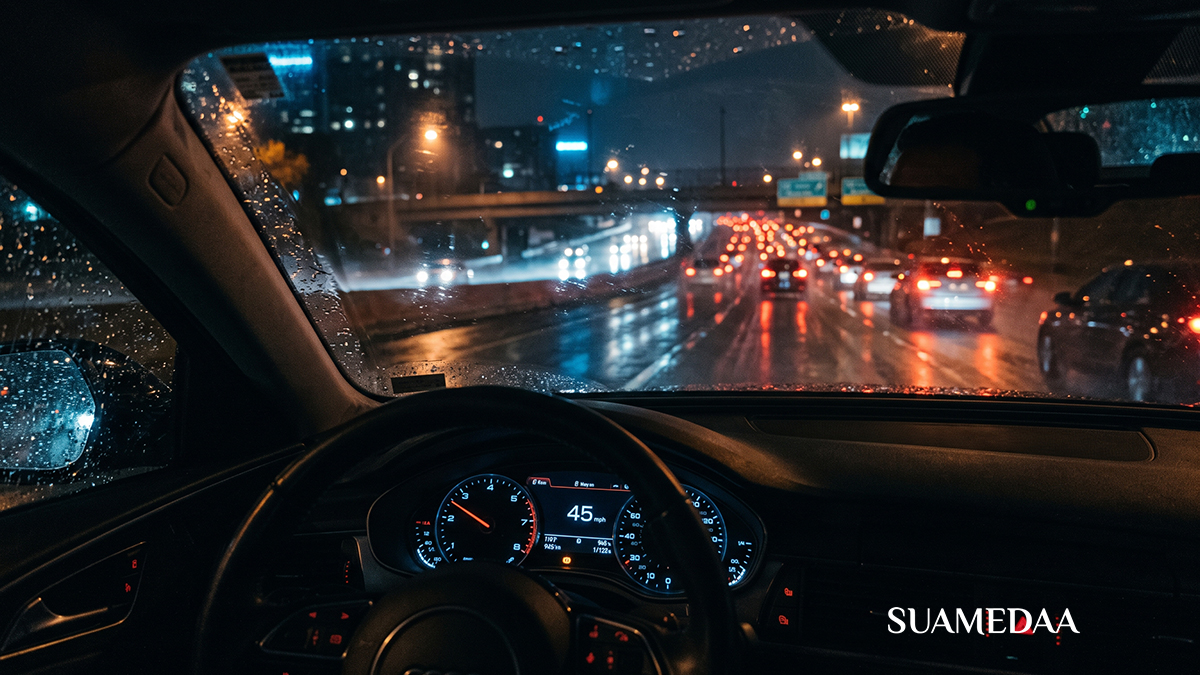
Driving at night introduces a specific set of challenges that require adjusted technique. Visibility is dramatically reduced. Pedestrians and cyclists are far less visible, particularly if wearing dark clothing. Depth perception and peripheral vision are both reduced. And the risk of encountering impaired drivers is higher at night, particularly in the hours between midnight and 4am when alcohol-related crashes are most concentrated.
Reduce speed at night below your daytime speed for the same road, because your effective stopping distance now exceeds your headlight illumination range on full beam and far exceeds it on dipped headlights. On dipped headlights, the illuminated range in front of you is typically 30 to 40 metres. At 60 kilometres per hour on a wet road, your total stopping distance exceeds 60 metres. This means that if a pedestrian appears at the edge of your dipped headlight range, you cannot stop in time. This is a physical fact that requires a physical response: slower speed.
Keep headlights clean and correctly aligned. Dirty or misaligned headlights dramatically reduce effective illumination range and cause unnecessary glare for oncoming drivers. When faced with the glare of oncoming headlights, look toward the left edge of the road rather than directly at the oncoming lights. This reduces the duration of the glare effect and maintains your visual reference for the road edge.
Driving in Adverse Weather
Rain, fog, strong wind, and where applicable ice and snow, each introduce specific hazards that require specific technique adjustments. Treating adverse weather as requiring only a marginal adjustment to normal driving practice is one of the most common and most costly mistakes drivers make.
Rain reduces visibility, increases stopping distances, increases the risk of aquaplaning at speed, and makes road markings harder to see. Reduce speed, increase following distance, and be alert to pooling water where aquaplaning risk is highest. In very heavy rain where visibility drops significantly, consider whether the journey is necessary at all.
Fog is among the most dangerous weather conditions for driving because it dramatically reduces visibility while the road surface may remain clear and dry, creating a false sense of normal conditions. Use fog lights when visibility drops below 100 metres. Reduce speed to a level at which you can stop within the distance you can see. Do not be lulled into following the tail lights of the vehicle ahead as a navigation guide: those lights will disappear into the fog wall well before you can see the vehicle itself, and if that vehicle stops suddenly you may have no warning at all.
Strong crosswinds affect high-sided vehicles, motorcyclists, and cyclists most dramatically, but all vehicles are affected. Be alert to sudden gusts as you pass gaps in hedgerows, bridges, or enter open exposed road sections. Hold the wheel firmly, reduce speed, and give more space to cyclists, motorcycles, and lorries who are more vulnerable to being pushed across the lane by a gust.
Ice demands maximum caution, minimum speed, and the gentlest possible inputs. Accelerate gently to avoid wheel spin. Brake early and gently. Steer smoothly. Use the highest gear possible to keep engine braking gentle. If the vehicle begins to skid, do not brake hard. Remove the accelerator and steer gently in the intended direction of travel.
The Attitude That Underpins It All
Defensive driving is not just a set of techniques. It is an attitude toward the act of driving that places safety above speed, above convenience, and above ego.
The driver who tailgates because they want the vehicle ahead to move faster is not a capable driver managing a situation. They are a dangerous driver creating one. The driver who overtakes on a bend because they are impatient has made a mathematical bet with another person’s life as the stake. The driver who speeds through a school zone because they are late has made a decision that their schedule matters more than a child’s safety. These are not neutral choices made in the moment. They are character choices that define the kind of road user a person decides to be.
Defensive driving asks for a consistent commitment to the proposition that arriving safely is more important than arriving quickly, that the responsibility of controlling a machine capable of killing does not end at the legal minimum, and that every other road user, regardless of how they are behaving, deserves to encounter a driver who is not going to make their situation worse.
The licence proves you can drive. Defensive driving proves you should.
Where to Learn More
If this article has prompted a genuine interest in developing your driving to a higher standard, there are formal routes worth exploring. Advanced driving organisations exist in many countries and offer structured training and assessment that goes far beyond the initial licence standard.
In the United Kingdom, the Institute of Advanced Motorists (IAM RoadSmart) and the Royal Society for the Prevention of Accidents (RoSPA) both offer advanced driving courses and assessments that are widely recognised as among the most rigorous civilian driving standards available. In the United States, the National Safety Council offers defensive driving courses that are accepted by insurance providers and courts. Similar organisations exist across Europe, Australia, and increasingly across Africa and Asia.
Many of these programmes are available at a modest cost and are often partially offset by reductions in motor insurance premiums for drivers who hold an advanced qualification. The return on investment, measured in lives, injuries, and vehicle damage avoided over a lifetime of driving, is incalculable. Get the licence. Then go beyond it.