How Used Clothing Imports erode Africa’s Artisanal Textile Industry via silent Dumping
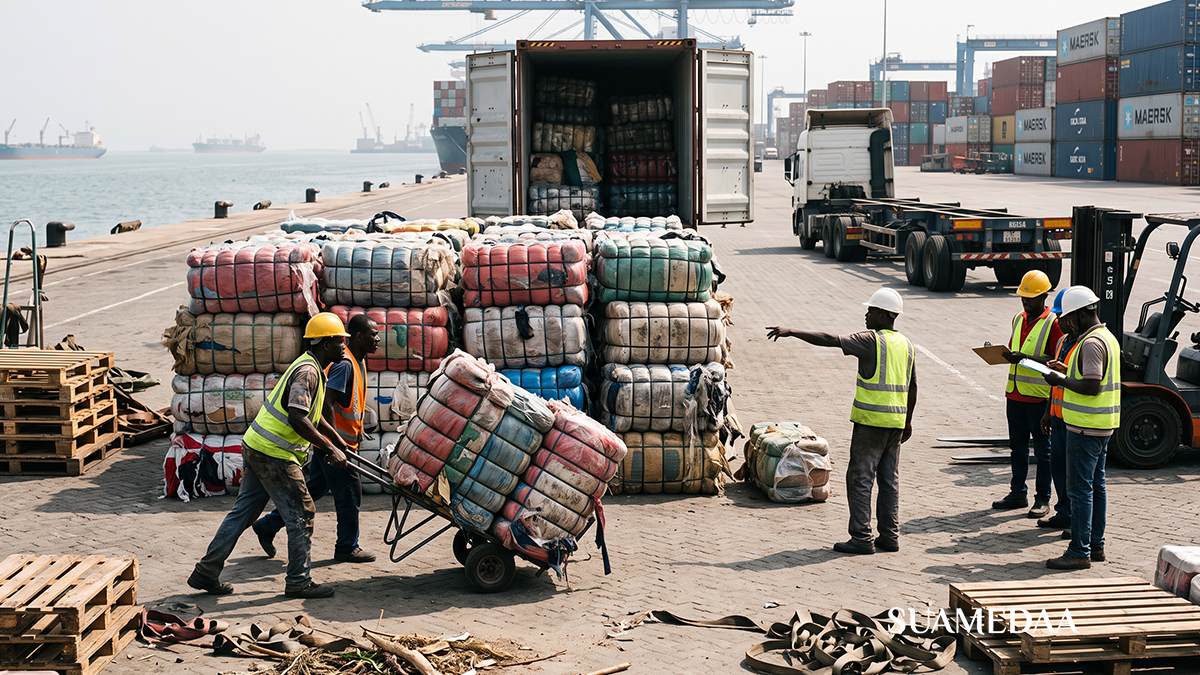
Every week, up to fifty shipping containers arrive at Kantamanto, one of the largest secondhand clothing markets in the world, in the heart of Accra. Each container is packed with compressed bales of used clothing, shipped from the United Kingdom, the United States, China, Canada, and other high-consumption economies. The bales are unpacked by traders who have paid hundreds of dollars for them without knowing exactly what is inside. They sort through the contents quickly, hoping for wearable garments they can resell. What they find determines whether this week’s investment was worth making.
What nobody finds, ever, inside those bales, is a kente weaver who stayed in business. Or a wax print manufacturer whose looms kept running. Or a batakari tailor whose workshop stayed open because demand for locally made cloth held up.
The used clothing trade is one of the most discussed and least resolved tensions in African economic life. It employs millions of people across informal supply chains. It provides affordable clothing to consumers whose budgets the formal retail market cannot serve. It has genuine economic weight. And it has systematically undermined the domestic textile and artisanal industries that African countries have been trying, with limited success, to build and sustain for decades.



A Market Built on Someone Else’s Surplus
The secondhand clothing trade to Africa did not begin as an industry. It began with donations. Church groups and charities in Europe and North America collected used garments from their congregations in the post-war decades and shipped them to Africa as humanitarian aid. The clothes were distributed through mission stations and relief organisations, reaching people who had little access to manufactured clothing.
Over time, the charitable logic gave way to a commercial one. Intermediary companies began sorting donated clothing, separating the wearable from the unwearable, and selling the wearable portion in bulk to exporters who shipped it to markets in the Global South. What had been given became a commodity. What had been aid became a trade. And what had been a trickle became a flood.
In Ghana, the used clothing trade is spoken of by a phrase that carries its own cultural charge. Obroni wawu means, in Twi, the white man has died. It is the name given to the secondhand clothes because they were understood to have come from the deceased possessions of wealthy foreigners. The name has softened into a colloquial term for any imported used clothing, but its origins reflect an early understanding that this trade was a flow of surplus from wealthy countries to poorer ones, dressed as charity and eventually revealed as commerce.
By the early 2000s, the trade was enormous and accelerating. The rise of fast fashion in Europe and North America dramatically increased the volume of clothing produced, purchased, and discarded. Charity shops received more than they could sell. Sorting facilities exported the overflow. And Africa, with its large informal markets, its low trade barriers, and its price-sensitive consumer base, became the destination for clothing that the Global North no longer wanted.
The Numbers Behind the Damage
Ghana receives roughly 15 million garments per week through Kantamanto alone. The Used Clothing Dealers’ Association reported that imports exceeded 300 million US dollars across 2021 and 2022, with the United Kingdom accounting for approximately 150 million dollars of that total and China for 82 million. The trade employs an estimated 2.5 million people across its supply chain in Ghana.

Those numbers describe a large and functioning informal economy. They do not describe what was lost to make room for it.
At its peak in the 1960s, Ghana had more than twenty large-scale textile factories. By 2011, four remained. By 2017, three: Akosombo Textiles Limited, Textile Subsidiary of Ghana, and Printex, all operating at an estimated five percent of capacity. Ghana Textile Manufacturing Company, Ghana Textile Printing, and their peers had closed their spinning and weaving departments years earlier.
Employment in the formal textile sector fell from approximately 25,000 workers at its height to roughly 1,580, a decline of around 79 percent. Output fell from approximately 130 million yards of fabric in 1977 to about 15 million yards in 2017. By 2010, imported textiles made up around 70 percent of national textile consumption. Research suggests that approximately 90 percent of clothing worn in Ghana today is secondhand or imported.
These are not numbers that describe a sector in difficulty. They describe a sector that has, in practical terms, ceased to exist at industrial scale.
The Price That Cannot Be Matched
The mechanism by which used clothing undermines local production is straightforward to the point of being merciless.

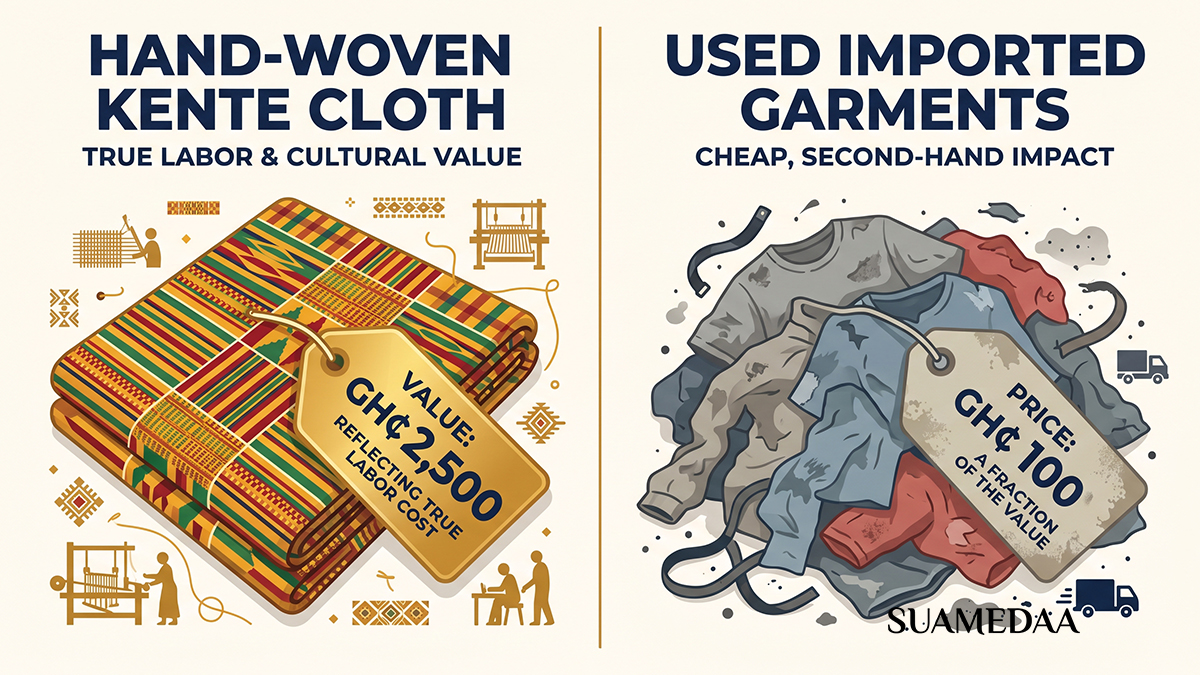
A Ghanaian textile manufacturer producing wax print fabric bears the full cost of electricity, which can account for forty percent of production costs, plus raw materials, labour, equipment maintenance, quality control, and distribution. A used clothing bale imported from the United Kingdom has already had its costs paid, in full, by the British consumer who bought the garment at retail and discarded it. The exporter paid a marginal sorting cost. The importer paid a fraction of the original manufacturing cost for a container of goods. The Kantamanto trader bought a bale for a few hundred dollars and is selling individual garments for a few cedis each.
There is no cost structure a local manufacturer can build that competes with this. The used clothing garment’s original production cost has been fully written off by the consumer who wore it. It is, in economic terms, being sold for close to zero marginal cost against a local product whose full production costs must be recovered from the sale price. The comparison is not between two products in a fair market. It is between a product and a subsidy.
This price asymmetry operates across every clothing category. T-shirts, trousers, dresses, jackets, shoes: imported used versions of all of them arrive at Kantamanto at prices that domestic manufacturers and tailors cannot approach even by eliminating their profit entirely. For the mass market consumer whose priority is covering the basic clothing needs of a family on a limited budget, the rational choice is clear.
The Artisans Who Cannot Compete
The damage to large-scale industrial manufacturers is documented and visible. Less visible, but equally significant, is the damage to the artisanal tier of Ghana’s textile culture: the kente weavers, the adinkra stamp printers, the smock weavers of the north, the batik and tie-dye producers, the tailors trained in domestic fashion traditions.
These producers exist in a different market from the industrial manufacturers. They are not trying to produce volume fabric at low prices. They are producing culturally specific, skill-intensive textiles whose value lies precisely in their hand-made character, their design language rooted in Ghanaian tradition, and the craft knowledge accumulated over generations.
But even this market has been undercut, from a different angle. The same global fast fashion system that produces the used clothing flooding Kantamanto also produces cheap mass-market imitations of African fabric designs. Counterfeit kente-print fabric, machine-manufactured in Chinese factories, arrives in Ghanaian markets at prices that genuine hand-woven kente cannot match. Wax print fabrics bearing designs that originate in Ghanaian tradition are printed in bulk overseas and sold back into the market at prices that domestic wax print manufacturers struggle to compete with.
The result is a double displacement. Traditional artisans lose the everyday market to cheap used clothing from Europe and North America. They then lose the aspirational market, the consumers who want to wear African-designed fabric without paying hand-made prices, to counterfeit and machine-produced imitations manufactured abroad. What remains is a narrow ceremonial market, kente for funerals, outdoorings, and special occasions, that sustains a diminished community of weavers and artisans at a fraction of the scale the tradition deserves.
Kente weaving, adinkra printing, and batakari production have contracted from everyday commercial activities into what are increasingly understood as cultural heritage practices. They are worn on festival days. They appear at the events that mark births, deaths, and marriages. But they have largely lost their place in the daily wardrobe, displaced by cheap imports that carry none of the cultural weight but all of the price advantage.
Kantamanto and the Waste That Cannot Be Hidden
The used clothing trade’s environmental costs have become impossible to ignore.
Approximately 40 to 50 percent of the garments arriving at Kantamanto each week are unsellable. They are too worn, too stained, too damaged, or too low quality even for the price-sensitive informal market. They cannot be returned. They accumulate in mountains of textile waste that overwhelm the city’s waste management infrastructure.
The Korle Lagoon, one of Accra’s major water bodies, is clogged with discarded textiles. The beaches near the market are periodically blanketed with clothing. Illegal dumpsites around Kantamanto are layered with fabric waste that does not biodegrade. When the waste is burned, the synthetic fibres, polyester and nylon from the fast fashion garments that make up an increasing share of the imports, release toxic fumes. Respiratory illness among market traders, particularly women, has been linked to chronic exposure to textile smoke.
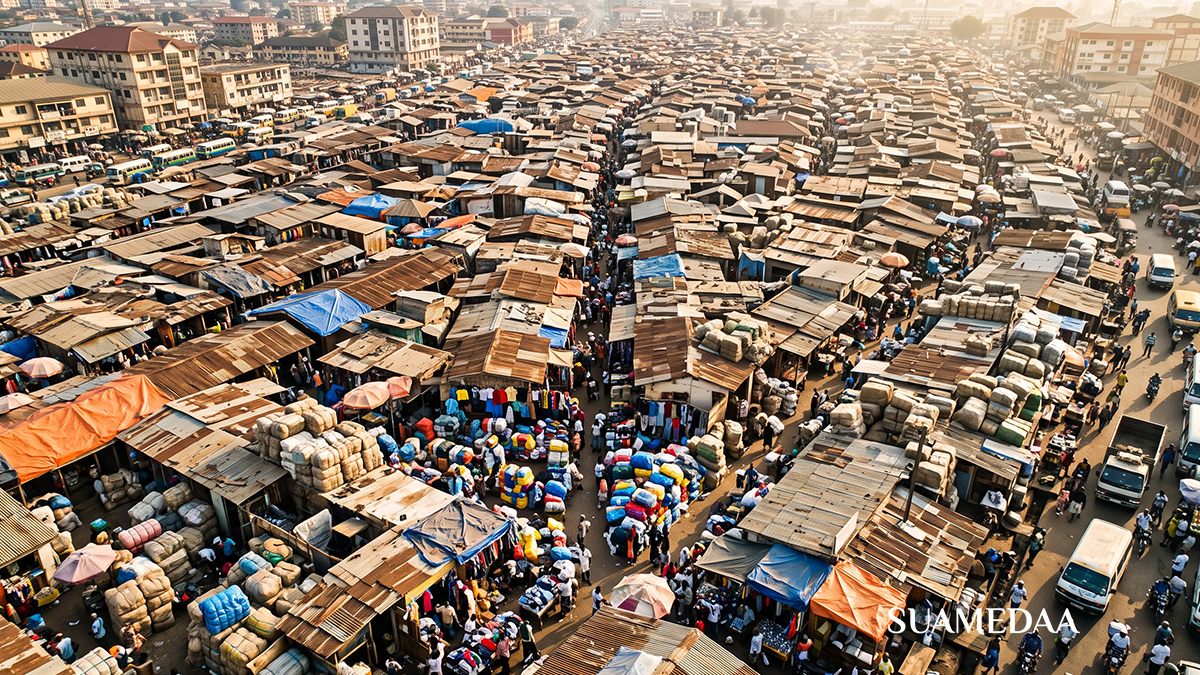
A 2024 fire in Kantamanto destroyed large sections of the market and displaced thousands of traders, many of whom had invested their savings in bales of clothing. The Or Foundation, an organisation that has worked with Kantamanto traders for years, documented the loss and the slow, contested process of rebuilding. The fire destroyed livelihoods. It also briefly made visible a waste problem that the market generates continuously, in smaller and less dramatic ways, every single week.
The waste is not a by-product of the secondhand clothing trade. It is a structural feature of it. The Global North has, in effect, exported not just its surplus clothing but its clothing waste to countries with far less capacity to manage it.
The Policy Responses That Have Struggled
Awareness of this problem is not new. Several African governments have attempted policy responses, with mixed results.
The East African Community, comprising Rwanda, Kenya, Uganda, Tanzania, and Burundi, announced a phased ban on used clothing imports in 2016, with the explicit goal of protecting and rebuilding domestic textile industries. The announcement attracted immediate pushback from the United States, whose textile recycling industry exports large volumes to East Africa and whose government threatened to suspend AGOA preferential trade access if the ban proceeded. Most of the countries backed down under that pressure. Rwanda maintained its position, accepting the trade consequences, and has since seen modest growth in its domestic apparel sector.
Ghana has not imposed a ban. The political economy is complicated by the scale of the informal employment the trade supports: 2.5 million people in a sector is not a constituency any government finds easy to move against. Proposals for import tariff reform, quality controls on incoming bales, and extended producer responsibility frameworks that would require foreign fashion brands to fund the management of the waste their products generate in destination markets have been discussed but not implemented at scale.
The ECOWAS regional trade framework creates additional complexity. A policy effective in Ghana can be undermined by imports arriving through neighbouring countries with lower barriers. A regional approach is more effective than a national one, but regional coordination on an issue affecting millions of informal livelihoods is not simple to achieve.
The Deeper Economic Logic
The used clothing trade is a symptom of a structural problem that predates it. African economies’ role in the global trade system has historically been defined by exporting primary commodities and importing manufactured goods, a pattern that concentrates value-addition, employment, and industrial capacity in the Global North while leaving Africa dependent on commodity revenues and cheap imports.
Textile and garment manufacturing has historically been one of the most accessible entry points for industrialising economies. It is labour-intensive, does not require advanced technology to enter at basic levels, and generates broad employment. Countries in East Asia used it as a stepping stone: textiles and garments were among the first industries to develop in Japan, South Korea, Taiwan, and later China and Bangladesh, providing the employment, skills, and capital accumulation that funded more sophisticated industrial development over time.
Africa’s attempt to follow that path has been systematically disrupted by trade policies, structural adjustment conditions, and competitive dynamics that kept the continent’s domestic markets open to cheap imports at precisely the point when domestic industry needed protection to develop. The used clothing trade is the most visible expression of this disruption, but it sits within a larger pattern.
What Resistance Looks Like
Against this backdrop, the artisans who have maintained their craft deserve attention for what their persistence represents.
Kente weavers in Bonwire and Kpetoe, adinkra printers in Ntonso, batakari weavers in the Upper East and Upper West regions, batik producers in Kumasi: they continue to work with skills that took years to acquire, producing textiles whose quality and cultural specificity cannot be replicated by a machine or imported in a bale. They are not competing with Kantamanto. They are operating in a different register, one whose value is not primarily about price.
A growing segment of the global fashion industry has developed an appetite for exactly what these artisans produce: authentic, hand-crafted textiles with a genuine cultural story and a documented human origin. The movement toward sustainable and ethical fashion, slow fashion as it is sometimes called, has created markets in Europe, North America, and among the African diaspora that are willing to pay prices that reflect the true cost of hand-made artisanal production.
Whether these markets can be grown large enough to sustain the artisanal sector at meaningful scale is an open question. Access to those markets requires infrastructure that many Ghanaian artisans lack: e-commerce capability, logistics, quality certification, and the marketing capacity to tell their story to a consumer who is not physically present at the point of production.
The Accountability That Is Missing
The global fast fashion system that produces the waste flowing through Kantamanto operates almost entirely without accountability for what happens to its products downstream.
A brand that manufactures a polyester jacket in Bangladesh, sells it to a British consumer for fifteen pounds, and watches it donated to a charity shop after three wears has incurred no cost from the fact that a portion of that jacket will eventually be burned in an Accra dumpsite. The cost is borne by the Kantamanto trader who paid for the bale, by the communities around the dumpsite, by the traders with respiratory illness, and by the Ghanaian government and municipality that lack the infrastructure to manage the waste.
Extended producer responsibility legislation, which exists in the European Union for electronics waste and is being discussed for textiles, would shift some of that cost back to the producers and brands who created the goods in the first place. It is the most direct policy lever available at the source of the problem. Its implementation is slow, contested by industry, and geographically incomplete. In the meantime, the bales keep arriving.
A Tradition That Deserves a Better Deal
The kente weaver in Bonwire who spends three days weaving a single cloth is not competing in the same market as the Kantamanto trader selling a used polyester shirt for two cedis. They never were. But the cultural and commercial space that the kente weaver’s work once occupied, the everyday textile culture of a society that dressed itself in locally made fabric, has been steadily compressed by decades of cheap imports, structural policies that left domestic manufacturing exposed, and a global waste system that treats African markets as its disposal destination.
Rebuilding that space is not simply a matter of policy, though policy matters. It is also a matter of cultural reclamation: a society deciding that what its artisans make has value beyond the ceremonial, that dressing locally is an act with economic and cultural significance, that the skills preserved by weavers and printers and tailors represent an inheritance worth protecting.
That conversation is happening in Ghana, in Nigeria, in Senegal, across the continent. The organisations working with Kantamanto traders on waste management and quality, the designers building brands around African textile traditions, the governments considering how to protect domestic industry while acknowledging the employment the informal sector creates: all of them are working on different pieces of the same problem.
The problem, stripped to its essentials, is this. A trade flow built on someone else’s surplus has been allowed to price out the people who could have built something lasting. The correction will be harder than the disruption was. But the artisans are still there, the skills are still alive, and the cloths they make are still worth making.