
Understanding Brushstrokes -Techniques That Define Your Style
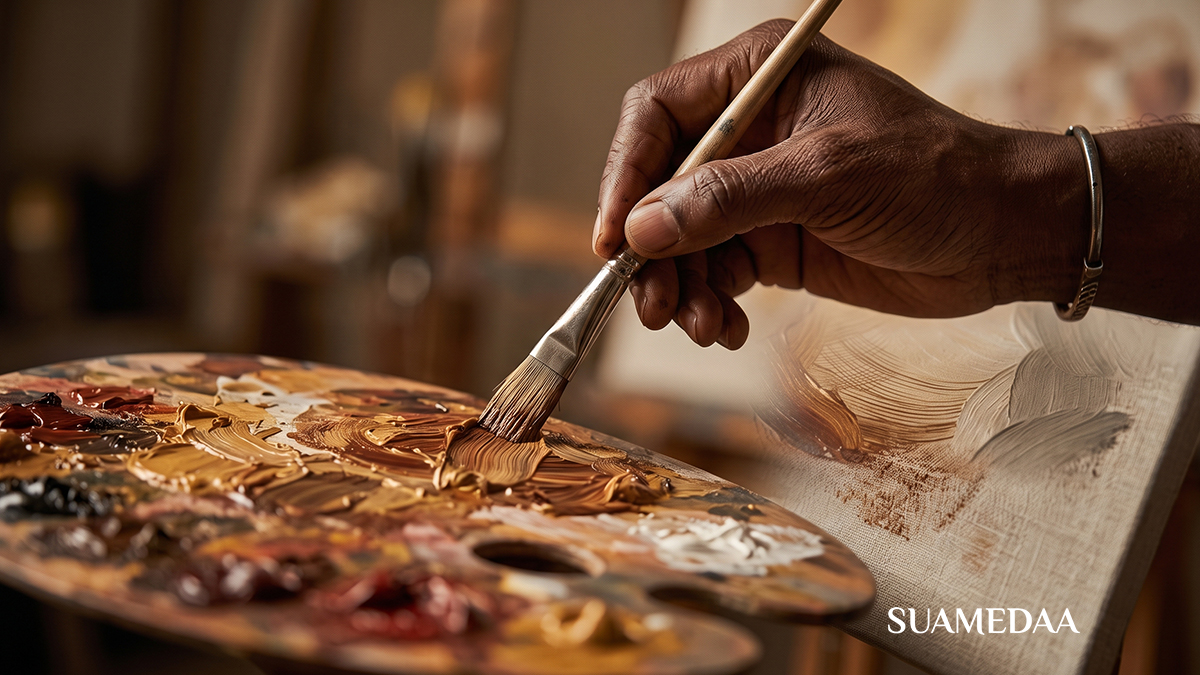
Every painting begins with a single mark. Before color, before composition, before subject matter, there is the brushstroke: the physical gesture of a hand moving a loaded brush across a surface. It is the most intimate record a painting keeps of the person who made it. Long after the painter has left the room, the strokes remain, preserving the pressure of a wrist, the speed of an arm, the hesitation or confidence of a particular moment.
Yet the brushstroke is also the element most beginning painters think least about. They focus on mixing the right color, on getting the proportions of a face correct, on choosing a subject worth painting. The stroke itself, the actual physical unit of painting, is treated as incidental, a mere delivery mechanism for pigment. This is a mistake that separates technically competent painters from artists with a genuine visual voice.
Understanding brushstrokes means understanding how paint behaves, how different tools and techniques produce different marks, how masters across centuries have used their strokes not just to describe subjects but to express feeling, energy, and intention. It means developing the physical vocabulary to make marks that are authentically yours rather than approximations of someone else’s approach.



This guide covers that vocabulary in full, from the physical mechanics of how a brushstroke is made, through the major techniques and the artists who defined them, to the practical work of discovering and refining the stroke that becomes your signature.
The Physics of a Brushstroke
Before technique, there is physics. A brushstroke is the result of a chain of variables interacting simultaneously: the viscosity of the paint, the moisture content of the brush, the type of bristle or hair, the texture of the surface, the speed of the gesture, the angle of the brush, the pressure applied, and the direction of movement. Change any one of these and the mark changes character entirely.
Paint consistency is the first variable most painters encounter. Oil paint straight from the tube is thick and buttery. It holds the shape of a brushstroke with sharp, sculptural edges. Thinned with medium or solvent, it flows more freely, fills textured surfaces evenly, and produces translucent layers. Watercolor straight from a pan is a dry pigment that dissolves in water and behaves entirely differently from its oil-based counterpart. Acrylic paint dries quickly and can be worked at any consistency from thick impasto to fluid washes depending on how much water or medium is added. Knowing your paint’s behavior at different consistencies is a prerequisite for controlling what happens on the surface.
Brush load refers to how much paint is on the brush. A heavily loaded brush produces full, opaque marks that may drag or feather at the edges as the paint runs out. A lightly loaded brush skips across textured surfaces, depositing color only on the raised grain and leaving the valleys untouched, a technique called drybrushing that produces texture effects impossible to achieve any other way. Learning to judge and control how much paint is on the brush, and knowing what effect a given load will produce, is a skill that develops through physical practice rather than reading.
Pressure and speed work in tandem. Heavy pressure spreads the bristles, widens the mark, and pushes paint into the surface. Light pressure keeps the bristles together, producing a narrower, more precise line. Speed affects texture and edge quality: a fast stroke tends to be looser and more energetic, sometimes catching the surface texture in ways a slow stroke does not. A slow, deliberate stroke allows more control over direction and shape but can feel labored if the paint begins to drag.



Brush angle determines a great deal about the character of a mark. Holding the brush nearly perpendicular to the surface and using the very tip produces thin, controlled lines. Tilting the brush at a lower angle and using more of the body of the bristles produces broader, flatter strokes. Some painters hold the brush almost parallel to the surface, loading the side of the bristles and sweeping broad marks with the flat belly of the brush in a technique that creates textured, almost accidental passages.
Surface texture is the silent collaborator in every brushstroke. A smooth, gessoed panel produces clean, distinct marks where every bristle track is visible. A heavily textured linen canvas catches paint on its raised weave and resists it in the valleys, producing a broken, granular mark. Rough watercolor paper blooms and spreads pigment unpredictably in ways smooth hot-pressed paper does not. The surface is never passive: it participates in every stroke.
Types of Brushes and What They Do
The brush is the painter’s primary instrument, and like any instrument it has a range of capabilities that depends on its design. Understanding what different brushes are built to do is fundamental to making informed choices about the marks you want.
Rounds
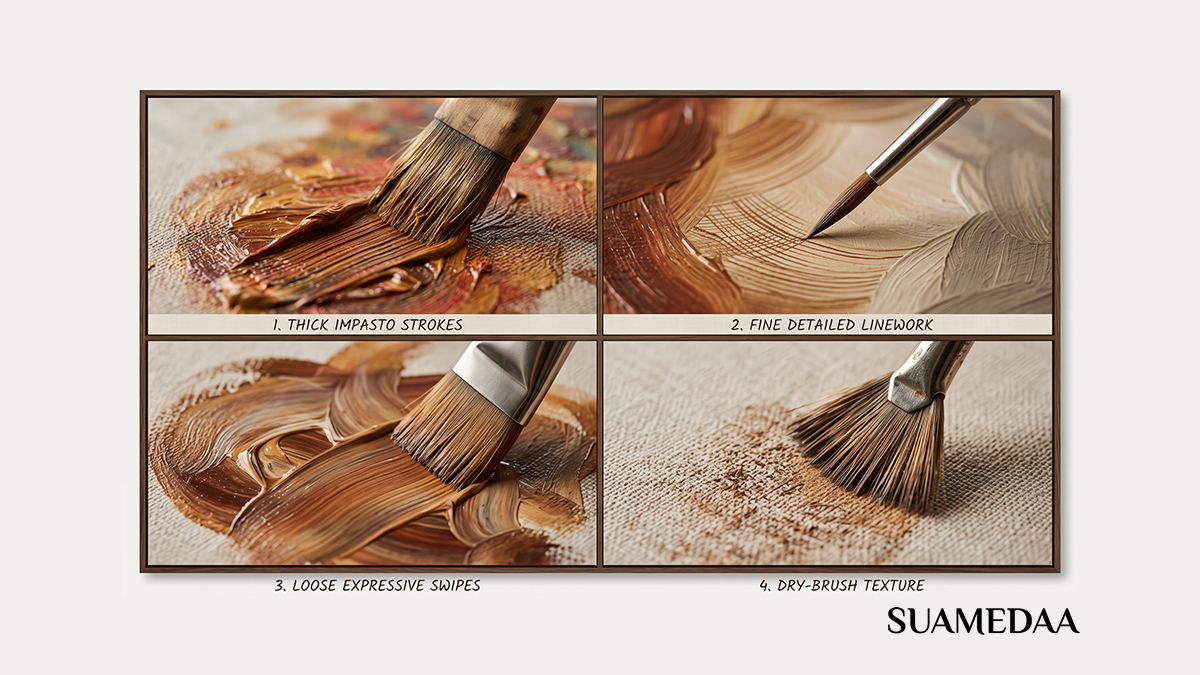
A round brush has a full body of bristles that taper to a point. It is the most versatile brush shape available. At full pressure, a round produces a broad stroke. Using only the tip, it produces a fine line. Varying pressure within a single stroke creates a line that swells and tapers, useful for calligraphic marks, botanical illustration, and the kind of expressive line drawing associated with Asian ink painting traditions. Rounds are available in every size from 000, used for the finest detail work, to large sizes used for washes and broad passages.
Flats
A flat brush has bristles cut straight across to produce a rectangular edge. It makes square, decisive marks with clean, hard edges. Flats are excellent for architectural subjects, geometric shapes, and any passage where a crisp edge is needed. Used on its thin side, a flat becomes a liner, producing a straight thin stroke. Turned flat and dragged sideways, it makes a broad textured mark. The angular variation, which has bristles cut on a diagonal, is particularly useful for painting leaves, petals, and other organic shapes that benefit from a stroke with one sharp corner and one angled edge.



Filberts
A filbert brush has bristles that are full in the body but taper to a rounded, oval tip rather than the straight edge of a flat or the pointed tip of a round. It is the preferred brush of many portrait and figurative painters because it produces a mark with soft edges rather than the hard corners of a flat. The filbert’s stroke has a natural beginning, middle, and end that blends into the surrounding paint rather than cutting into it. It is forgiving in ways that the flat and the precise round are not.
Fans
A fan brush spreads its bristles in a wide, flat arc. It is frequently misused as a gimmick but has genuine technical applications: blending two adjacent wet passages of color where the meeting edge needs to be diffused, suggesting distant foliage or grass texture with a light skimming stroke, and creating feathered cloud edges. Used with restraint, the fan brush solves specific problems elegantly. Used indiscriminately, it produces the visual signature of beginner landscape painting.
Palette Knives
Technically not a brush at all, the palette knife is a flexible metal blade used for mixing paint on the palette and for applying, scraping, and manipulating paint directly on the surface. Knife painting produces marks with a completely different character from any brush: flat, smooth passages with hard edges where the blade terminates, thick ridges of impasto where paint is piled and dragged, and scraped textures where the blade removes wet paint to reveal layers beneath. Many contemporary painters work exclusively with the knife, citing its directness and the physicality of the marks it produces as reasons for preferring it over the brush.
Hake Brushes and Mops
Large, soft, wide brushes designed for laying broad washes of color over large areas. The hake brush, originally from Japanese watercolor tradition, has soft goat hair that holds enormous quantities of dilute paint and releases it evenly across the surface. Mop brushes serve a similar function in oil and acrylic painting. Neither is useful for detail but both are essential for the broad, atmospheric passages that underpin many landscape and abstract paintings.
Foundational Brushstroke Techniques
Technique in painting is not a set of recipes but a set of physical skills, each of which opens up certain expressive possibilities. The following techniques are the core vocabulary of the brushstroke.
Impasto
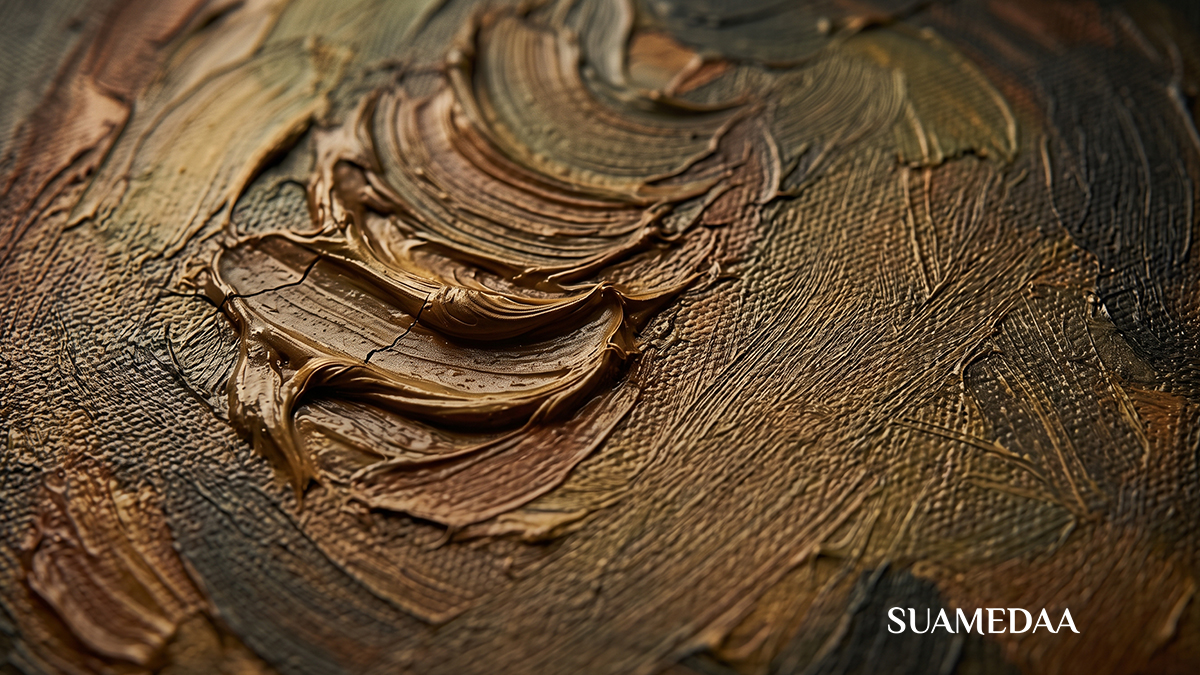
Impasto refers to paint applied thickly, in layers heavy enough to stand up from the surface in ridges and peaks that catch the light and cast small shadows. An impasto stroke is three-dimensional. It has physical mass. When you look at a van Gogh painting up close and see the dense, sculptural whorls of paint twisting across the canvas, you are looking at impasto taken to one of its most extreme and expressive conclusions.
The technique requires paint of sufficient body to hold its shape as it dries. Oil paint is the natural medium for impasto because it remains workable for hours, allowing the painter to build and manipulate texture extensively before it sets. Acrylic paint dries too quickly for extended wet manipulation but can achieve impasto effects using texture mediums or gels that add body without affecting color. Impasto paste mixed into acrylic extends working time and dramatically increases viscosity.
The tool matters enormously in impasto. A stiff hog-bristle brush pushes thick paint around forcefully and leaves bristle tracks in the paint surface. A palette knife piles paint into smooth mounds with clean, sharp edges. The choice between them produces entirely different textural qualities in the finished surface.
Impasto is not just about drama or thickness for its own sake. It is a tool for directing light. The ridges and peaks of impasto paint catch directional light from the side in ways that flat paint does not, activating the surface and making it visually dynamic under changing light conditions. Many Old Master painters used strategic impasto in the light areas of a composition, where the raised paint catches light most brilliantly, while keeping shadows thin and transparent, a technique that creates a luminous quality impossible to achieve with flat, even paint application.
Glazing
Glazing is the opposite of impasto in every sense. Where impasto builds the paint surface up, glazing builds it up through transparency. A glaze is a thin, translucent layer of paint mixed with a large proportion of medium, applied over a dry layer of lighter paint beneath. The glaze tints the underlying color without obliterating it, allowing the lower layers to glow through and mix optically with the glaze color.
The luminous, jewel-like quality of Flemish Old Master painting, the deep, rich shadows and the translucent skin tones of Rembrandt’s portraits, are largely products of glazing applied over careful underpainting. Light passes through the glaze, bounces off the lighter paint beneath, and returns through the glaze again, producing a depth and richness impossible to achieve by mixing the same color directly and applying it opaquely.
Glazing requires patience. Each glaze must be fully dry before the next is applied. In oil painting, this means waiting days between layers, though fast-drying alkyd mediums can reduce this. In acrylic painting, glazes dry in minutes, making the technique considerably faster and more accessible. Watercolor is inherently a glazing medium: its characteristic luminosity comes from transparent washes built up in layers over the white of the paper.
Scumbling
Scumbling is a technique in which a lighter, semi-opaque or broken layer of paint is dragged or scrubbed over a darker dry layer beneath, allowing the darker color to show through in patches. The result is a broken, atmospheric effect: not as transparent as a glaze, not as opaque as a direct stroke, but something in between. The Venetian painters of the 16th century used scumbling to create atmospheric sky effects and to soften the transitions between passages of color. Degas used it extensively in his pastel work.
The key to scumbling is that the paint layer is not solid. The application is deliberately uneven, leaving gaps and variations through which the underlying color contributes to the overall effect. A dry brush dragged lightly across a textured surface scumbles naturally, catching only the high points of the texture. A brush loaded with paint that has been almost entirely wiped off on a rag will scumble on a smoother surface.
Wet-on-Wet (Alla Prima)
Wet-on-wet painting, also called alla prima from the Italian meaning “at once,” involves painting into still-wet paint rather than waiting for layers to dry. In wet-on-wet work, strokes blend at their edges with the paint already on the surface, producing soft transitions, merged colors, and an overall freshness and spontaneity that is very difficult to achieve by building layers up slowly.
The technique demands decisive, confident brushwork. Every stroke either successfully places color where intended or muddles the wet paint beneath. Reworking wet paint repeatedly produces a deadened, overworked surface where all the colors have begun to merge into grey. The great alla prima painters, Frans Hals, Velazquez, John Singer Sargent, work with the discipline of calligraphers: each stroke placed once, correctly, and left alone.
Bob Ross is perhaps the most widely recognized contemporary proponent of wet-on-wet technique, having built an entire teaching method around it. His cheerful instruction that “there are no mistakes, only happy accidents” underscores one of the genuine qualities of wet-on-wet painting: the looseness of control it requires produces results that can feel surprisingly organic and alive, even for beginners.
Broken Color and Pointillism
Broken color is a technique in which colors are applied in small, separate strokes rather than blended together on the palette. When viewed from a distance, the eye optically mixes the separate strokes of color rather than seeing them as distinct. The effect is more vibrant than a flat, blended color mix because optical mixing preserves the intensity of each individual color, whereas physical mixing on the palette always reduces overall saturation.
The Impressionists, particularly Monet, Pissarro, and Sisley, used broken color as their primary technique for capturing the shimmer of light on water, foliage, and atmospheric distance. Their canvases, which can look almost illegibly fragmented up close, resolve at viewing distance into extraordinarily luminous and coherent images.
Pointillism, developed by Georges Seurat and Paul Signac in the 1880s, took the principle of broken color to its logical extreme by insisting that all color be applied in small, regular dots of pure, unmixed pigment. Seurat’s large canvas “A Sunday on La Grande Jatte” is built entirely from thousands of tiny points of color that resolve, at the correct viewing distance, into a scene of remarkable clarity. The technique, which Seurat called Chromoluminarism, is enormously time-consuming and produces results with a particular jeweled stillness quite different from the loose energy of Impressionist broken color.
Drybrushing
Drybrushing is a technique in which a brush containing very little paint, almost none, is dragged quickly across a textured surface. The paint deposits only on the raised points of the surface, leaving the recesses untouched. The result is a broken, scratchy mark that suggests texture, speed, and surface quality in ways that no other technique replicates.
Drybrushing is used extensively in illustration, particularly for rendering fur, hair, rough stone, weathered wood, and similar textures. It is also used in acrylic and oil painting to soften edges, add surface interest, and create the impression of atmospheric haze in distance passages. In watercolor, drybrushing over rough paper creates the sparkling effect of light on water, where the white of the paper gleaming through the broken marks reads as reflected light.
Feathering and Blending
Feathering is the technique of softening the edge between two adjacent color areas by drawing a dry or nearly dry brush back and forth across the meeting line with very light pressure, gradually blending the pigments without creating a hard boundary. It is the primary technique for creating smooth gradients and the soft edges characteristic of academic portraiture and classical still life painting.
The Old Masters combined feathering with glazing to achieve the extraordinarily subtle transitions in skin tone that make their portraits look almost alive. Blending stumps, dry brushes, and even fingertips have all been used as blending tools throughout history. In oil painting, the slow drying time of the medium allows extensive blending before the paint sets. In acrylic, blending must be faster and more decisive, with retarder mediums often used to extend working time.
Calligraphic Strokes
Calligraphic brushwork treats the painted mark as a gestural line with its own expressive life, rather than as a shape-filling device. It draws on the traditions of East Asian ink painting, in which the quality of a single stroke, its speed, pressure variation, direction, and spontaneity, is considered as expressive as the subject it describes. A branch painted with calligraphic strokes is not just a branch. It is a record of a gesture, a breath, a moment of focused attention.
Western painters who have incorporated calligraphic sensibility into their work include Franz Kline, whose large black and white abstract paintings translate calligraphic energy into a monumental scale, Cy Twombly, whose canvases blur the line between painting and written language, and contemporary figurative painters like Jeremy Mann and Martin Mull, who use loose, gestural line work that reads almost as drawing within the context of a painted composition.
The Masters and Their Marks: Learning from History
Studying how great painters used their brushstrokes is one of the most direct ways to expand your own technical vocabulary. Each major painter in the history of art can be read as a case study in a particular approach to the mark.
Rembrandt van Rijn
Rembrandt’s brushwork is one of the most studied in all of art history, and for good reason. In his early work, the paint surface is smooth and refined, the strokes invisible. As he matured, his handling became progressively freer, and his late paintings are remarkable for the visible, sculptural quality of the brushwork in the light areas. He used thick, loaded strokes to build up the highlights of skin, jewelry, and fabric, while keeping the shadows painted in thin, almost transparent glazes. The contrast between the physical weight of the lights and the weightlessness of the shadows creates a sense of three-dimensional form and atmospheric depth that remains technically astonishing.
Johannes Vermeer
Where Rembrandt builds texture and physicality, Vermeer pursues something close to the opposite: a painted surface so smooth and controlled that the strokes themselves virtually disappear. His painting of light, particularly the way cool northern light falls across fabric, skin, and ceramic, is achieved through an almost invisible technique of tiny, precisely placed strokes that build up tonal gradients of extraordinary subtlety. The pointillist quality of Vermeer’s highlights, particularly the sparkling highlights on pearls and fabric, was noted by art historians long before the Impressionists made broken color a conscious movement.
Vincent van Gogh
Van Gogh’s brushwork is possibly the most recognizable in Western art. His mature paintings from his time in Arles and Saint-Remy are covered in dense, directional strokes that follow the contours of forms: curved, swirling strokes in skies and wheat fields, short parallel strokes in rocks and earth, long twisting strokes in cypress trees. The stroke becomes an emotional force, not just a way of applying paint. His famous turbulent skies in “The Starry Night” read simultaneously as accurate observations of night sky motion and as expressions of psychological intensity. The brushwork is inseparable from the meaning.
John Singer Sargent
Sargent is the supreme master of the confident, decisive alla prima stroke. His portraits and watercolors display an economy of means that seems almost casual until you realize the precision and control required to achieve it. A single stroke in a Sargent painting frequently does the work that a lesser painter would accomplish with ten. His technique of placing a stroke exactly once and not reworking it produces a freshness and immediacy that makes his paintings feel as if they were completed minutes ago, still wet with the confidence of the gesture.
Claude Monet
Monet’s brushwork changed dramatically over the course of his career, from the relatively controlled early Impressionist paintings to the immense, almost abstract late water lily series painted as his eyesight failed. In his mature work, the stroke is no longer a tool for describing objects but for capturing the quality of light and atmosphere at a specific moment. Different passage of the same canvas use entirely different stroke types: horizontal dabs for the reflective surface of water, vertical strokes for the reflections of reeds, rounded strokes for lily pads, and thick, sweeping marks for the sky’s reflection. The variety of stroke types within a single painting creates a visual richness that rewards close looking.
Gustav Klimt
Klimt’s decorative, pattern-saturated surfaces use brushwork in a way that is almost unique in Western painting. His backgrounds are often painted with small, regular mosaic-like strokes of gold, silver, and jewel-toned pigment that recall Byzantine iconography. His figures emerge from these decorative fields with passages of more naturalistic, softly blended brushwork, creating a tension between the flat patterned ground and the three-dimensional forms of the figures. The contrast of stroke types, mechanical and decorative versus fluid and organic, is itself part of the painting’s meaning.
Developing Your Own Brushstroke Vocabulary
Reading about brushstrokes and studying reproductions of paintings is valuable but ultimately insufficient. The brushstroke lives in the body, in the hand, wrist, arm, and shoulder that move the brush. The only way to develop a personal stroke vocabulary is through physical practice, conducted with genuine attention rather than habitual repetition.
Exercises for Building Awareness
Set up a canvas or paper with the sole intention of making marks rather than creating an image. Load a brush and make a single stroke, paying attention to everything: how the paint leaves the brush, how pressure changes the width, how speed affects the edge quality, how the texture of the surface participates in the mark. Make the same stroke slowly and then quickly. Change the angle of the brush. Vary the load. Use the tip, then the body, then the side. Work through every brush you own and document what each one does.
This kind of mark-making practice, separated from the pressure of creating a finished work, accelerates technical development faster than almost anything else because it builds the physical memory of what different actions produce before you need to deploy them in service of an actual painting.
Copying Masters
Copying masterworks has been a cornerstone of artistic training for centuries, and it remains one of the most effective ways to internalize techniques that are impossible to fully understand from description alone. Choose a work whose brushwork you want to understand and copy it as faithfully as you can, not to produce a reproduction but to experience from the inside what decisions the painter made. You will immediately discover things that no art history text will tell you: how physically demanding impasto actually is, how quickly wet-on-wet paint begins to muddy if reworked, how the brush must be held differently for different effects.
Sketchbooks as Stroke Laboratories
Keep a sketchbook or small canvas board dedicated to stroke experiments. Date your experiments and return to earlier pages as your understanding develops. What felt difficult three months ago often becomes natural through repetition. Comparing early experiments with current ones gives you a visible record of development that sustains motivation through the inevitable plateaus of skill-building.
Restraint as a Practice
One of the most important disciplines a developing painter can cultivate is the habit of using fewer strokes rather than more. Overworked passages in a painting, where paint has been fussed with repeatedly until all life has been squeezed out, are almost always the product of a painter who did not trust a stroke that was already working and felt compelled to add one more. Learning to stop, to recognize when a passage is complete and resist the urge to improve it, is a skill as technical as any stroke type.
Set yourself exercises in economy. Try to paint a simple subject in no more than thirty strokes. Then try twenty. Then ten. The constraint forces a clarity of decision-making that carrying on indefinitely never develops.
The Role of the Non-Dominant Hand and the Whole Body
Most painters hold the brush in their dominant hand and paint from the wrist and forearm, producing marks of limited scale and a certain sameness of energy. Extending the movement into the shoulder, or even standing and painting from the whole body, produces strokes of a different character: larger, more sweeping, more energetic, less controlled but more alive. Jackson Pollock painted on canvases laid on the floor, walking around them and dripping paint from above, using his entire body as the instrument.
Experimenting with your non-dominant hand, with painting while standing, with longer brush handles that increase the distance between your body and the surface, and with working on a larger scale than you are comfortable with are all ways of disrupting habitual stroke patterns and discovering new possibilities.
When the Stroke Becomes Style
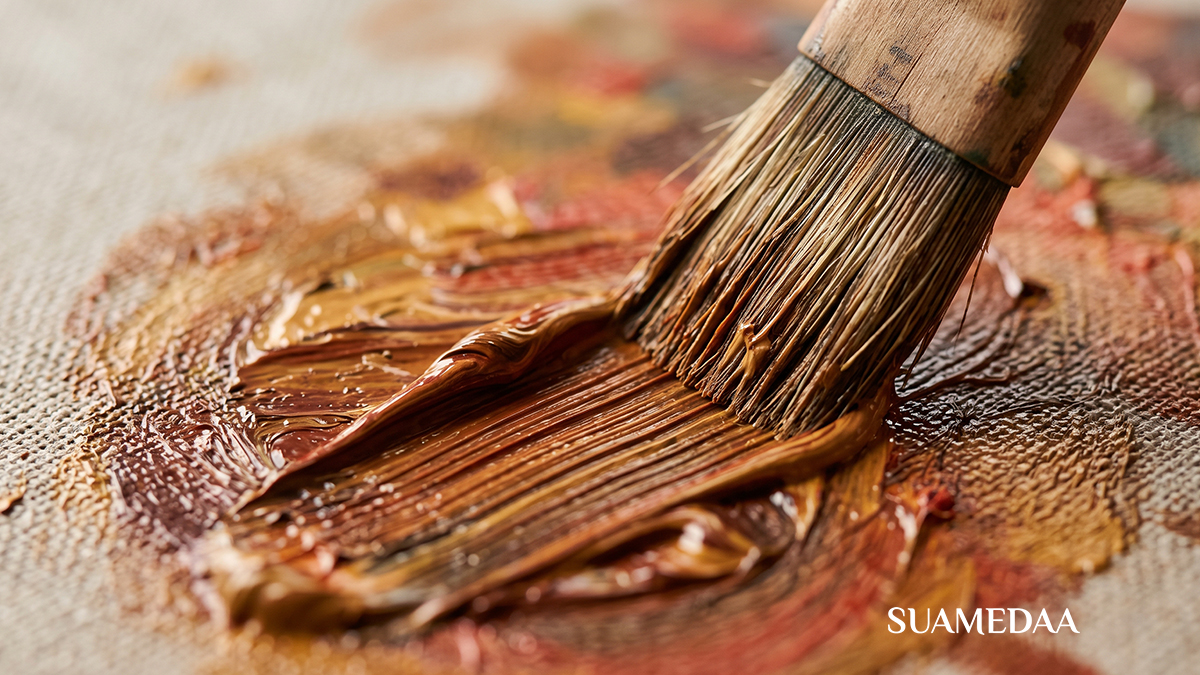
Style in painting is not something an artist chooses deliberately, like selecting a filter on a photograph. It emerges, over time, from the accumulation of countless decisions made at the level of the individual stroke: which brush, how loaded, what pressure, what speed, what angle, what surface. The painter who makes these decisions consciously and with full attention to what each choice produces gradually develops a stroke vocabulary that is uniquely theirs, recognizable in the way a handwriting is recognizable.
This is why copying masters is useful but has a limit. You can learn Sargent’s technique without developing Sargent’s style, because style is the product of a specific person’s specific physical responses to specific problems encountered over a lifetime of looking and painting. Your style will be different from any painter you admire, not because you are avoiding imitation but because you are not them. Your hand is different, your visual preferences are different, your subjects are different, your cultural context is different.
What you can do is look carefully at the painters whose work moves you and identify the specific stroke decisions that produce the quality you admire. Is it the thickness of the paint? The confidence of a single decisive mark? The broken color in the lights? The soft, feathered edges? Isolate the technical decision and then practice it in your own context, on your own subjects, until it becomes naturally available to you rather than a conscious imitation.
Over time, through thousands of paintings and tens of thousands of strokes, some choices will feel more natural than others. Some mark types will recur because they suit your temperament, the subjects you are drawn to, the light conditions you return to again and again. The accumulation of these recurring choices, the marks you make without thinking because they are the ones that feel right, is where your style lives.
The Stroke That Is Yours Alone
Every painter who has ever stood before a canvas has wondered, at some point, whether what they are doing is original, whether their strokes carry something of themselves or are merely approximations of influences and models. The answer is almost always yes: your stroke carries you, whether you intend it to or not.
The goal of understanding brushstroke technique is not to replace instinct with calculation. It is to expand the range of what instinct can draw on. The more technically you understand about what a brush loaded with thick paint dragged at a low angle across a rough surface will do, the more freely you can deploy that knowledge in service of a feeling or an idea without stopping to figure it out in the moment.
The painter who knows their tools deeply works freely. The stroke that defines your style is not the one you decide upon. It is the one you discover, made visible by years of looking, practicing, questioning, and returning to the canvas with a brush in hand and something to say. Make the marks. Pay attention to what they do. The rest will follow.