Pay in Cedis – Ghana Opens a New Route for Trade with China
For decades, a Ghanaian importer ordering goods from China faced a routine that was more complicated than it needed to be. The transaction was in dollars. The cedi had to be converted to dollars before the payment could leave the country. That conversion attracted fees, exchange rate risk, and a dependence on US correspondent banks to process the transfer even when neither Ghana nor China had any fundamental use for American currency in a deal between them. The dollar sat in the middle of the transaction as a kind of toll booth, extracting a cost from every side.
In late September 2026, Bank of Ghana Governor Dr. Johnson Pandit Asiama stood before journalists at the 132nd Monetary Policy Committee press briefing and described what he presented as a straightforward solution. “If you want to buy anything from China,” he said, “just go to Stanbic Bank with your cedis.” The comment, casual in its delivery but significant in its implications, announced the public phase of a pilot programme that allows Ghanaian businesses to pay Chinese suppliers directly in yuan from their cedi accounts, bypassing the US dollar entirely. Ghana Commercial Bank, he added, was developing a parallel service.
The announcement captured something that Ghanaian businesses had wanted for years and that the Bank of Ghana had been working toward in the months prior: a direct payment corridor between the cedi and the renminbi that removes the dollar as a compulsory intermediary in bilateral trade between Africa’s third-largest economy and the world’s second-largest.



How It Works
The mechanism that makes this possible is China’s Cross-Border Interbank Payment System, known as CIPS. Launched by the People’s Bank of China in 2015 and expanded significantly since, CIPS is the infrastructure that processes yuan-denominated cross-border payments and settlements. It is, in functional terms, an alternative to the SWIFT-based correspondent banking system that routes most international transactions through US banks.
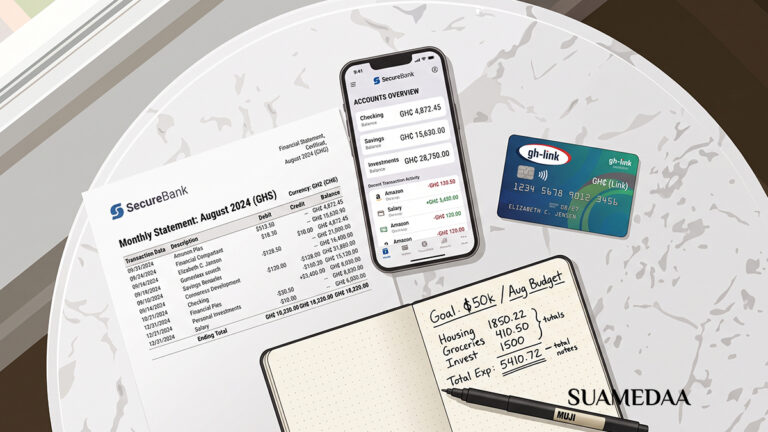
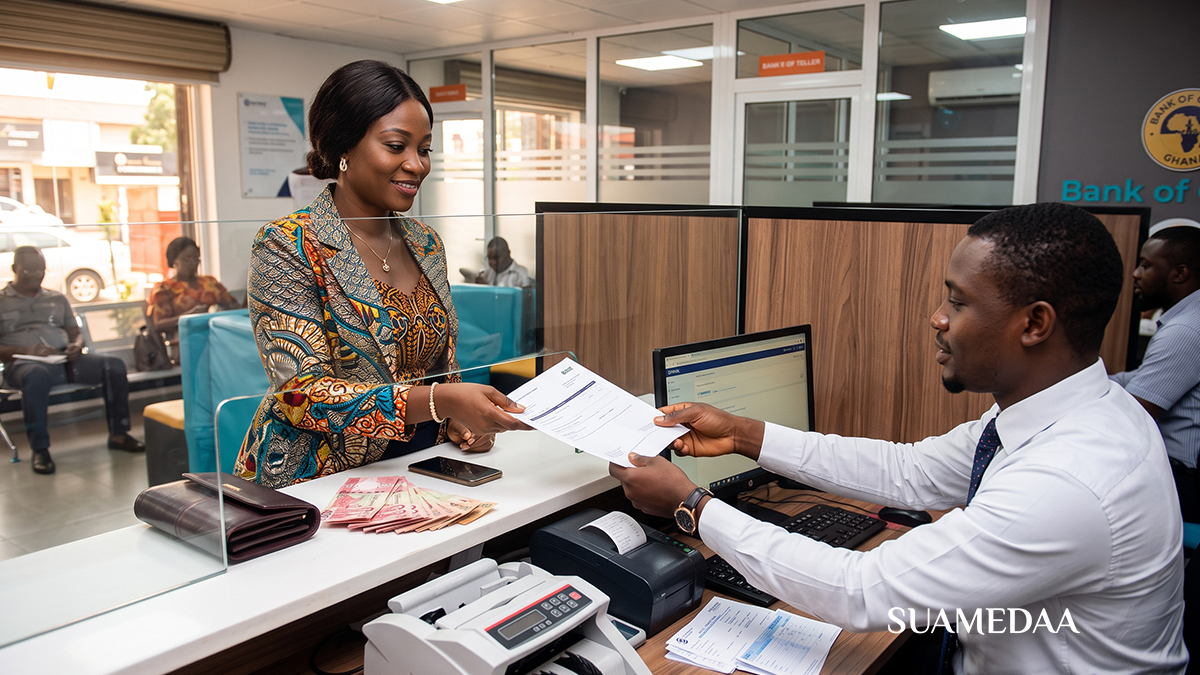
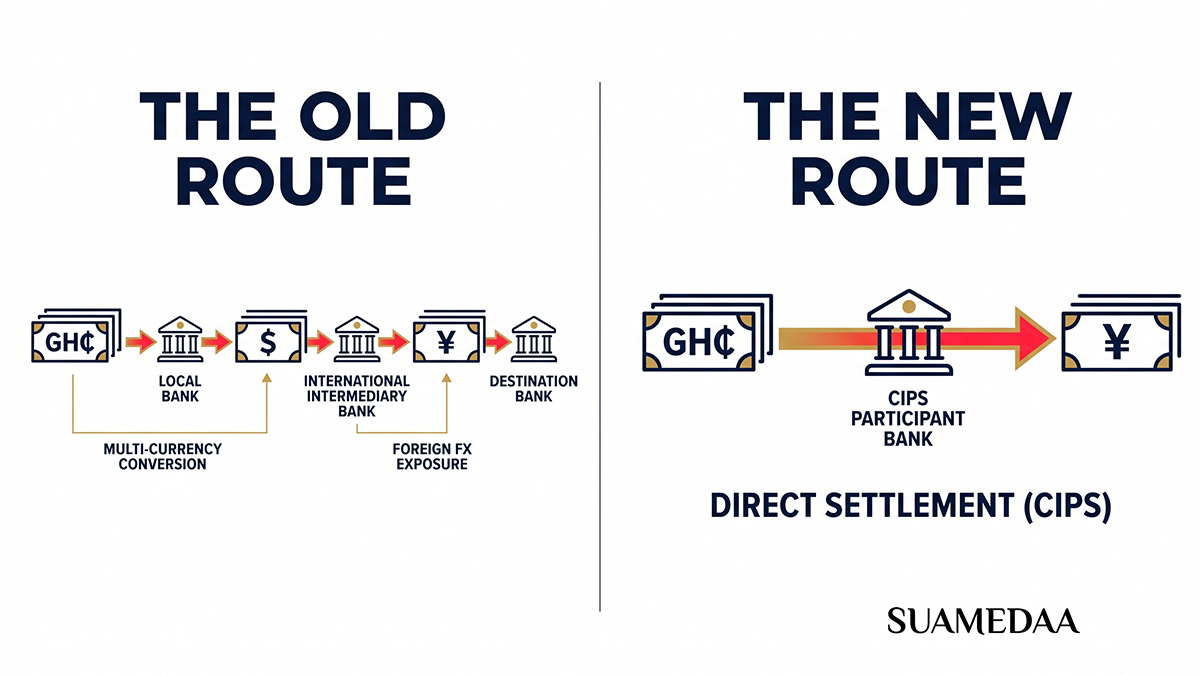
Under the Stanbic Bank pilot, a Ghanaian importer who wants to pay a Chinese supplier no longer needs to first acquire US dollars. The importer approaches Stanbic Bank with Ghana cedis, instructs the bank to pay in yuan, and submits the supporting trade documents. The bank handles the conversion from cedi to yuan and routes the payment through CIPS. For complete submissions received by 2 p.m. GMT, settlement can occur the next business day, subject to regulatory and compliance requirements.
The process retains all the documentation and compliance obligations that govern any legitimate import transaction. What it removes is the extra leg of the journey: the conversion to dollars before the conversion to yuan, the routing through a US correspondent bank, and the fees and foreign exchange exposure that the dollar intermediary created. Stanbic’s chief executive, Kwamina Asomaning, described it as eliminating “the need for US correspondent or intermediary banks” on China-Ghana payments.
This is an alternative route, not a guarantee of lower costs in every circumstance. The actual savings for any given transaction depend on prevailing exchange rates, bank fees, and the specific terms each importer negotiates. The US dollar remains available as a settlement currency for those who prefer or need it. What the pilot creates is choice: Ghanaian importers now have an option that did not exist before in any accessible, commercially operational form.
Why It Matters: The Dollar Dependence Problem
To understand why this matters, it helps to understand the structural problem it addresses.

For most of its post-independence history, Ghana’s external trade, like most of Africa’s, has been denominated in dollars. This was practical when it became the norm: the dollar was the dominant global reserve currency, most commodity prices were set in dollars, and the international banking infrastructure was built around dollar clearing. But the arrangement carries costs that are easy to overlook until they are made visible.
Every time a Ghanaian importer pays for Chinese goods in dollars, two currency conversions take place: cedis to dollars, and dollars to yuan. Each conversion attracts a spread. Each conversion carries exchange rate risk during the time the money is in transit. And the entire chain runs through US correspondent banks, which means Ghanaian and Chinese businesses are subject to American financial infrastructure and, implicitly, American regulatory jurisdiction, for transactions that have nothing substantively to do with the United States.
For Ghana, the dollar dependence problem has a second dimension. The cedi has experienced significant volatility against the dollar, depreciating sharply during periods of economic stress and recovering partially during periods of stability. When imports are priced in dollars, cedi depreciation raises the cost of those imports directly, feeding into inflation and squeezing the margins of businesses that depend on Chinese goods. A payment system that reduces the dollar leg of the transaction does not eliminate exchange rate risk, since cedi-yuan rate movements still apply, but it simplifies and potentially shortens the exposure.
Governor Asiama also pointed to a related opportunity: the Bank of Ghana plans to engage the People’s Bank of China at the World Bank and IMF Annual Meetings to coordinate on supporting Ghanaian exporters under China’s zero-tariff regime, which took effect on May 1, 2026. Under that initiative, China extended duty-free treatment to exports from 53 African countries that maintain diplomatic relations with Beijing. For Ghana, which exports mineral fuels, oil, manganese ore, and cocoa to China, accessing that regime with lower transaction costs is a material commercial opportunity. The Ministry of Trade, the Governor noted, has a critical role in ensuring Ghana fully captures the benefits.
The Scale of Ghana-China Trade
The backdrop to this payment reform is a trading relationship that has grown to a scale that commands serious attention. According to figures from the Chinese Embassy in Ghana, bilateral trade between the two countries reached 14.1 billion US dollars in 2025, an increase of 19.3 percent from the previous year. China is Ghana’s largest trading partner by a significant margin, ahead of any individual European or North American country.



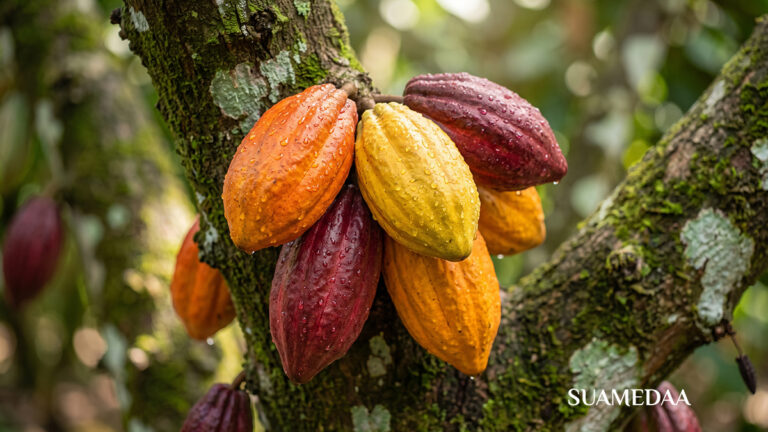
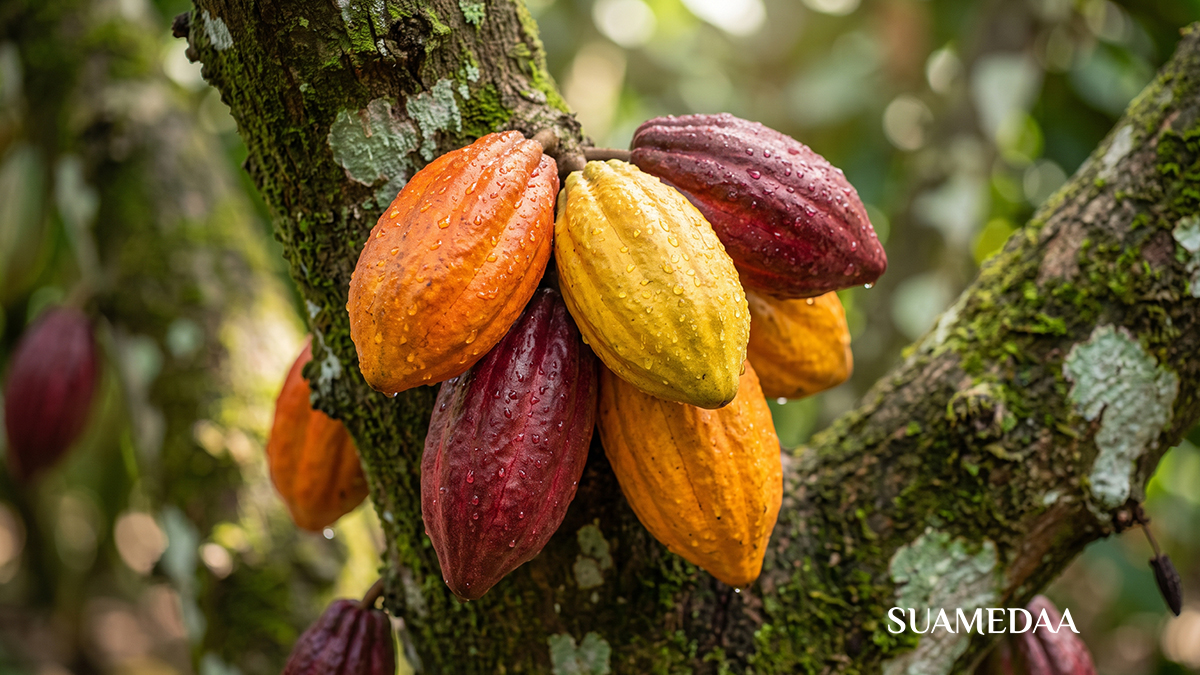
The composition of that trade reflects a familiar but consequential asymmetry. Ghana exports primary commodities to China: mineral fuels and oil, which account for approximately 933 million dollars of annual exports; manganese and other ores, at around 356 million dollars; and smaller quantities of cocoa and other agricultural products. China exports manufactured goods to Ghana: machinery, electronics, vehicles, textiles, and consumer products that fill the country’s shops and power its industries.
This pattern, raw materials leaving Ghana, finished goods arriving, is the structure that both governments say they want to change over time, through investment in local processing, manufacturing, and value addition. The payment arrangement does not by itself alter that structure, but it lowers the friction cost of the existing relationship and may make it easier for Ghanaian traders, particularly small and medium-sized importers, to conduct business with Chinese suppliers without navigating the complexities of dollar acquisition.
Stanbic and GCB: Two Paths to the Same Destination
The two banks at the centre of this development represent different parts of Ghana’s banking landscape, and their participation signals that the initiative has traction across the sector.
Stanbic Bank Ghana is the local subsidiary of Standard Bank, one of Africa’s largest banking groups, headquartered in Johannesburg. Its parent company’s continental reach, and its familiarity with cross-border payment infrastructure across Africa, positioned it to move first on CIPS integration. The bank’s direct participation in the CIPS network is the technical foundation that makes the cedi-to-yuan route functional.
Ghana Commercial Bank is a majority state-owned institution with one of the largest branch networks in the country and deep relationships with Ghanaian traders across every sector. Its pursuit of a similar arrangement, though at a later stage of development at the time of the announcement, signals that the government sees this as a national priority, not just a commercial innovation from a private bank. When GCB’s service becomes operational, it will extend access to direct cedi-yuan payments to a significantly wider base of Ghanaian businesses.
The Bank of Ghana’s role is facilitative: it is not running the payment system itself but is actively encouraging and coordinating the commercial banks, engaging with Chinese counterparts at the central bank level, and ensuring the regulatory environment supports the new arrangements. Asiama’s explicit public endorsement, with its memorable instruction to simply “go to Stanbic Bank with your cedis,” signals that the central bank wants businesses to use the new route.
The Broader Dedollarisation Picture
Ghana’s cedi-yuan payment corridor is one element of a trend that is reshaping how African economies manage their international trade finance. Across the continent, the question of dollar dependence has become more urgent in recent years, for several interconnected reasons.
The US Federal Reserve’s interest rate cycle, which pushed rates sharply higher between 2022 and 2024, strengthened the dollar and created debt service pressures for African governments with dollar-denominated borrowing. Several countries experienced debt crises or near-crises linked in part to the cost of servicing dollar debt in a period of cedi, naira, and kwacha weakness. The lesson drawn in multiple finance ministries was that reliance on a single foreign currency for trade, debt, and reserves creates a structural vulnerability.
China, for its own reasons, has been actively promoting the internationalisation of the yuan. The CIPS infrastructure, the bilateral currency swap agreements with dozens of central banks including the Bank of Ghana, and the zero-tariff initiative that creates incentives for African exporters to engage more deeply with Chinese markets are all elements of a deliberate Chinese strategy to reduce the dollar’s role in trade with the Global South.
Elsewhere in Africa, the pattern is visible. Zambia has begun accepting yuan for mining tax payments. Kenya converted a portion of its dollar-denominated Chinese debt to yuan, reportedly saving the equivalent of approximately 250 million US dollars per year in exchange costs. Ethiopia has been exploring similar debt conversion arrangements. Ghana’s cedi-yuan payment pilot fits within this continental shift, though it is distinct from debt arrangements: it is about trade payment flows rather than liability management.
What It Means for Ghanaian Businesses
For the average Ghanaian importer, the practical significance of this development is most visible in three areas.
The first is simplicity. Sourcing US dollars to pay Chinese suppliers has been a routine but cumbersome part of import business. It required holding dollar accounts, monitoring exchange rates, and often paying a premium to acquire dollars quickly when orders needed to move. The ability to simply walk in with cedis removes several steps from a process that most importers would have happily simplified years ago.
The second is cost reduction, in principle. By removing the dollar conversion leg, the new payment route eliminates at least one set of conversion fees and reduces the bank intermediation charges that accumulate when a payment passes through multiple correspondent banks. Whether those savings are material in any given transaction depends on how Stanbic and eventually GCB price their cedi-yuan conversion service relative to what importers were previously paying for the cedi-dollar-yuan route.
The third is speed. For importers managing relationships with Chinese suppliers where payment timing affects production schedules, the ability to settle the next business day on a compliant, documented transaction is commercially meaningful. Dollar-based wire transfers involving multiple correspondent banks can take longer and involve more uncertainty about exactly when funds arrive.
The pilot is not a finished product. It is a beginning, limited initially to eligible transactions through Stanbic Bank, with GCB’s service still in development. Documentation and compliance requirements remain, as does the Bank of Ghana’s oversight of the foreign exchange component of each transaction. As the pilot matures, the expectation is that more banks will develop similar capabilities and that the service will become a standard part of the Ghanaian trade finance landscape.
A Signal About Ghana’s Direction
Read alongside the government’s Cabinet-approved application to join BRICS, the cedi-yuan payment corridor is part of a coherent direction of travel in Ghana’s economic foreign policy under President John Dramani Mahama. The phrase that has appeared most frequently in both contexts is resource sovereignty: the idea that Ghana should be able to conduct its own economic affairs, including its trade and its financial flows, on terms that serve Ghanaian interests rather than those of whoever owns the dominant currency or institution in any given arrangement.
This does not mean rejection of Western relationships or institutions. The Bank of Ghana is simultaneously engaged with the IMF and the World Bank, and the Governor was explicit that dollar-based payment routes remain available alongside the new cedi-yuan option. What it does mean is a deliberate effort to build alternatives, so that Ghana’s economic choices are not constrained by the absence of options.
The cedi-yuan payment corridor, modest in its initial form, is a practical expression of that ambition. It is not a geopolitical statement. It is a commercial convenience that saves Ghanaian importers time and money. But it is also, in its own quiet way, a structural change in how Ghana is connected to the global economy, and those changes have a way of accumulating into something larger than any individual announcement suggests.