
Putting a Price on It – Common Methods for Valuing a Business
When someone buys a house, there are recent sales of comparable properties on the same street to guide the negotiation. When someone buys shares in a listed company, the market prints a price every second of every trading day. Neither of these conveniences exists for a private business, which is why business valuation is at once more important and more contested than most business owners realise.
The value of a private company is not a fact that can be looked up. It is an estimate that emerges from the intersection of method, data, and judgment, and it shifts depending on who is doing the estimating and why. A seller wants a number that reflects the years of effort that built the company. A buyer wants a number that reflects what the company can actually return on invested capital. A bank considering a loan wants a number that reflects the collateral available if things go wrong. A tax authority wants a defensible number that holds up to scrutiny. These are not necessarily the same number, and the method chosen to arrive at the number will shape which interests it reflects.
None of which means that business valuation is arbitrary. The methods are well-established, the inputs are largely traceable, and the principles behind each approach are grounded in genuine financial logic. What it does mean is that understanding the methods, and understanding what each one is actually measuring, is essential for anyone who will ever sell a business, buy one, raise capital, or enter a dispute where the value of a company is at issue.



The Three Approaches That Contain Everything Else
Before getting into the specific methods, it helps to understand the three conceptual approaches from which all valuation methods derive. Every technique for valuing a business belongs to one of these three families.
The market approach values a business by reference to what comparable businesses have sold for. If similar companies in the same industry have been selling at certain multiples of their earnings, and your business has comparable earnings, the market approach applies those multiples to your company. The underlying logic is that the market, through its transactions, has already incorporated the judgment of informed buyers and sellers, and that the price those parties agreed on for a comparable company is the best available benchmark for what a buyer would pay for yours.
The income approach values a business based on the future economic benefits it is expected to generate, discounted back to their present value. If a business will produce a certain stream of cash flows over the next ten years, the income approach estimates what that stream is worth in today’s money. The underlying logic is that what a buyer is really acquiring is the right to receive those future economic benefits, and the price should reflect what those benefits are worth given the time and risk involved in receiving them.
The asset approach values a business based on the value of the assets it holds, net of its liabilities. It is less a measure of what the business can earn and more a measure of what the business contains. The underlying logic is similar to calculating personal net worth: add up everything of value, subtract everything owed, and what remains is the value.
Most competent valuations do not rely on a single approach. They triangulate across two or three methods, using the results as checks on each other and weighting them according to which is most relevant to the specific business being valued.



EBITDA Multiples: The Language of Professional Deals
For businesses above a certain size, the most common valuation shorthand is EBITDA, and the most common valuation question is: what multiple of EBITDA would a buyer pay?
EBITDA stands for earnings before interest, taxes, depreciation, and amortisation. It is a measure of a company’s operating profitability stripped of financing decisions, tax structures, and accounting treatments for long-lived assets. Two companies with identical operations but different capital structures, different tax jurisdictions, and different depreciation schedules will show different net profits but similar EBITDA figures. For the purpose of valuation, this makes EBITDA a more comparable and controllable measure than net profit.
The multiple applied to EBITDA reflects what a buyer is willing to pay for each unit of that operating profit, expressed as a number of years of earnings. An EBITDA multiple of 6x means the buyer is paying the equivalent of six years of current EBITDA for the business. Whether that represents good value depends on the industry, the growth trajectory, the reliability of the earnings, and what alternatives the buyer has.
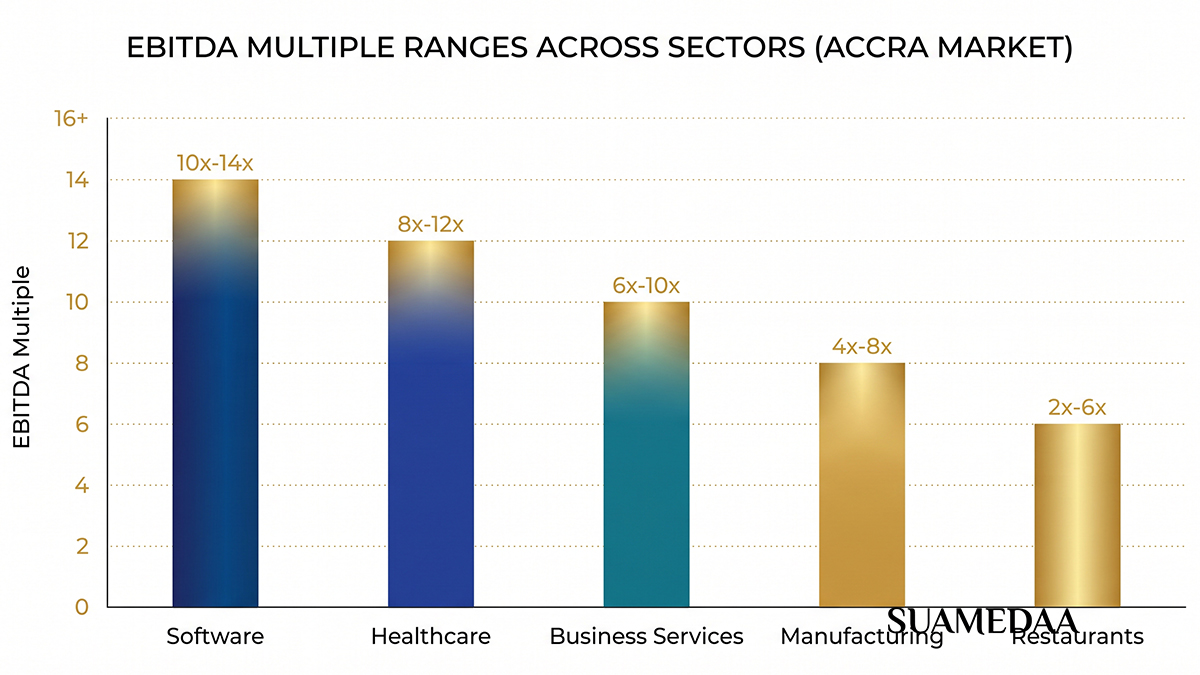
Multiples vary considerably by sector. Software and software-as-a-service businesses command some of the highest multiples, often 6 to 15 times EBITDA and sometimes substantially more, because their revenue tends to be recurring, their margins tend to be high, and their growth potential tends to be significant. Healthcare businesses, which benefit from demographic tailwinds and often have defensible market positions, typically trade at 7 to 12 times EBITDA. Financial services businesses trade at 6 to 12 times. Business services, manufacturing, and professional services businesses typically fall in the 5 to 9 times range. Restaurants and retail businesses, which tend to have lower margins and higher operational complexity, trade at 3 to 6 times EBITDA in most transactions.
Multiples also vary with size. Smaller businesses attract lower multiples, partly because they carry more risk (greater dependence on individual relationships, thinner management benches, less diversified customer bases) and partly because fewer buyers are capable of or interested in acquiring them. A business generating less than 1 million US dollars in EBITDA might trade at 3 to 4 times. A business generating between 1 and 10 million dollars might trade at 4 to 6 times. A business generating over 10 million dollars, which starts to attract private equity buyers alongside strategic acquirers, might trade at 7 to 9 times or higher.



The EBITDA multiple is a market approach method. Its validity depends on having genuinely comparable transactions to reference, and its limitation is that it captures a snapshot of what the market is paying right now, which shifts with economic conditions, sector sentiment, and deal flow.
Seller’s Discretionary Earnings: For Owner-Operated Businesses
For smaller businesses where the owner is also the primary operator, a different earnings measure becomes more useful than EBITDA. Seller’s discretionary earnings, known as SDE, adjusts the profit figure to reflect what the business would generate for a single owner-operator who takes a market-rate salary and whose personal expenses may be running through the business.
The calculation starts with net profit and adds back several categories of expenditure: the owner’s salary (on the theory that a new owner would pay themselves differently), personal benefits and perquisites that run through the company, non-recurring expenses that will not continue under new ownership, and the standard EBITDA add-backs of interest, taxes, depreciation, and amortisation.
SDE is the appropriate measure for businesses below approximately 2 million dollars in EBITDA where the value of the business is substantially tied to the efforts and relationships of its owner. A small professional services firm, a family-owned retail operation, a single-location restaurant: these are businesses whose earnings are less independent of their owners than a larger company’s earnings would be, and SDE captures what a buyer who steps into the owner’s role could realistically expect to earn.
Multiples for SDE-based valuations tend to be lower than EBITDA multiples, typically ranging from 2 to 4.5 times, reflecting the greater risk and personal dependency of smaller owner-operated businesses.
Discounted Cash Flow: The Theoretically Complete Method
Discounted cash flow analysis, known as DCF, is the income approach in its most complete form. It attempts to answer a precise question: given a specific projection of future cash flows, and given a specific discount rate that reflects the risk of receiving those cash flows, what is the business worth today?
The mechanics work as follows. The analyst projects the business’s free cash flows over a forecast period, typically five to ten years. Free cash flow is the cash the business generates after maintaining and investing in its operations, which is the cash available to distribute to investors or deploy for growth. These projected cash flows are then discounted back to their present value using a rate that reflects the riskiness of the investment. A safer, more predictable cash flow stream commands a lower discount rate; a riskier, more uncertain stream commands a higher one. The sum of the discounted cash flows, plus a terminal value that captures the value of the business beyond the forecast period, produces the total enterprise value.
The discount rate used in a DCF for private businesses is typically higher than for public companies, reflecting the illiquidity of a private investment and the additional risks inherent in smaller, less diversified operations. For lower middle-market businesses, discount rates often fall in the range of 15 to 25 percent.
The strength of DCF is that it is forward-looking and theoretically complete: it captures everything that matters about a business’s value in a single framework. Its weakness is that it is highly sensitive to the assumptions embedded in the projection. Small changes in the assumed growth rate or discount rate produce large changes in the output. A business projected to grow at 10 percent per year for ten years is worth substantially more than the same business projected to grow at 5 percent, and the difference in the valuation can be large enough to collapse a deal or trigger a dispute. For this reason, DCF analysis is more reliable as a check on other methods and as a framework for stress-testing assumptions than as a standalone valuation.
The discount rate in a DCF often incorporates the weighted average cost of capital, or WACC, which blends the cost of the debt and equity capital used to finance the business into a single rate that reflects the overall cost of funding the enterprise.
Asset-Based Valuation: What the Business Contains
The asset approach values a business by examining its balance sheet and assessing the value of what it owns. The calculation is straightforward in principle: add up the current market value of all assets, subtract all liabilities, and the remainder is the value of the equity.
The complexity lies in the gap between book value and market value. A balance sheet prepared under standard accounting rules records assets at their historical cost, depreciated over time according to accounting schedules. A piece of equipment purchased for 500,000 dollars a decade ago might be fully depreciated on the books while still functioning well and commanding a meaningful price in the used equipment market. Conversely, a computer system that still sits at historical cost on the books may have a market value close to zero. Adjusting book values to reflect current market reality is the substantive work of the asset approach, and it typically requires appraisals of physical assets, assessments of receivable collectability, and judgments about inventory value.
The asset approach is most relevant for businesses where the value is primarily in the assets rather than in the earnings those assets generate. Capital-intensive businesses with significant physical plant, real estate holding companies, and businesses that are being liquidated rather than sold as going concerns are the natural home of asset-based valuation.
For businesses that generate meaningful earnings above what their asset base would suggest, the asset approach often undervalues the business because it fails to capture the intangible value of the customer relationships, brand recognition, workforce capability, and operational know-how that allow the business to earn more than a simple return on its assets.
One specific application of the asset approach is the liquidation value: what the assets would yield if sold individually in a forced or orderly liquidation, rather than as part of a going-concern business. Liquidation value sets a floor on the valuation, because a rational seller would not accept less than they could obtain by selling the parts.

Comparable Transactions: Learning from What Has Sold
The comparable transactions method sits within the market approach and attempts to value a business by direct reference to the prices paid for similar businesses in arm’s length transactions. If three businesses of similar size in the same sector have sold in the past two years at multiples of 5 to 7 times EBITDA, those transactions establish a range within which the subject business should plausibly trade.
The challenge with comparable transactions is data quality. Private market transactions are not reported in any public registry with consistent detail. Databases of deal data exist, including those maintained by investment banks, business brokers, and data providers, but the coverage is incomplete and the comparability of reported transactions is often imperfect. Two businesses described as operating in the same sector may have very different customer concentrations, growth trajectories, and margins. The comparable transactions method requires careful selection of which transactions are genuinely comparable and appropriate adjustment for differences between the comparables and the subject business.
When genuinely comparable data is available, the method is powerful because it reflects what informed buyers actually paid, incorporating all the due diligence and negotiation that preceded each closing. When the comparable data is thin or imperfect, the method is less reliable.
The Adjustments That Change Everything
Whatever method is used, the inputs require careful adjustment before they can be applied. The most important of these adjustments concerns the treatment of owner compensation and personal expenditures in owner-operated businesses. Many private companies pay their owners salaries that are either above or below what a professional manager would be paid to perform the same role, and many run personal expenses through the business in ways that reduce reported profitability. Normalising the accounts to reflect what the earnings would be under typical ownership conditions is essential groundwork for any valuation.
Non-recurring items require similar treatment. A year in which a business received a legal settlement, sold a piece of real estate, or absorbed a one-time restructuring cost shows earnings that are not representative of ongoing profitability. These items must be identified and stripped from the earnings figure used as the valuation input.
Customer concentration is a factor that adjusts multiples downward. A business that generates 60 percent of its revenue from a single customer carries a risk that a diversified revenue base does not, and buyers price that risk by accepting lower multiples or by structuring part of the purchase price as an earn-out that depends on whether the key customer relationship survives the transaction.
Contracts, intellectual property, and transferability matter too. A business whose value depends on contracts that do not survive a change of ownership, or on intellectual property that is informally held, or on customer relationships that are personal to the departing owner, is worth less than a business whose value is more structurally embedded and less dependent on any individual.
Enterprise Value, Equity Value, and the Bridge Between Them
A distinction that trips up many first-time participants in business transactions is the difference between enterprise value and equity value.
Enterprise value is the total value of the business, the value that accrues to all capital providers including both debt holders and equity holders. The EBITDA multiples and DCF analyses described above typically produce enterprise value.
Equity value, which is what a buyer actually pays for the shares of the company, is enterprise value adjusted for the financial structure: enterprise value minus net debt (total debt minus cash and cash equivalents). If a business has an enterprise value of 10 million dollars and carries 2 million dollars in net debt, the equity value is 8 million dollars. The buyer pays 8 million dollars for the shares, and the business continues to carry the 2 million dollars in debt on its balance sheet.
This distinction matters because two businesses with identical enterprise values but different capital structures produce different equity values and different cheques at closing.
Why the Same Business Gets Different Numbers
Any experienced adviser will confirm that two equally competent valuators, given the same business, will produce different numbers. This is not a failure of the discipline. It reflects the genuine uncertainty involved in estimating the future, the legitimate judgment calls embedded in each method, and the influence of purpose on approach.
A valuation prepared for a sale to a financial buyer, who will finance the acquisition with debt and seek to exit in five years, will apply different assumptions than one prepared for a strategic acquirer who sees meaningful synergies with their existing business and is willing to pay a premium to capture them. A fairness opinion prepared for a board of directors has different requirements than a business plan valuation prepared for a bank loan. A tax valuation must satisfy standards set by the relevant revenue authority, which may or may not align with what a commercial buyer would pay.
The appropriate response to this uncertainty is not to abandon the exercise but to use multiple methods deliberately, understand what each one is capturing, and be honest about the range within which a defensible value falls. A business that is worth somewhere between 8 and 12 million dollars on a reasonable analysis is more usefully described that way than by a single precise number that creates false confidence.
What Owners Get Wrong About Their Business’s Value
The most common error in private company valuation is the owner’s natural tendency to weight years of personal sacrifice, emotional investment, and perceived potential above what a market-calibrated analysis would support. The business is worth what a willing, informed buyer would pay for it on the day it is sold, which is a function of earnings, risk, comparables, and transferability, not of what it would be worth if the product roadmap is executed perfectly, the key contract is renewed, and the next two years match the optimistic scenario.
Future potential that has not yet been demonstrated in earnings belongs in the earn-out conversation, not the upfront price. A buyer who pays full value for potential that has not yet materialised is taking the risk that should belong to the seller.
Customer concentration, key person dependency, and undocumented processes each reduce what a buyer will pay, because each of them represents a risk that the earnings the buyer is paying for will not persist after the transaction closes. Addressing these issues before going to market, by diversifying the customer base, building out management, and documenting operational processes, is among the highest-return activities available to an owner who intends to sell in the next three to five years.
A Working Example
Consider a business that generates 3 million dollars in EBITDA in its most recent fiscal year. It operates in the business services sector, has grown at 12 percent annually for the past three years, serves 40 active clients with no single client representing more than 15 percent of revenue, and has a management team capable of operating without the owner’s daily involvement.
A market approach using sector EBITDA multiples would suggest a range of 6 to 10 times, putting enterprise value between 18 and 30 million dollars. The business’s clean customer concentration, demonstrated growth, and management independence support the upper end of that range, perhaps 8 to 10 times. A discounted cash flow analysis, projecting continued growth at a moderating rate over seven years and applying a 20 percent discount rate, might arrive at a similar figure, lending confidence to the market-based result. The asset approach would likely produce a lower number, since the business’s value lies in its client relationships and operational capability rather than in its physical assets, and the DCF and market approach results would be weighted more heavily in the final analysis.
The business might be quoted to buyers with an asking price of 24 to 27 million dollars, representing roughly 8 to 9 times EBITDA, with the expectation that negotiation and due diligence findings will set the final price.
The Role of the Adviser
Business valuation, at its most consequential, is not a spreadsheet exercise. It is a professional discipline with established standards, significant technical requirements, and meaningful consequences when it goes wrong. For a transaction, a major financing, a shareholder dispute, or a tax event, a formally credentialed valuation professional produces a report that can withstand scrutiny from counterparties, regulators, and courts.
For an owner trying to understand roughly what their business might be worth in a potential sale, the rule of thumb methods described here provide useful orientation. For anything that requires a defensible, auditable number, the right approach is to engage someone who does this work professionally and can stand behind their analysis with the full weight of their credentials and methodology.
The question of what a business is worth is one of the most consequential questions in commerce. The answer deserves to be reached carefully, from multiple directions, with an honest reckoning for the assumptions it rests on and the uncertainty that remains after those assumptions are made.