
The 20-Hour Rule – How to Learn Any Skill Faster
Somewhere in the popular understanding of skill acquisition, the number 10,000 took on a life of its own. Malcolm Gladwell’s interpretation of psychologist Anders Ericsson’s research on expert performers, published in his 2008 book Outliers, produced one of the most cited and most misunderstood ideas in self-improvement culture: that mastery requires 10,000 hours of practice. The figure lodged itself into the collective consciousness of anyone who ever wanted to learn something new, and it did considerable damage in the process.
Because if mastery requires 10,000 hours, and you are a working adult with responsibilities, limited free time, and a long list of things you would like to be able to do, the calculation is discouraging before it even begins. Ten thousand hours, at ten hours a week of dedicated practice, is nearly twenty years. At twenty hours a week, it is almost ten. Most people look at that arithmetic and decide, reasonably but incorrectly, that learning a new skill is simply not worth starting.
The problem is that 10,000 hours was never the whole story. It was a figure associated with reaching the level of world-class expert performance in highly competitive fields: concert pianists, chess grandmasters, elite athletes. It was never a statement about what was required to go from zero to genuinely useful competence. And genuinely useful competence is what most people actually want when they say they want to learn something new.



Josh Kaufman, author of The First 20 Hours: How to Learn Anything Fast, identified the gap between these two very different goals and proposed a figure that is considerably more encouraging and, for most practical purposes, considerably more relevant: 20 hours. Not 10,000. Twenty. Roughly 45 minutes a day for a month. His argument, grounded in his own extensive self-directed learning experiments, is that 20 hours of focused, intelligent practice is enough to take any skill from zero competence to a level that is genuinely satisfying and functional.
This article explains the 20-hour framework, the principles that make it work, and how to apply it to any skill you have been putting off learning because you assumed the investment required was too large.
Where the 20 Hours Comes From
The 20-hour figure is not arbitrary, and it is not a motivational shorthand designed to make skill learning feel easier than it is. It is a practical observation grounded in the shape of the learning curve itself.
Learning curves are not linear. In virtually every skill domain, the relationship between time invested and competence gained follows an exponential pattern in the early stages: steep improvement at the beginning, gradually flattening as competence increases. This is sometimes called the power law of practice, and it is one of the most robustly observed phenomena in the entire field of skill acquisition research.
What this means in practice is that the first few hours of learning any skill produce the most dramatic gains. You go from zero ability to some ability, from complete incompetence to basic functional competence, in a relatively short time. The subsequent journey from basic competence to advanced competence takes longer. The journey from advanced competence to expert performance takes longer still. And the journey from expert performance to world-class distinction, the 10,000-hour territory, takes the longest of all and is in many domains never fully completed regardless of time invested.



Kaufman estimated, based on his own documented skill-learning experiments and his review of the broader research literature, that the initial steep part of this curve, the part that takes you from zero to genuinely functional, tends to be covered in roughly 20 hours for most skills, assuming those hours are spent intelligently. The early frustration barrier, the period of maximum incompetence and minimum reward that causes most beginners to quit, is typically overcome somewhere between 8 and 10 hours in, after which progress becomes both faster and more motivating.
This is not a claim that 20 hours makes you an expert. It is a claim that 20 hours, well spent, is enough to make you capable: capable of playing a song on the guitar, capable of holding a basic conversation in a new language, capable of writing code that does something useful, capable of performing a yoga sequence, capable of sketching a recognisable portrait. Capable in a way that brings genuine pleasure and utility from the skill.
That is a completely different and considerably more achievable target than world-class mastery, and for most of the skills most people want to learn, it is the target that actually matters.
The Four Principles of Rapid Skill Acquisition
Kaufman’s framework does not simply tell you to spend 20 hours on something and trust that competence will emerge. The hours must be spent in a specific way, guided by four principles that collectively distinguish productive practice from the kind of time-filling activity that produces minimal improvement.
Principle One: Deconstruct the Skill
Every skill that appears unified and whole from the outside is, on closer examination, a bundle of sub-skills. Playing the guitar, for instance, involves chord formation, chord transitions, strumming patterns, finger-picking technique, reading chord diagrams or sheet music, ear training, and music theory. Public speaking involves content structure, vocal delivery, physical presence, eye contact, managing nerves, and reading an audience. Cooking involves knife technique, heat management, flavour balancing, timing multiple components, and understanding ingredient behaviour.



The first and arguably most important step in rapid skill acquisition is to break the target skill down into its component sub-skills and to identify which of those sub-skills will deliver the greatest proportion of the functional ability you are seeking. This is the 80/20 principle applied to learning: which 20 percent of the sub-skills will produce 80 percent of the results you want?
For guitar, if the goal is to play simple songs for personal enjoyment around a campfire, the highest-leverage sub-skills are a small set of common open chords, smooth transitions between them, and basic strumming rhythms. Advanced barre chords, fingerpicking technique, and music theory are all valuable eventually, but they are not what will make the guitar enjoyable to play in the first 20 hours. Focusing on the high-leverage sub-skills first produces functional competence faster and makes the early experience of the skill more rewarding rather than more frustrating.
This deconstruction also reveals which elements are prerequisites for which others, allowing you to sequence your learning intelligently rather than bouncing between sub-skills in an order determined by a textbook or a course structure that was not designed with your specific goals or timeline in mind.
Principle Two: Learn Enough to Self-Correct
In traditional learning models, a teacher or instructor observes your practice, identifies errors, and provides corrective feedback. When you are learning a skill as a self-directed adult with limited time, you may not have consistent access to an expert instructor, and even when you do, you will spend most of your practice time alone. The capacity to observe your own performance, identify when something is wrong, and diagnose the specific source of the error is therefore essential.
This does not mean becoming an expert before you start practising. It means learning enough about the skill, enough of its structure, principles, and key performance indicators, that you can distinguish better from worse in your own output and make reasonable hypotheses about what is causing the difference.
For a person learning to touch-type, this means understanding the principle of keeping fingers on the home row and using each finger for its designated keys, so that when you notice your speed dropping or your error rate rising, you can identify whether you are lifting your hands off the home position, looking at the keyboard, or using the wrong finger for a particular key. For a person learning to draw, it means understanding basic principles of proportion and perspective, so that when a figure looks wrong you can identify whether the error is in the head-to-body ratio, the angle of the eye line, or the relationship between the limbs.
The best learning resources for this purpose are not necessarily the most comprehensive. They are the ones that explain the underlying principles clearly and quickly, giving you the conceptual framework you need to practise intelligently without requiring you to read or watch everything available before you can begin.
Kaufman recommends deliberately selecting two or three good resources for any skill, reviewing them enough to understand the fundamental principles and the most common beginner errors, and then closing them and practising. The trap of consuming more and more learning material rather than actually practising is one of the most common and most costly errors in self-directed skill acquisition. Information is not practice. Only practice is practice.
Principle Three: Remove Barriers to Practice
The third principle addresses something that learning frameworks almost never discuss: the environmental and logistical obstacles that prevent practice from happening at all. This is not about mindset or motivation. It is about the practical reality that humans are creatures of least resistance, and that any friction in the path between the desire to practise and the actual act of practising will, in aggregate, reduce the total practice time to below what the goal requires.
If the guitar is in a case in the back of a wardrobe, the probability of picking it up for a spontaneous 20-minute session is low. If it is on a stand in a visible, accessible place, the probability is significantly higher. If the language learning app requires you to navigate through a phone full of other notifications and temptations, the probability of opening it is lower than if it is the first icon on your home screen, all other apps tucked away in folders.
These are small differences individually. In aggregate, across dozens of potential practice sessions over a month, they are not small at all. Research on habit formation consistently shows that reducing the physical and environmental friction associated with a desired behaviour is one of the most effective interventions for increasing its frequency, often more effective than motivational strategies that attempt to increase willpower or enthusiasm.
Practical barrier removal for skill practice might include: setting out your practice materials the night before, scheduling a specific daily time slot for practice and treating it like a meeting that cannot be cancelled, establishing a dedicated physical space for the practice where everything needed is already set up and ready, removing competing activities from the environment during practice time, and telling people in your household about your practice schedule so that interruptions during that time are minimised.
The goal is to make practising the easiest possible thing to do at the time you have allocated for it, and to make not practising require an active decision rather than simply a passive default.
Principle Four: Practice for at Least 20 Hours
The fourth principle is simultaneously the simplest and the most demanding: commit to practising for at least 20 hours before judging whether the skill is worth continuing to develop. This commitment is the insurance policy against the single most common cause of failed skill acquisition: quitting during the early frustration period.
Every learner who has ever started a new skill knows the frustration of the first few hours. You are bad at this. Embarrassingly bad. Worse than you imagined. The gap between what you can hear, see, or imagine in your mind and what you can actually produce with your hands or your voice is vast and humiliating. The beginner’s mind knows what good looks like but cannot yet produce it, which creates a specific kind of frustration that is genuinely uncomfortable and that generates a very compelling narrative: you are not talented enough for this, this skill is harder than it looked, you should try something else.
This narrative is almost always wrong. The frustration of early incompetence is not a signal that the skill is wrong for you or that you lack the talent to develop it. It is a signal that you are learning, which by definition begins in a state of not yet knowing how to do the thing you are trying to do. The discomfort is the learning. The people who successfully acquire new skills are not the ones who experience less early frustration. They are the ones who do not treat that frustration as information about whether to continue.
The commitment to 20 hours is a pre-commitment strategy: a decision made before the frustration arrives that insulates the learning process from the emotionally driven judgements that the frustration will otherwise provoke. Once you have decided in advance that you will not evaluate the skill or your suitability for it until 20 hours have been completed, the frustration of hours two and three becomes something to move through rather than something to act on.
The Role of Focused Practice
The quality of practice matters as much as its quantity, perhaps more. Twenty hours of distracted, low-intensity engagement with a skill produces far less progress than 20 hours of focused, deliberate practice in which you are genuinely attending to what you are doing and pushing at the edges of your current ability.
Focused practice has several specific characteristics that distinguish it from unfocused time-filling.
It is deliberate about the target of improvement. Rather than practising the entire skill in a generalised way, effective practice isolates specific sub-skills or specific weaknesses and directs effort at them with precision. A pianist who runs through a piece from beginning to end in every practice session, including the sections they have already mastered, is spending practice time inefficiently. A pianist who identifies the two measures where mistakes consistently occur and drills those two measures until they are automatic is practising deliberately. The same principle applies to every skill: identify the weakest point, isolate it, and practise specifically that.
It operates just outside the comfort zone. Research by Anders Ericsson, the same researcher whose work was popularised by Gladwell, found that effective practice is not comfortable. It requires operating at the limit of current ability, attempting things that are difficult enough to produce occasional failure but not so difficult as to be completely incomprehensible. This zone, sometimes called the zone of proximal development in educational psychology, is where the nervous system is being asked to encode genuinely new patterns rather than rehearsing existing ones.
It involves immediate feedback. Effective practice incorporates rapid feedback loops that allow the learner to know, as soon as possible after a performance, whether it was correct or incorrect and why. Feedback can come from an instructor, from a recording of your own performance, from measurement tools, from standardised tests, or from the results of the skill itself. Whatever the source, feedback must be specific enough to inform the next attempt rather than simply confirming whether the attempt was good or bad in a general sense.
It requires full attention. Research consistently shows that distracted practice produces slower learning than focused practice of equal duration. Practising with the television on, while checking a phone, or while thinking about something else, is not equivalent to practising with full cognitive resources directed at the task. The brain encodes skills through the same neural plasticity mechanisms that encode all learning, and those mechanisms are sensitive to attention. What receives sustained, focused attention is what the brain prioritises for consolidation during sleep and for automated retrieval during future performance.
Adapting the Framework to Different Skill Types
The 20-hour framework applies differently depending on the nature of the skill being learned. Understanding how to adapt the principles to different skill types prevents the common error of applying a one-size-fits-all approach to the highly varied landscape of human abilities.
Physical and Motor Skills
Skills that primarily involve the body, such as a sport, a musical instrument, a martial art, yoga, dance, or a manual craft, are governed by physical neural encoding: the process by which repeated physical movements become automatic through the formation of specific motor pathways in the brain and nervous system. This process, sometimes called muscle memory, is not stored in the muscles themselves but in the cerebellum and motor cortex, and it requires physical repetition to develop.
For physical skills, the 20-hour framework is applied by prioritising the most fundamental physical movement patterns: the basic technique that underlies all further development. In tennis, this means the grip, the stance, and the basic swing mechanics. In guitar, the finger placement for the most common chords. In swimming, the breathing pattern and the fundamental stroke mechanics. Getting the foundational physical patterns right in the early hours is important because motor patterns, once established through repeated practice, are difficult to change and poor early technique can create ingrained habits that require significant effort to unlearn later.
Physical practice sessions for motor skills benefit from being shorter and more frequent rather than longer and less frequent. A 30-minute daily practice session produces faster skill encoding than a single three-hour weekly session covering the same total time, because the brain consolidates motor learning during sleep between sessions, and more frequent sessions provide more consolidation opportunities.
Cognitive and Intellectual Skills
Skills that primarily involve mental processing, such as learning a language, programming, mathematics, chess, writing, or financial analysis, develop through the encoding of conceptual frameworks and the automation of specific cognitive operations through repeated application.
For cognitive skills, the deconstruction principle is particularly powerful. A language learner who focuses initial effort on the most frequent 1,000 words of their target language, which typically cover around 80 percent of everyday spoken communication, makes faster practical progress than one who starts with a comprehensive textbook that covers grammar rules in comprehensive sequence before providing enough vocabulary to say anything useful. A programmer who learns to read, understand, and modify existing code before attempting to write code from scratch often develops practical competence faster than one who begins with a comprehensive study of syntax and theory.
For cognitive skills, spaced repetition is a particularly valuable practice technique. Rather than reviewing new information in a single massed session, spaced repetition schedules review at increasing intervals based on the forgetting curve: the well-documented tendency of human memory to decay at a predictable rate over time. Reviewing new vocabulary or new concepts at the moment they are about to be forgotten, rather than immediately after learning or long after the memory has faded, is the most efficient approach to long-term retention that cognitive science has identified.
Creative Skills
Creative skills, such as drawing, writing, photography, design, or music composition, involve both technical sub-skills that can be practised deliberately and a more elusive dimension of creative judgement and taste that develops through exposure, experimentation, and reflection.
For creative skills, the 20-hour framework is best applied to the technical foundations, the specific abilities that need to be in place before creative expression becomes possible and satisfying. A writer who cannot construct grammatically coherent sentences, a photographer who cannot operate their camera without thinking about the controls, and a designer who cannot use their software intuitively are all limited in their creative expression not by a lack of creative vision but by technical bottlenecks that consume cognitive resources needed for the creative thinking itself.
The key insight for creative skill development is that taste typically develops faster than technical ability. Most beginning creative practitioners can already distinguish good from mediocre in their domain before they can produce good work themselves, a gap that Ira Glass famously described as the taste-versus-ability problem. The solution is to close the technical gap as quickly as possible through focused practice on specific techniques, allowing the taste that is already present to guide and improve the creative output as technical ability catches up.
Tracking Progress and Staying the Course
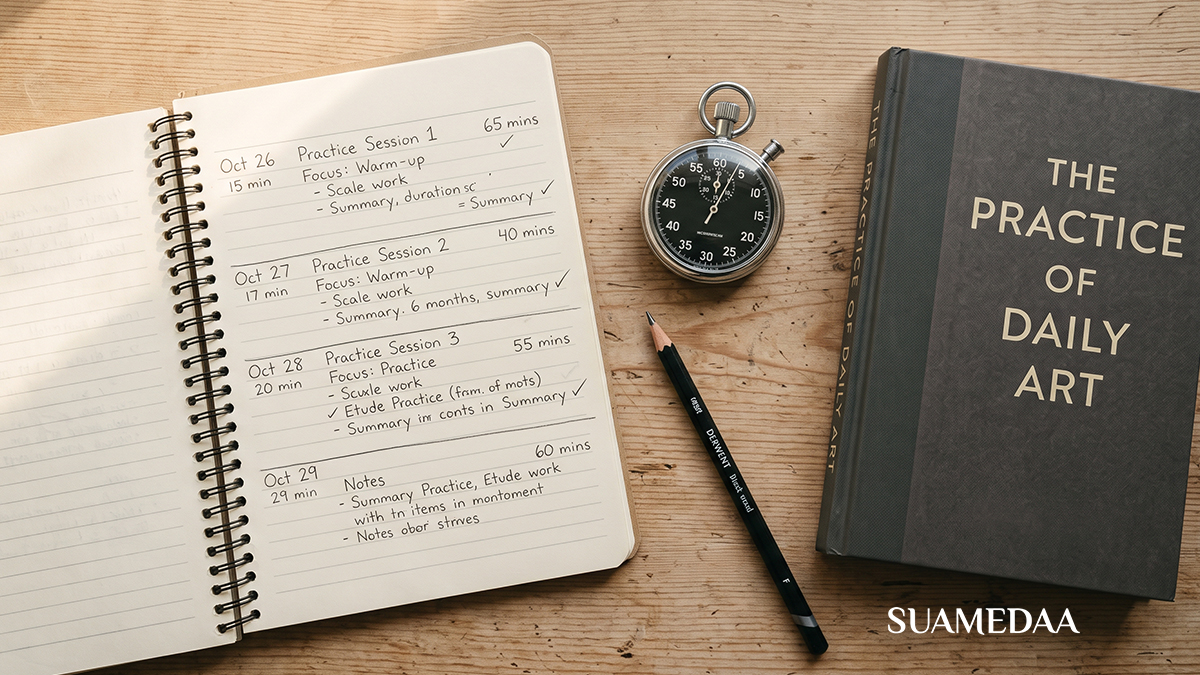
One of the most practically useful habits a learner can adopt is keeping a simple record of practice time and progress. This serves several functions simultaneously.
It creates accountability: when you can see in concrete terms how many hours you have spent and how much remains toward your 20-hour commitment, the goal becomes real and specific in a way that a vague intention to learn something does not. It counteracts the distorted sense of how much practice you have actually done, which most learners significantly overestimate.
It documents progress that might otherwise be invisible. Progress in skill acquisition is often imperceptible in the short term and dramatic in the long term, which means that learners who pay attention only to their day-to-day experience often underestimate how much they have improved. A recording of your guitar playing at hour two compared with hour 18 is almost always more encouraging than how practice at hour 18 feels from the inside.
It provides data for improving your practice approach. If progress seems slow relative to time invested, a practice log allows you to identify patterns: are sessions being cut short by distractions? Is practice time concentrated too heavily on sections already mastered? Is one sub-skill being neglected in favour of others that are already comfortable?
A simple log need not be elaborate. The date, the duration of the session, what was practised, and a brief note on what was difficult and what improved is sufficient. Kept consistently, this record becomes a valuable motivational document as well as a practical learning tool.
What 20 Hours Looks Like in Real Life
The abstract commitment to 20 hours of practice becomes more motivating and more actionable when translated into a concrete daily or weekly schedule that fits an actual life.
For someone with 30 minutes per day of available practice time, 20 hours takes approximately 40 days, roughly six weeks. For someone with 45 minutes per day, it takes about 27 days, less than a month. For someone who can commit an hour a day, 20 hours is completed in three weeks.
The key is consistency rather than volume. A practice habit that holds for six weeks at 30 minutes daily is considerably more valuable than an initial burst of two-hour sessions that burns out after a fortnight, both because the consistency produces better neural encoding and because the skill is developed over a longer period during which it has more time to integrate into daily life.
Scheduling practice at a specific, consistent time each day reduces the cognitive load of deciding when to practise and reduces the number of occasions on which other activities crowd it out. Morning practice, before the demands of the day accumulate, works well for many people because it is the time of day least subject to unpredictable disruption. Evening practice works for others, particularly when the skill is a vehicle for decompression after a demanding day. What matters is consistency rather than the specific time chosen.

Beyond 20 Hours: What Comes Next
Reaching 20 hours of focused practice does not mean stopping. It means arriving at the point from which further development becomes a genuine choice made from a position of competence rather than a pursuit conducted in blind ignorance of whether the skill will ever be worth pursuing.
At 20 hours, you know the skill. You know what it feels like to do it, what its specific challenges are, what aspects of it you find engaging and what aspects you find tedious, how it fits into your life, and whether the trajectory of improvement you have experienced suggests continued development will be rewarding. You can make an informed decision about whether to continue, plateau, or redirect your efforts.
For skills that turn out to be genuinely engaging and valuable, the 20-hour foundation is the beginning of a longer journey. The principles of deliberate practice, targeted improvement, consistent feedback, and operating at the edge of current ability continue to apply regardless of the level of competence being developed. The 10,000-hour figure, while not the universal law that Gladwell’s popularisation implied, does capture something real about the investment required for truly exceptional performance. What it fails to capture is the value of everything below that level, and the accessibility of a level of competence that is genuinely satisfying and useful in far less time.
For many skills, the sustainable plateau that most practitioners reach, the level of ability that provides consistent pleasure and utility without requiring the obsessive dedication of professional-level development, is reached somewhere between 100 and 500 hours of practice. Getting to 20 is the first step onto a path that extends as far as the learner chooses to take it.
The Skills Waiting for 20 Hours of Your Time
Think about the skills you have wanted to develop but have not started because the investment seemed too large. The language you have always wanted to speak. The instrument you have always wanted to play. The programming language that would open new professional possibilities. The drawing ability that has always felt like something other people have. The sport you have watched for years but never tried. The craft that combines manual engagement with creative expression in a way that desk work cannot.
Every one of those skills is 20 hours from being real. Not perfect. Not professional. Not 10,000-hour world-class. Real: functional, satisfying, capable of giving you something that the decision not to start never will.
The learning curve is steep at the beginning. The early hours are uncomfortable. The gap between your current ability and your desired ability is large and obvious in the first sessions in a way that it is not after 15 hours, when that gap has narrowed significantly and the pleasure of the skill has begun to emerge through the improving competence.
The only thing standing between you and that 20-hour competence is the decision to begin, the commitment to stay with it through the frustrating early hours, and 45 minutes a day for a month.
You already have the 20 hours. The question is whether you spend them on a skill you have wanted or on something that will not matter six months from now. Start today. Start badly. The improvement will take care of itself.