Into the Wild – Outdoor Equipment Market Forecast 2026
The pandemic changed where people wanted to be. In the years since, the outdoor equipment market has become one of the most sustained growth stories in global consumer goods, and 2026 finds the industry at a confident point in that trajectory: not a boom defined by pent-up demand, but a structural shift that has embedded outdoor recreation into how a significant portion of the world’s population approaches health, leisure, and identity.
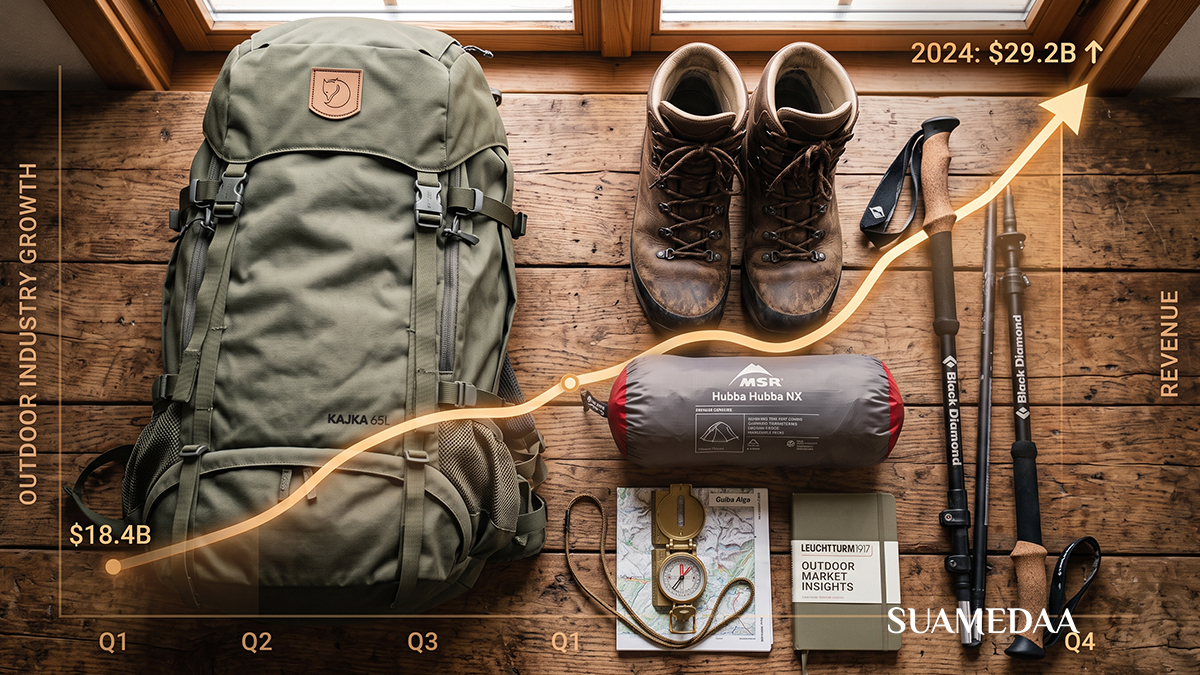
The numbers reflect it at every scale. The Outdoor Industry Association reported that outdoor recreation participation increased for the ninth consecutive year in 2024, growing by 4.1 percent to reach 175.8 million participants in the United States alone, representing 57.3 percent of the population. The global recreational and outdoor products market was estimated at USD 144.5 billion in 2025 and is expected to grow from USD 152 billion in 2026 to USD 253.9 billion by 2035, at a compound annual growth rate of 5.9 percent. The outdoor recreation economy generated USD 887 billion in consumer spending in 2026 in the United States alone, accounting for 2.3 percent of GDP and supporting 5 million jobs across manufacturing, retail, and distribution.
This is no longer a niche industry. It is a pillar of the global consumer economy. And it is changing fast in ways that go beyond participation numbers.

The market in 2026: size, segments, and structure
The global outdoor gear and equipment market stood at USD 63.61 billion in 2026, projected to grow at a CAGR of 5.8 percent through 2035 to reach USD 105.66 billion. When outdoor apparel and footwear are included in the full outdoor products market, the figure rises substantially: the global outdoor product market is set to reach USD 65.28 billion in 2026 on its way to USD 111.7 billion by 2035, while the broader recreational and outdoor products market, which includes all equipment, apparel, accessories, and footwear, sits at USD 152 billion in 2026.
The market is not uniform. Three broad categories dominate the product landscape.
Outdoor clothing accounts for 46 percent of global market consumption. Outdoor shoes account for 32 percent. Outdoor equipment, which encompasses tents, sleeping bags, backpacks, navigation and safety devices, cooking systems, climbing hardware, and water sports gear, accounts for 22 percent. Within the equipment segment specifically, camping equipment is the largest sub-category, with a market value of USD 22.08 billion in 2026 projected to reach USD 29.49 billion by 2031 at a 5.92 percent CAGR.
The distribution picture has shifted fundamentally from five years ago. Online retail channels have grown to represent approximately 42 percent of all outdoor gear purchases, a 15 percent shift from offline channels since 2020. Specialty stores still lead with a 55 percent share of distribution but are losing ground steadily to e-commerce platforms and direct-to-consumer brand channels, which are growing at a 7.12 percent CAGR through 2031.
The competitive landscape is moderately consolidated. The top five players, Patagonia, The North Face, Columbia Sportswear, Yeti, and REI, collectively held 30 percent of global market share in 2025, with Patagonia leading at over 10 percent. This concentration is significantly lower than in many other consumer goods sectors, leaving meaningful space for specialist brands, regional players, and new entrants to compete through differentiation.