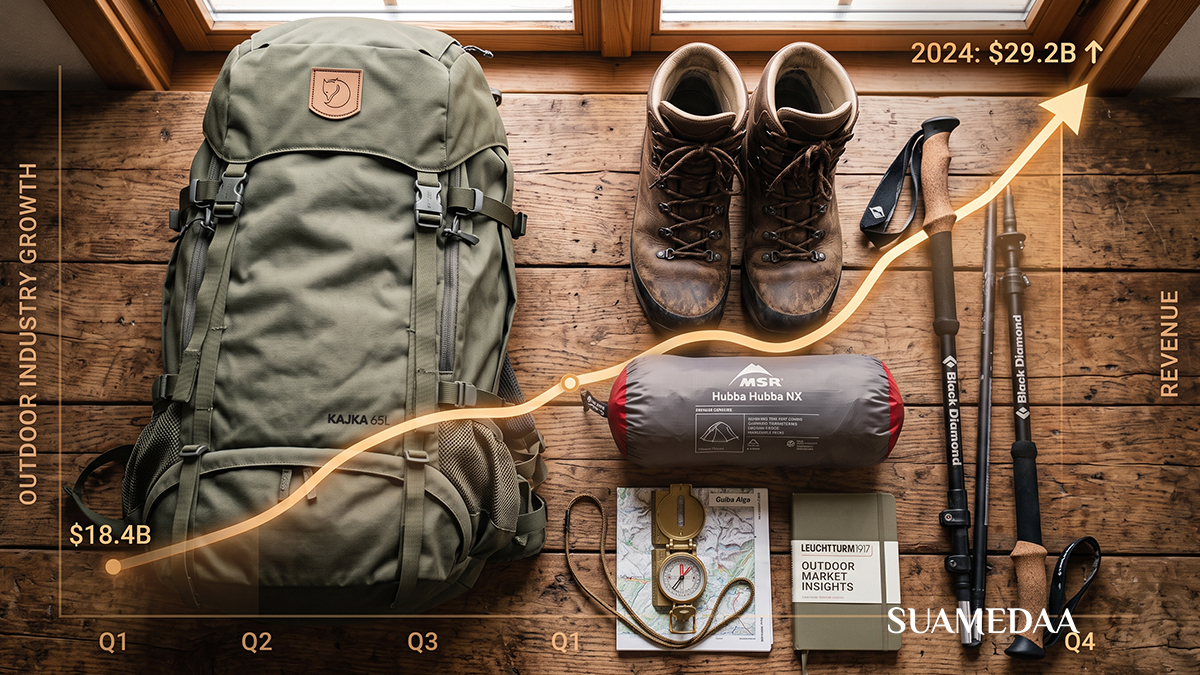
Into the Wild – Outdoor Equipment Market Forecast 2026
The competitive landscape: who is winning and how
The outdoor equipment market’s competitive dynamics reward distinct strategies at different price and performance tiers, and the most interesting brands in 2026 are those that have defined their position precisely enough to defend it.
Patagonia leads the market overall with over 10 percent global share and has built its position around a sustainability proposition that extends from its supply chain to its ownership model. Its Worn Wear programme actively encourages customers to repair rather than replace products, and to buy second-hand rather than new. The commercial logic is counterintuitive but functions at brand level: consumers who believe in what Patagonia stands for are more loyal and less price-sensitive than those who chose based on product features alone. Patagonia’s environmentally friendly design strategies create a strong appeal for environmentally friendly consumers, creating a strong correlation between consumers and finding apparel and equipment that meets their high standard of performance while making a minimal effect on the environment.
Arc’teryx differentiates through its focus on high-performance, technical gear for extreme conditions, and investment firm KKR’s confidence in the brand, reflected in its investment position, signals institutional belief in the market’s growth potential and demand for product innovation. The MO/GO powered hiking pants are the clearest expression of Arc’teryx’s trajectory: a brand that treats the outdoor equipment category as a space for genuine technological advance rather than incremental improvement.

The North Face, owned by VF Corporation, occupies the premium accessible tier, maintaining technical credibility while distributing through channels that maximise reach. Columbia Sportswear competes on accessibility and broad market reach through extensive retail partnerships, occupying the mid-market position where volume is highest.
REI’s cooperative model gives it a unique structural advantage: as a consumer co-op, it does not have shareholders demanding short-term profit maximisation, which allows it to invest in inclusivity initiatives, sustainability programmes, and customer experience improvements that publicly traded competitors find harder to justify. In March 2024, REI introduced its Active Pursuits collection as the co-op’s first nongendered apparel line for adults, launching a new body-measurement-based sizing system designed to fit a wider range of consumers, expanding sleeping bag sizing to nine variations from short narrow to long wide.
In the Scandinavian market and among premium European consumers, brands including Haglöfs, Mammut, Fjällräven, and Norrøna integrate technical advancements with environmental practices to meet consumer demand that consistently shows a higher willingness to pay more for environmentally responsible products than equivalent consumer segments elsewhere.
Segments to watch: where growth is fastest
Hiking gear and equipment is the largest and fastest-growing activity-specific segment. The hiking gear and equipment market size is projected at USD 91.45 billion in 2026, set to rise to USD 124.18 billion by 2031, growing at a CAGR of 6.31 percent. Record outdoor participation, swift adoption of digital retail, and ongoing material innovations are the primary drivers.
Adventure tourism and sports represents an enormous adjacent market. The adventure sports and activities market was valued at USD 582.07 billion in 2026 and is projected to reach USD 909.81 billion by 2033, exhibiting a CAGR of 5.9 percent. Demand for specialized outdoor equipment from this segment is sustained and growing as adventure travel operators report improved profitability and median trip costs of USD 2,813 for eight-night excursions.



Water sports equipment, including gear for kayaking, paddleboarding, surfing, and diving, benefits from growing interest in water-based activities and increasing awareness of their health benefits. The segment represented 18 percent of total unit demand in 2025.
Outdoor power equipment, a parallel market covering garden and landscaping machinery rather than recreation equipment, sits at USD 39.33 billion in 2026 and is growing at a CAGR of 5.58 percent through 2034, with electrification the dominant technical trend as battery-powered tools replace petrol alternatives across residential and commercial use.
The restraints and risks
No market analysis is complete without an honest account of what could slow growth or disrupt the trajectory.
The high cost of premium equipment remains the most significant barrier to broader participation. Nearly 36 percent of outdoor gear products face high production costs, limiting affordability in low-income economies and pricing out potential consumers in developed markets. The move to sustainable materials has in many cases increased manufacturing cost, creating a tension between environmental responsibility and accessibility that the industry has not fully resolved.
Counterfeit products affect brand reputation and compromise consumer safety, posing a significant hurdle for established market players. As e-commerce has grown, so has the volume of counterfeit outdoor gear circulating on marketplace platforms, particularly in price-sensitive markets.


The seasonal nature of many outdoor activities creates demand volatility that manufacturing and retail supply chains must absorb. Climate change introduces additional unpredictability: warmer winters reduce demand for cold-weather gear in regions that previously had reliable seasonal demand, while more extreme weather events create both opportunity and uncertainty for equipment designed around specific environmental conditions.
Market saturation in certain product categories, particularly mainstream hiking footwear and entry-level camping equipment, is increasing competitive pressure on margins and forcing brands toward either premium differentiation or cost leadership with little middle ground.