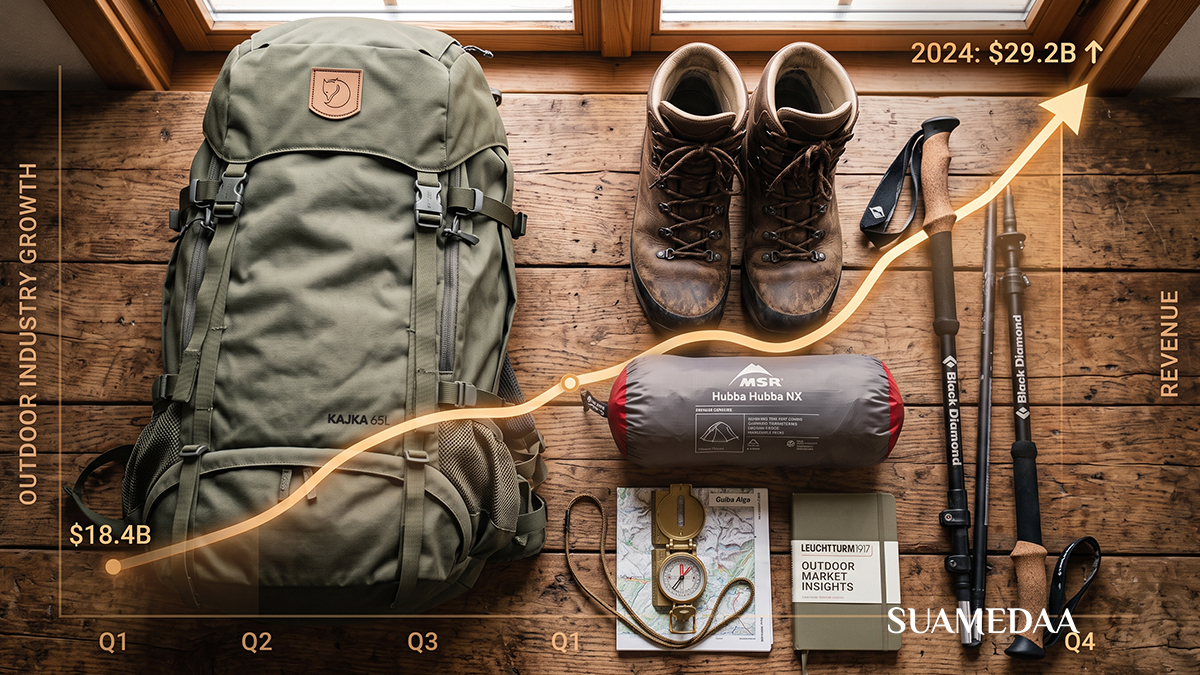
Into the Wild – Outdoor Equipment Market Forecast 2026
The five forces shaping the market
1. Participation growth across demographics
The growth in outdoor participation is not concentrated in any single age group. The Outdoor Industry Association’s 2025 Outdoor Participation Trends Report documented senior participation increasing by 7.4 percent and youth participation growing by 5.6 percent, creating a diverse, multigenerational outdoor community. Gen Z and Millennials are shaping demand through what analysts describe as “micro-adventures,” short-duration outdoor experiences that blend fitness, digital detox, and social content creation, prompting brands to foreground sleep quality, recovery, and mindfulness in their product messaging and design priorities.
The camping equipment market’s personal use segment, which accounts for 76.05 percent of demand, is projected to grow at a 7.74 percent CAGR through 2031. This growth reflects structural shifts in leisure behaviour: remote work enables extended trips, wellness trends position camping as a preventive healthcare measure, and the “glamping” phenomenon has expanded the definition of camping to include luxury outdoor experiences that require their own specialized product category.
2. Sustainability as competitive differentiator
Sustainability has moved from a brand value to a regulatory requirement and a purchasing criterion simultaneously, creating a situation where manufacturers who have invested in eco-friendly materials and processes have a genuine competitive advantage.


Sustainable and recycled materials now represent 58 percent of new product launches, with 62 percent of brands adopting eco-friendly manufacturing practices. Approximately 54 percent of consumers preferred eco-friendly products in 2025, driving sustainable product launches by 29 percent across manufacturers globally.
The regulatory pressure is specific and consequential. PFAS, the group of per- and polyfluoroalkyl substances used for decades in waterproof coatings for outdoor apparel and equipment, are banned in textiles effective January 1, 2025 in California and New York, with European regulations applying similar restrictions. Every manufacturer selling into these markets must reformulate their waterproofing chemistry. NEMO Equipment launched a PFAS-free waterproof coating for tents and sleeping bags in March 2024, maintaining hydrostatic head ratings above 3,000mm while eliminating the chemicals. This is the kind of materials science investment that the market now demands as standard rather than premium.
The European Union’s Ecodesign for Sustainable Products Regulation (ESPR) is restructuring material selection and product longevity expectations across the outdoor apparel industry. The EU’s Corporate Sustainability Reporting Directive (CSRD) is accelerating the shift toward recycled materials and transparent sourcing. Together, these frameworks are making Europe the world’s most demanding regulatory market for outdoor equipment sustainability, and brands that meet European standards have the credibility to lead globally.
The second-hand outdoor gear market is expanding rapidly, growing by 20 percent in 2023. Platforms facilitating peer-to-peer sales have contributed to this growth, driven by environmentally conscious consumers seeking sustainable and affordable options. Brands including Patagonia, with its Worn Wear programme, have leaned into circular economy models as both a sustainability strategy and a brand loyalty mechanism.
3. Smart technology integration
Technology integration is the growth frontier that separates the outdoor equipment market of 2026 from its predecessor of five years ago. Smart wearable and high-performance gear expanded by 55 percent in 2024, with 57 percent of brands introducing tech-enabled outdoor solutions.



The most dramatic example of what this looks like in product terms came in August 2024 when Arc’teryx launched the world’s first powered hiking pants, the MO/GO, in collaboration with Skip. Featuring exoskeleton technology, the garment provides 40 percent more power for climbing while reducing the energy expenditure of the wearer. The product is extreme and expensive, but it signals where materials science and wearable technology are heading at the premium end of the market.
Navigation and safety devices are projected to grow at a 7.02 percent CAGR through 2031 as hikers and outdoor enthusiasts adopt tech-enabled risk-mitigation tools. GPS-enabled watches, personal locator beacons, solar-powered portable chargers, and smart fabrics capable of health monitoring are all moving from specialist to mainstream. Garmin released the Varia RearVue 820 high-intensity radar taillight for cyclists in February 2026, illustrating how the navigation and safety technology segment is expanding its product vocabulary.
The integration of mobile app connectivity has become an expected feature rather than a differentiator in the mid-range and premium equipment segments. Tents, sleeping systems, lighting solutions, and cooking equipment are increasingly designed with smartphone integration as a baseline assumption.
4. The Asia-Pacific surge
The regional geography of the outdoor equipment market is shifting in ways that have significant implications for the global competitive landscape. The Asia-Pacific region commands 43 percent of global market share, primarily led by China, Japan, and India, and is projected to grow at a CAGR of 6.88 percent through 2031, outpacing every other region.
China’s outdoor sports development plan, eyeing a market value of 3 trillion yuan by 2025, showcases government-backed efforts pushing market growth beyond the confines of traditional Western markets. Approximately 37 percent of investments in outdoor equipment globally are concentrated in Asia-Pacific due to rising participation rates and expanding middle-class consumer spending. The region’s rapidly growing middle class, combined with government initiatives to promote tourism and outdoor sports, has created a consumer base whose preferences are reshaping global product design priorities.


The strategic significance of this shift is visible in the acquisition activity. In April 2025, Anta Sports, a Chinese sports conglomerate, finalized its USD 290 million acquisition of German outdoor brand Jack Wolfskin from Topgolf Callaway Brands, gaining access to Jack Wolfskin’s materials technologies and European market expertise. The deal represents a structural model: Asian capital acquiring European technical heritage to serve Asian consumers while maintaining European brand credibility.
Decathlon opened its 1,750th global store in August 2024, expanding into Southeast Asian markets including Vietnam and Thailand, where rising middle-class incomes are driving participation in outdoor recreation. The French retailer’s vertically integrated model, developing and manufacturing much of its product internally, gives it a price advantage in markets where cost sensitivity limits the premium segment.
5. The rental and subscription economy
One of the most structurally interesting developments in the outdoor equipment market is the growth of rental and subscription models, with 40 percent of urban consumers opting for temporary equipment access instead of ownership. Around 36 percent of brands are offering modular gear systems, allowing customization based on activity type.
The drivers are multiple. Urban consumers face storage constraints. The cost of quality gear for infrequent users is prohibitive. Environmental consciousness creates preference for shared use over individual ownership. And the variety of outdoor activities that consumers engage in has broadened to a point where owning specialized equipment for each would require significant capital outlay.
REI partnered with outdoor adventure platform Outdoorsy in July 2024, providing customers access to outdoor vehicle rentals and enhancing the outdoor experience with shared adventure opportunities. The commercial segment of the camping equipment market, including rental operators, tour companies, and campground concessions, is expanding by addressing barriers to ownership such as urban storage constraints, maintenance requirements, and capital outlays that can exceed USD 2,000 for a family of four.