
What Are You Really Worth? A Practical Guide to Calculating Net Worth
Most people have a vague sense of how much money they make. Far fewer have a clear sense of how much they are actually worth. These are not the same thing, and the difference between them is one of the most important distinctions in personal finance.
Income is a flow: the money that arrives in your account each month and departs again as expenses, taxes, and debt payments. Net worth is a stock: the accumulated result of every financial decision you have ever made, the sum total of what you own minus what you owe, at a single point in time. Income can be high and net worth can be low, or even negative, if spending keeps pace with earning and debt accumulates. Income can be modest and net worth can grow steadily if the gap between earning and spending is invested consistently over years.
Knowing your net worth does not require a financial adviser, a complex spreadsheet, or a degree in accounting. It requires honesty, a few hours, and a willingness to look at the complete picture rather than the comfortable parts of it. This guide walks through the process from the beginning.



What Net Worth Actually Is
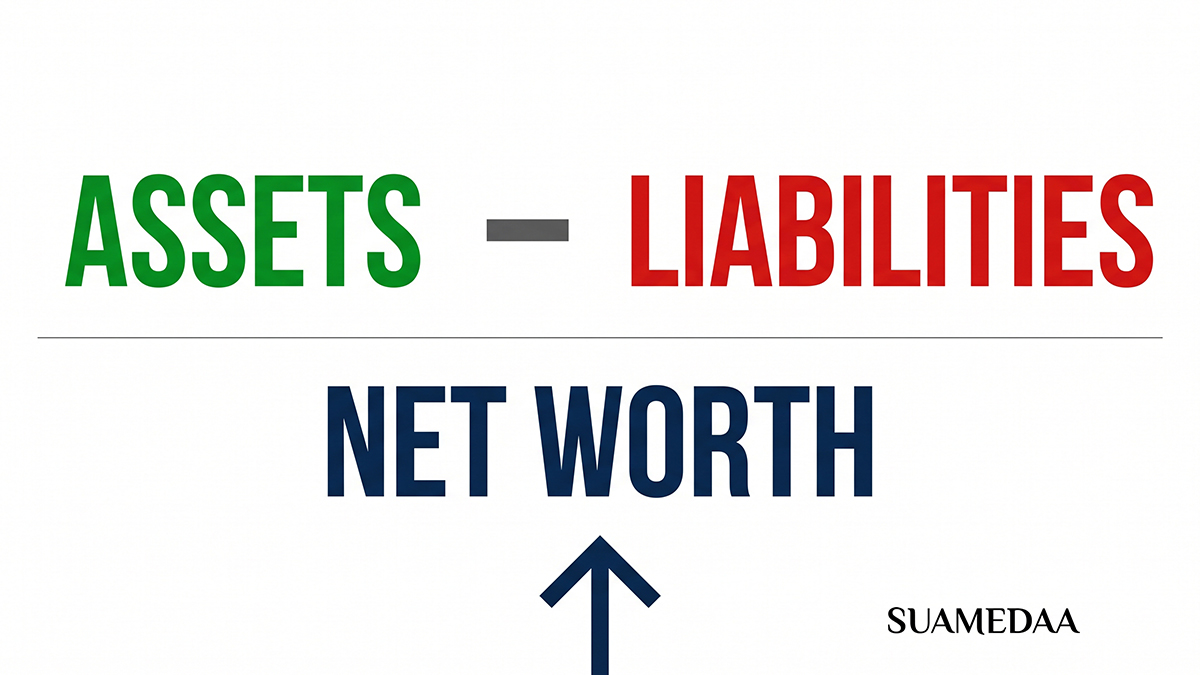
The formula is simple enough to fit on a single line:
Net Worth = Total Assets minus Total Liabilities
Assets are everything you own that has monetary value. Liabilities are everything you owe to someone else. Subtract the second from the first and the result is your net worth: the figure that would remain if you sold everything you own and paid off every debt you carry.
A positive net worth means your assets exceed your debts. This is the goal, and for most adults with some years of working life behind them, it should be achievable. A negative net worth means you owe more than you own, which is common at the beginning of adult financial life when student loans, car payments, and starting costs outweigh accumulated assets. Zero net worth, where assets and liabilities are exactly equal, is itself a milestone worth recognising: it means the debt has been matched by assets and the ground floor has been reached.
The number that results from this calculation is not a moral judgement. It is a measurement. It can go up, and it can go down, and the point of knowing it is to understand where you are starting from.



Step One: Inventory Your Assets
Assembling a complete picture of your assets requires going through every category where value might exist. The list is longer than most people initially assume.
Cash and Cash Equivalents
Start with the most liquid assets, the ones already in the form of money or immediately convertible to it. This includes:
Every bank account you hold: current accounts, savings accounts, fixed deposits, money market accounts. The balance shown on your most recent statement is the figure to use. If you are doing this calculation mid-month and your account balance reflects a temporary low before a salary arrives, you may want to use the average balance rather than the current low.
Physical cash, if you hold meaningful amounts of it at home or in a safe. Most people should not carry large cash balances outside the banking system, but if you do, it counts.
Foreign currency holdings and their current exchange value.



Investment Accounts
This is where the calculation becomes more consequential for people who have spent years building financial assets.
Stock portfolios, whether held through a broker, an investment app, or a direct share purchase plan. Use the current market value, not the price you paid. Markets move, and your net worth reflects what you could realise by selling today, not what you paid to acquire.
Bonds, bond funds, and fixed income investments of any type.
Unit trusts, mutual funds, index funds, and exchange-traded funds (ETFs).
Pension funds and retirement savings accounts: this is the category that surprises many people most. A pension that has been accumulating for fifteen years can represent the largest single asset a person holds, and it belongs in the asset calculation even though it cannot be accessed until retirement age. Some people prefer to run two versions of the net worth calculation, one including pension assets and one excluding them, to show both the total picture and the liquid picture.
Vested employer share options and restricted stock units, at their current market value. Unvested options do not count; they are promises rather than assets.
Property and Real Estate
Real estate is where several important distinctions become necessary.
If you own a home with a mortgage, the relevant figure for your net worth calculation is not the market value of the property. It is the equity: the market value minus the outstanding mortgage balance. If your home is worth GHS 800,000 and you still owe GHS 350,000 on the mortgage, your home equity is GHS 450,000, and that is what goes into the asset column. The mortgage goes into the liability column as a separate entry.
For rental properties or investment real estate, the same principle applies: current market value of the property as an asset, outstanding mortgage as a liability.
The market value of real estate is an estimate rather than a precise figure until you actually sell. Use the most honest estimate you can: recent sale prices of comparable properties in your area, a professional valuation if you have had one done recently, or a conservative estimate based on what you have seen similar properties sell for.
Vehicles
Motor vehicles depreciate, but they retain value, and that value belongs in your asset calculation. The relevant figure is the current resale value of the vehicle in its present condition, which is typically lower than the price you paid for it and lower than what it would cost to buy a similar vehicle new.
For a car you purchased new, the realistic resale value in the private market is the number to use. Various online tools provide estimates for vehicle values based on make, model, year, and mileage. Be honest rather than optimistic: the resale value is what a buyer would actually pay, not what you wish they would.
Business Interests
If you own a business, part or whole, its current market value is an asset. This is also where the calculation becomes genuinely complex, because private businesses are not traded on an open market and their value is not quoted in a daily price.
Common approaches to valuing a small business include a multiple of annual revenue, a multiple of annual profit (earnings before interest, taxes, depreciation, and amortisation), or a discounted cash flow analysis that attempts to estimate what future earnings are worth in today’s money. None of these is precise, and for a business that depends heavily on the personal involvement of the owner, the market value on a sale would likely reflect a discount for that dependency.
For the purpose of a personal net worth calculation, a conservative estimate of what a willing buyer would pay for the business today, not an optimistic projection of what it might be worth in five years, is the appropriate figure. If you genuinely do not know how to estimate this, a conservative approach is to use the book value of the business’s assets minus its liabilities.
Personal Property of Significant Value
Jewellery, art, collectibles, and valuable personal items belong in the asset calculation if their value is meaningful. Their value is what they would realise in a sale to an unrelated buyer, which is typically less than what you paid for them and less than what you are sentimentally attached to them for.
If you have items of genuinely significant value, a professional appraisal is the reliable way to establish an accurate figure. For everyday personal property such as furniture, clothing, and household electronics, the realistic resale value is typically quite low, and many people simply exclude everyday personal property from their calculation rather than attempting to estimate it. This is a reasonable choice.

Step Two: List Your Liabilities
Liabilities are debts: amounts you are obligated to repay to someone else. Every debt you carry reduces your net worth by exactly the outstanding balance of that debt.
Mortgage Debt
If you own property with a mortgage, the current outstanding balance is a liability. This is the amount you would need to pay to the lender to clear the debt, which you can find on your most recent mortgage statement. This figure decreases over time as you make payments, and for a standard repayment mortgage, the rate of decrease accelerates as the balance falls and more of each payment goes toward principal rather than interest.
If you have a home equity loan or a home equity line of credit that you have drawn down, the outstanding balance on that also counts as a liability.
Instalment Loans
Car loans: the outstanding balance as shown on your loan statement. Auto loans are amortising debts, meaning each payment reduces the balance, and the balance you owe is in the liability column while the current value of the car is in the asset column.
Student loans: the current outstanding balance of every student loan you carry. Student loan balances can be surprisingly large even after years of payments, particularly if only minimum payments have been made and interest has accrued. Pull the actual figure from your loan servicer’s portal rather than estimating.
Personal loans: any amount borrowed from a bank, credit union, or other lender for personal use.
Credit Card Balances
The outstanding balance on every credit card you carry counts as a liability, even if the statement has not yet closed and even if you intend to pay it in full before the due date. If you routinely pay your full balance each month, your credit card liabilities are typically low or zero. If you carry balances from month to month, the full outstanding balance is a liability.
Other Debts
Any other financial obligation you carry: loans from family members (if you intend to repay them), outstanding tax bills, medical debt, overdrafts, or margin loans from investment accounts. The principle is that if you owe money to any party under an obligation to repay, it is a liability.
Step Three: Do the Maths
Once your assets and liabilities are assembled, the calculation is straightforward. Add up the total value of all assets to get your total assets figure. Add up the total of all outstanding balances across all liabilities to get your total liabilities figure. Subtract total liabilities from total assets.
The result is your current net worth.
A simple table makes this concrete:
Assets
| Category | Value |
|---|---|
| Savings and current accounts | GHS 45,000 |
| Investment portfolio | GHS 120,000 |
| Pension fund | GHS 280,000 |
| Home equity (value minus mortgage balance) | GHS 310,000 |
| Vehicle (resale value) | GHS 55,000 |
| Total Assets | GHS 810,000 |
Liabilities
| Category | Balance |
|---|---|
| Mortgage (outstanding balance) | GHS 390,000 |
| Car loan | GHS 28,000 |
| Student loan | GHS 15,000 |
| Credit card balance | GHS 4,200 |
| Total Liabilities | GHS 437,200 |
Net Worth: GHS 810,000 minus GHS 437,200 = GHS 372,800
Common Mistakes That Distort the Calculation
Including the Full Property Value Instead of Equity
The most frequent error in personal net worth calculations is recording the full market value of a mortgaged property as an asset while recording the mortgage separately, without netting them. If your home is worth GHS 800,000 and the mortgage balance is GHS 350,000, the correct approach is to either record home equity of GHS 450,000 as a single asset entry, or record GHS 800,000 as an asset and GHS 350,000 as a separate liability, which produces the same net result. The error is to record GHS 800,000 as an asset and forget to include the mortgage in the liabilities column at all.
Using Purchase Price Instead of Current Market Value
Assets should be valued at what they are worth today, not what you paid for them. A car purchased for GHS 120,000 three years ago is not worth GHS 120,000 today. An investment purchased for GHS 50,000 that has since risen in value is worth its current market price, not the original cost. Use current values throughout.
Forgetting Liabilities That Feel Remote
Some debts are easier to ignore because they are not in the front of the mind. A student loan you have not thought about in years is still a liability. Money borrowed informally from a family member that you fully intend to repay is still a liability. Tax obligations that have accrued are liabilities. Credit card balances that will be paid next week are still liabilities today.
Counting Income as an Asset
Your salary, expected bonus, or business income for the coming year is not an asset for the purpose of net worth. Net worth is a snapshot of what you have right now, not what you expect to earn in the future. Future income is relevant to cash flow planning, budget building, and long-term projections, but it does not belong in a current net worth calculation.
Being Unrealistic About Property Value
There is a universal human tendency to believe that one’s own home is worth more than it would actually achieve in the market. The relevant figure for a net worth calculation is what a willing, informed buyer would pay for the property in its current condition today. If you are estimating this based on what you hope it is worth, or on what a neighbour’s different property sold for two years ago, the figure is likely inflated.
How to Track Net Worth Over Time
A single net worth calculation is a snapshot. The real value of the exercise comes from repeating it regularly and tracking the direction of travel.
Most financial advisers and personal finance practitioners recommend calculating net worth annually, at minimum. Quarterly tracking is more granular and more motivating for people who are actively working to reduce debt or build assets. Monthly tracking can be useful during periods of rapid financial change, such as aggressive debt repayment or a period of strong investment returns.
The important things to track across calculations are:
The total number, and whether it is moving in the right direction.
The composition: is net worth growing because assets are increasing, because liabilities are decreasing, or both? The healthiest trajectory involves both, but the specific situation of each person determines which lever is more available at any given time.
The rate of change: a person in their thirties building net worth at a consistent pace, even if the absolute number is modest, is in a stronger position than one whose net worth grows erratically or stagnates.
A simple spreadsheet with a row for each calculation date, columns for total assets and total liabilities, and a calculated column for net worth, is sufficient. No proprietary software is required, though various personal finance applications can automate the tracking by linking to bank and investment accounts and updating figures in real time.
The Benchmarks: What is Normal?
Benchmarks for net worth by age provide context for your own calculation, with the important caveat that they should inform rather than dictate your self-assessment.
The most reliable data in this area comes from the US Federal Reserve’s Survey of Consumer Finances, conducted every three years. The most recent available survey from 2022 provides these median figures (median is the midpoint of the distribution, less distorted by extreme wealth than the average):
Median net worth by age (United States, 2022):
- Under 35: approximately USD 39,000
- 35 to 44: approximately USD 135,300
- 45 to 54: approximately USD 246,700
- 55 to 64: approximately USD 364,270
- 65 to 74: approximately USD 410,000
- 75 and older: approximately USD 334,700 (reflecting retirement drawdown)
NB: The actual currency is GHS so measure at a placeholder USD value of 1 = 11.30
The average figures are substantially higher across all age groups because a small number of extremely high-net-worth households pull the average upward. The median is the more meaningful benchmark for most people.
Context matters alongside these numbers. Someone in their mid-thirties with a net worth below the median in their age group should not interpret this as failure. Career stage, country of residence, family circumstances, whether significant student debt was taken on to fund education, and countless other factors shape where someone is at a given point. What the benchmarks offer is orientation: a sense of the landscape rather than a verdict.
A simpler heuristic from personal finance research: aim for a net worth of one times your annual income by age 35, three times by age 45, five to six times by 55, and eight to ten times by retirement age. These are aspirational targets for comfortable financial independence, not universal prescriptions.
A Note on the Home
Whether to include the primary residence in a net worth calculation is a genuine philosophical debate in personal finance, and there is a legitimate argument on both sides.
The case for including it: the home is an asset with real market value that could be realised, and excluding it produces a net worth figure that understates actual accumulated wealth.
The case for excluding it, or at least running a separate calculation without it: you have to live somewhere, and if you sell your home, you typically need to buy or rent another one. The equity in your primary home is only freely realisable if you plan to downsize significantly, move to a much lower-cost area, or transition to renting.
The practical resolution for most people is to include home equity in the full net worth calculation, because it is real wealth, but to also calculate and track liquid net worth separately, meaning net worth excluding the primary residence and pension assets that cannot be easily accessed. Liquid net worth is the figure most relevant to short-term financial resilience and flexibility.
How to Move the Number in the Right Direction
Understanding net worth is the beginning. Moving it upward, consistently and intentionally, is the practice that matters.
There are exactly two ways to increase net worth: increase assets or decrease liabilities. Everything in personal financial management is a variation on one of these two levers.
Reducing Liabilities
High-interest debt, particularly credit card balances, is both a liability and a continuous drag on net worth because the interest compounds and the balance grows unless payments exceed interest. Eliminating high-interest debt is the highest guaranteed return available in personal finance: paying off a debt carrying 25 percent interest is the financial equivalent of earning 25 percent on an investment, risk-free.
The order of debt repayment depends on the balances, interest rates, and psychological factors. The mathematically optimal approach is to pay minimums on all debts and direct all additional payment toward the highest-interest debt first, then move to the next highest when the first is cleared. An alternative that some people find more motivating is to target the smallest balance first, regardless of interest rate, to generate the momentum of a paid-off debt. Either approach beats minimum payments on all debts simultaneously.
Mortgage debt is a lower priority for accelerated repayment than high-interest consumer debt. In most environments, mortgage interest rates are low enough relative to likely investment returns that the mathematics of investing additional money rather than paying down the mortgage can be favourable. This is a calculation worth running with your specific mortgage rate and your investment return assumptions.
Growing Assets
Regular, consistent investment is the mechanism through which most people build meaningful net worth over time. The specifics of what to invest in and through which accounts are extensive territory, but the foundational principle is accessible: time in the market, with a diversified portfolio, using whatever tax-advantaged accounts are available, compounds small contributions into substantial sums over decades.
Increasing income creates more capacity to save and invest. Reducing unnecessary expenses creates the same capacity without needing income to rise first. The size of the gap between what you earn and what you spend determines the rate at which your net worth can grow.
Physical assets that appreciate, like well-chosen real estate in growing areas, can increase the asset side of the equation over time, though real estate involves ongoing costs and illiquidity that make it a more complex asset class than financial investments.
Building skills and qualifications that increase your human capital and therefore your earning potential is an investment in future cash flows, which will eventually translate into higher asset accumulation. This is not captured in the current net worth calculation, but it is among the highest-return investments available to someone early in their working life.
The Right Relationship with Your Number
The net worth calculation can produce uncomfortable results the first time it is done. A negative number, or a number far below where you hoped or assumed you would be, is genuinely confronting. The discomfort is the point.
The value of the calculation is precisely that it is honest in a way that day-to-day financial life does not require you to be. It is possible to earn a respectable income, maintain a decent standard of living, and carry a financial position that is significantly weaker than it appears, because the appearance of financial wellbeing does not require good underlying foundations. The net worth calculation asks for the foundations.
Whatever the number reveals, it is the starting point for the trajectory that follows. A small positive net worth that grows consistently over years becomes a large one. A negative net worth that is understood clearly and addressed methodically can become positive. Neither outcome is available to someone who does not know where they are starting from. The question this guide poses is not a comfortable one, but it is the right one to ask.