Akan for Absolute Beginners – Where to Start and What to Expect
Spend a single day in Ghana and you will hear it: in the tro-tro, at the chop bar, in the market, on the radio, in the latest highlife and hiplife songs. Akan, often simply called “Twi,” is the language most Ghanaians share, whatever their home language. Learning even a little of it changes how Ghana feels to you.
This guide explains what Akan is, what will come easily, what will challenge you, and how to take your first real steps.
Twi, Fante, Akan: Clearing Up the Names
Beginners are often confused by the names, so let’s start there. The language is Akan, and Twi is one of its dialects. Broadly, the dialects fall into two groups: Fante and Twi. Twi includes Asante, Akuapem, Akyem, Kwahu, Wassa and Brong, while Fante covers coastal varieties such as Gomoa, Ekumfi and Agona.


The good news is that these dialects are mutually intelligible, so what you learn in one will largely carry you through the others. There are three standard written forms, for Asante, Akuapem and Fante, plus a unified Akan orthography created in the 1980s.
Which should you learn? For most beginners, Asante Twi is the best starting point. It is the most widely spoken variety and the one you’ll hear most across Ghana. If you’ll be living on the coast, around Cape Coast or Takoradi, Fante is worth adding later.
Why Akan?
Akan is Ghana’s most widely spoken language. The 2010 census put native Akan speakers at 47.5 percent of the population, and many more Ghanaians use it as a second language. In practice, knowing Akan alone lets you navigate most of Ghana, because in almost every part of the country you’ll find someone who at least understands it.
It’s also a language with a long written history. Missionaries began writing Akan down in the 17th and 18th centuries, and Akuapem Twi was the first Ghanaian language to achieve literary status through its Bible translation. Today Akan is taught in both primary and secondary schools in Ghana.
And beyond the numbers, Akan opens the door to a remarkable culture: Anansesem (the Ananse spider stories), Adinkra symbols, kente, a rich treasury of proverbs, and the music that soundtracks daily life in Ghana.



What to Expect: The Good News
A familiar alphabet. Akan uses the Latin alphabet with just two extra vowels, ɛ and ɔ. That’s it.
Straightforward word order. Akan follows subject, verb, object, like English. Me pɛ nsuo means “I want water,” word for word.
No gendered pronouns. One pronoun, ɔ (or ɔno), means both “he” and “she.”
Verbs that don’t change for each person. Tense and aspect are shown with small prefixes, which stay the same pattern whoever is speaking.
Instant rewards. Ghanaians love it when visitors try Akan. A simple greeting often gets a delighted laugh, a compliment and sometimes a better price.

What to Expect: The Challenges
Tone. Akan is a tonal language, and pitch can change meaning. Descriptions differ on the details, with some linguists describing high, mid and low tones. Standard spelling usually doesn’t mark tone, so you’ll learn it by listening. Audio is essential.
Vowel harmony. Akan has quite complex rules governing which vowels can appear together in a word. You don’t need to study the rules at the start. Just notice that certain vowels “belong” together, and your ear will gradually adjust.
New sounds and spellings. A few letter combinations work differently from English:
| Spelling | Sounds like | Example |
|---|---|---|
| ɛ | “e” in bed | ɛyɛ (it’s good) |
| ɔ | “aw” in law | ɔdɔ (love) |
| ky | “ch” in church | kyɛw (please, in mepa wo kyɛw) |
| gy | “j” in jam | gyae (stop) |
| hy | “sh” in shoe | hyia (meet) |
| tw | “chw” | Twi |
| dw | “jw” | adwuma (work) |
Letters you won’t see. J and V appear only in loanwords, and you’ll rarely meet C, Q, X or Z in Akan words.
Dialect differences. Greetings and some words differ between Twi and Fante. Pick one to start with (usually Asante Twi) and don’t worry about the variations until later.
Your First 20 Words and Phrases (Asante Twi)
Greetings
Akan greetings change with the time of day and come with special replies depending on who you’re talking to.
| Akan | English | Notes |
|---|---|---|
| Maakye | Good morning | Short for Me ma wo akye |
| Maaha | Good afternoon | |
| Maadwo | Good evening | |
| Yaa agya | Reply to a man older than you | agya = father |
| Yaa ɛna | Reply to a woman older than you | ɛna = mother |
| Yaa nua | Reply to someone your age | nua = sibling |
| Wo ho te sɛn? | How are you? | |
| Me ho yɛ | I’m fine | |
| Ɛte sɛn? | How is it? / What’s up? | Casual |
| Akwaaba | Welcome | You’ll see it at the airport |
Everyday essentials
| Akan | English |
|---|---|
| Medaase | Thank you |
| Medaase paa | Thank you very much |
| Mepa wo kyɛw | Please |
| Aane / Daabi | Yes / No |
| Kafra | Sorry / Excuse me |
| Me din de … | My name is … |
| Wo din de sɛn? | What is your name? |
| Mente aseɛ | I don’t understand |
| Ɛyɛ sɛn? | How much is it? |
| Nante yie | Goodbye (walk well) |
Numbers 1 to 10
baako, mmienu, mmiɛnsa, ɛnan, enum, nsia, nson, nwɔtwe, nkron, edu
A Peek at How Sentences Work
Akan shows time and aspect with small prefixes and changes to the verb. Here’s kɔ (to go):
| Akan | English | What’s happening |
|---|---|---|
| Mekɔ sukuu | I go to school | Habitual (regularly) |
| Merekɔ fie | I am going home | re = ongoing |
| Mekɔɔ fie | I went home | Lengthened vowel = past |
| Mɛkɔ fie | I will go home | ɛ = future |
| Menkɔ | I’m not going / I don’t go | n = negative |
Swap me (I) for wo (you), ɔ (he/she), yɛ (we), mo (you all) or wɔ (they), and the pattern stays the same. Learn ten useful verbs, like kɔ (go), ba (come), di (eat), nom (drink), pɛ (want) and tɔ (buy), and you can already build dozens of sentences.
Your Day Name: The Perfect Icebreaker
One of the most charming parts of Akan culture is the tradition of day names. Every Akan child gets a name based on the day of the week they were born. Tell a Ghanaian your day name and you’ll instantly make a friend.
| Day | Boy | Girl |
|---|---|---|
| Sunday (Kwasiada) | Kwasi | Akosua |
| Monday (Dwowda) | Kwadwo | Adwoa |
| Tuesday (Benada) | Kwabena | Abena |
| Wednesday (Wukuada) | Kwaku | Akua |
| Thursday (Yawda) | Yaw | Yaa |
| Friday (Fiada) | Kofi | Afua |
| Saturday (Memeneda) | Kwame | Ama |
Fante versions differ slightly: a Friday boy might be Kofi or Fiifi, and a Wednesday boy Kweku. Find out which day you were born, and introduce yourself with it: Me din de Kofi.
Culture Tips That Matter
- Greet before business. Launching straight into a question without a greeting can seem rude. A quick Maakye first makes all the difference.
- Use your right hand. Give, receive, wave, point and eat with your right hand. Using the left is considered disrespectful.
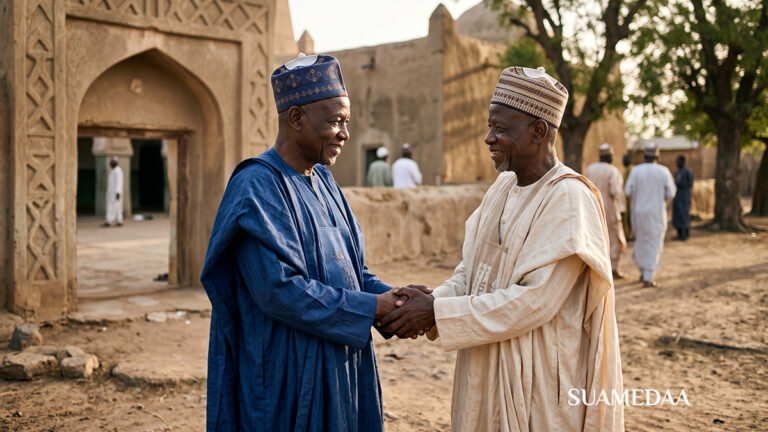
- Shake hands from right to left. When greeting a group, the custom is to start with the person on your right and move left.
- Respect elders. Reply to greetings with Yaa agya or Yaa ɛna, and address older people warmly as Agya (father), Maame (mother), Nana (grandparent) or Ɔpanin (elder).
- Enjoy the proverbs. Akan speech is full of mmɛbusɛm (proverbs). You’ll hear them in conversation, songs and even car stickers. Learning one or two will delight people.
Where to Start: A Four-Stage Roadmap
Stage 1: Tune your ear (weeks 1 to 3)
Listen before you speak. Put on Ghanaian radio, highlife and hiplife, and Akan YouTube lessons. Practise the vowels ɛ and ɔ and the sounds ky, gy and hy. Pay attention to the melody of sentences.
Stage 2: Greetings and survival phrases (weeks 3 to 6)
Master the greetings and their replies, Medaase, Mepa wo kyɛw, Ɛyɛ sɛn? and numbers 1 to 10. Use them every day with real people: drivers, market sellers, neighbours, colleagues.
Stage 3: Build sentences (weeks 6 to 10)
Learn the pronouns and the five patterns in the table above. Make simple sentences about your day: where you’re going, what you want, what you ate.
Stage 4: Real conversations (week 10 onward)
Find a conversation partner. In Ghana that’s easy; almost everyone speaks some Akan and will gladly help. Abroad, look for Ghanaian community groups, churches and online language exchanges.
Tools and Habits That Help
- Music is your best teacher. Highlife, hiplife and gospel songs are packed with everyday Akan. Pick a favourite song and learn the chorus.
- Watch Ghanaian films and TV. Kumawood films and local TV programmes give you natural, often very funny, everyday speech.
- Use audio for everything. Since tone isn’t written, pair every new word with a real voice.
- Keep a street notebook. Write down phrases you actually hear around you, not just textbook ones.
- Don’t fear mistakes. Ghanaians are famously friendly to learners. Laughing together is part of the process.
How Long Will It Take?
With 20 to 30 minutes of daily practice, most beginners can manage greetings, introductions and basic shopping within two to three months, especially if they’re living in Ghana and hearing Akan daily. Comfortable everyday conversation usually takes a year or more, mainly because tone and vowel harmony need time to sink in.
The encouraging part? Akan rewards effort socially from day one. A well-timed Maakye, a proper Yaa ɛna or a proudly announced day name will open doors long before you feel fluent. Akwaaba! Welcome to your Akan journey.