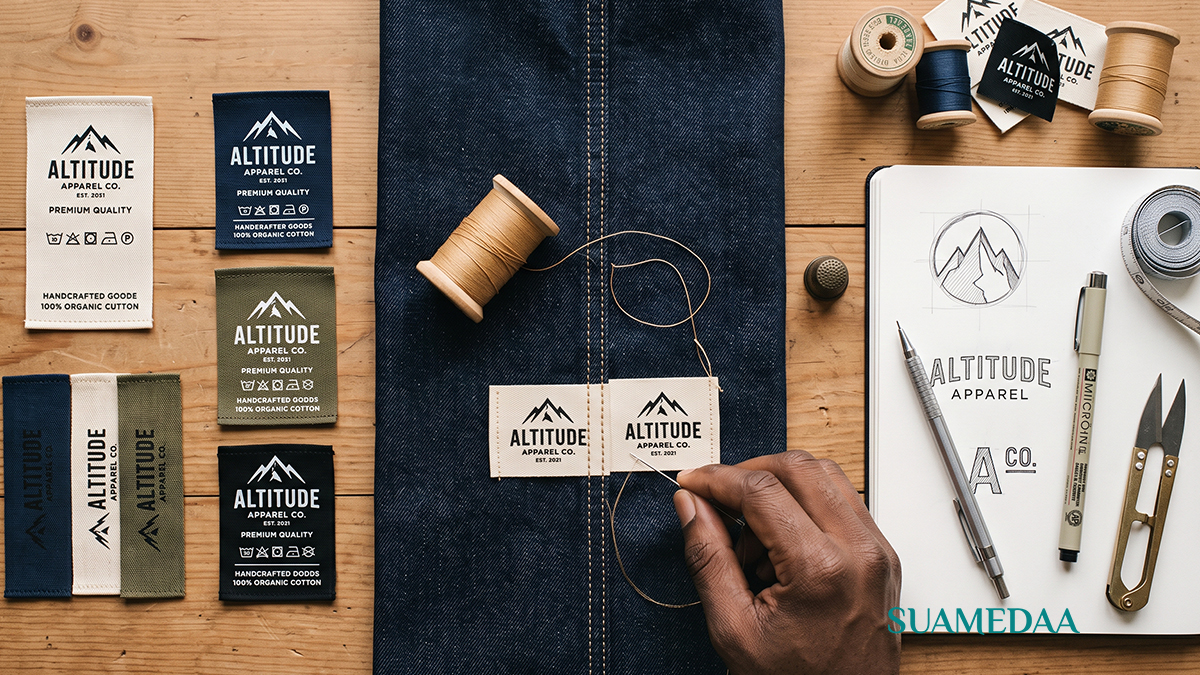
A Complete Guide to Making Your Clothing Labels for Your Collection
Before a customer reads your size, checks your care instructions, or notices where your garment was made, they see your label. In that fraction of a second, your label communicates everything your brand stands for: quality, attention to detail, price point, personality, and professionalism. A well-made label on a beautifully constructed garment confirms that the person behind it cares. A cheap, poorly printed label on that same garment creates doubt, even if the customer cannot immediately articulate why.
This guide walks you through every decision involved in creating clothing labels for your collection, from understanding the different types of labels, to choosing materials, to working with manufacturers and placing them correctly on your garments.
Understanding the Types of Clothing Labels
Not all clothing labels serve the same purpose, and most collections require more than one type. Before you begin designing, it helps to understand what each label does.


Main Label / Brand Label
This is your identity tag. It carries your brand name or logo and is typically the first label a customer looks for when inspecting a garment. It is usually sewn into the center back neckline on tops, dresses, and jackets, or into the inner waistband on trousers and skirts. This label is the one that gets photographed, shared, and associated with your brand in the customer’s memory. It is worth investing the most in this one.
Size Label
The size label is usually a smaller, secondary label stitched below or alongside the main label. It clearly states the garment size, whether in standard letters such as XS, S, M, L, XL, or in numerical sizing depending on your market and category. Some brands choose to combine the size label with the main label for a cleaner look inside the garment. Others keep them separate so the brand label stands on its own visually.
Care Label
Care labels are required by law in most countries. They must communicate washing instructions, drying instructions, ironing temperature, dry cleaning guidance, and bleaching guidance, typically using internationally recognized textile care symbols alongside or instead of written text. In Ghana, the United Kingdom, the United States, and across the European Union, care labeling carries legal obligations, so this is not a label you can skip or guess at. The symbols used are standardized by the International Organization for Standardization and should match the actual fiber content and construction of your fabric.
Content Label
Also called a composition label, this states what the fabric is made of: for example, 100% cotton, 65% polyester and 35% cotton, or 80% merino wool and 20% nylon. Like the care label, fiber content disclosure is legally mandated in most jurisdictions. Accurate content labeling also matters to your customers, particularly those with allergies or strong preferences for natural fibers.
Country of Origin Label
Many markets, including the United States and the European Union, legally require garments to state where they were made. Even where it is not legally required, a country of origin label is increasingly a point of pride, particularly for brands building a narrative around locally made or ethically produced goods.


Hang Tag
A hang tag is not technically a sewn label, but it functions as part of your labeling system and is often the first touch point a new customer has with your brand at the point of sale. It is the tag attached to the garment by a cord, pin, or safety pin, and it typically carries your brand name, price, and sometimes a short brand story, sizing guide, or QR code. Hang tags give you space for storytelling that the inside of a garment cannot accommodate.
Choosing Your Label Material
The material you choose for your labels determines how they feel against the skin, how long they last, and how well they hold your design. Each option has trade-offs.
Woven Labels
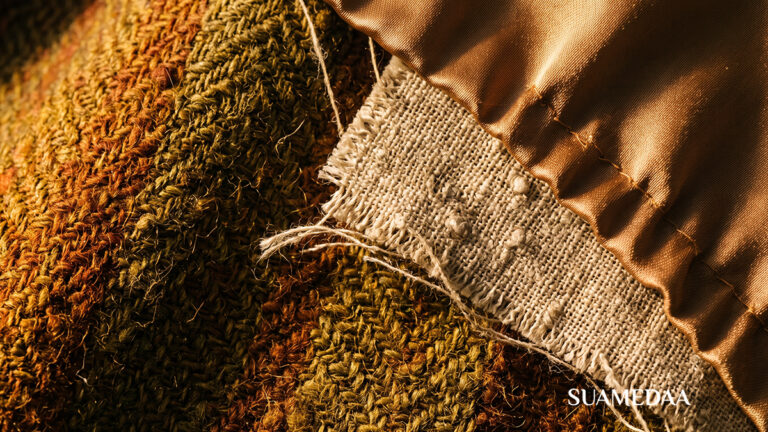
Woven labels are produced on a loom and your design is literally woven into the fabric of the label using colored threads. They are the most durable type of label available, surviving hundreds of washes without fading or fraying. The texture is soft enough for most applications, though the level of design detail they can capture is limited by thread count. Fine gradients and very small text do not translate well to woven labels. They work best for clean logos, bold typography, and designs with three to five colors. Woven labels read as premium and are the standard choice for mid to high-end fashion brands.
Printed Labels
Printed labels are made on a fabric or synthetic base, with your design applied through screen printing, digital printing, or heat transfer. They can reproduce full color and photographic detail that woven labels cannot, and they are generally less expensive to produce, especially at lower quantities. The trade-off is durability: printed labels are more susceptible to fading and cracking over time, particularly with repeated washing. Printed labels work well for care and content information because the text is precise and legible, and for hang tags and supplementary labels where longevity under washing is not a concern.
Leather and Faux Leather Labels
Leather or faux leather labels are debossed or embossed with your brand mark and add a distinctly tactile, premium quality to a garment. They are most commonly used on denim, outerwear, bags, footwear, and workwear, where a sturdier label aesthetic suits the garment’s character. They are heavier and stiffer than fabric labels, which limits where on a garment they can be placed comfortably.

Rubber and Silicone Labels
Rubber or silicone labels are molded with your logo in relief and are most common in sportswear, activewear, and streetwear. They are highly durable, water resistant, and give a modern, graphic edge to a garment. Their raised three-dimensional surface catches the eye and makes a brand mark feel sculptural rather than flat.
Damask Labels
Damask is a type of woven label produced on a finer loom with a higher thread count per inch, allowing for sharper detail and more refined text than standard woven labels. If your brand mark involves intricate detailing or small type, damask is the woven option most likely to capture it accurately. They are priced slightly higher than standard woven labels but are still far more durable than printed alternatives.
Heat Transfer Labels
Heat transfer labels, sometimes called tagless labels, are printed directly onto the inner surface of the garment using heat rather than being sewn in. They have become increasingly popular in activewear, childrenswear, and basics because they eliminate the irritation that traditional sewn labels can cause against skin. Their drawback is that they can crack or fade after prolonged washing, and they cannot be repositioned once applied.
Designing Your Labels
Before you send anything to a manufacturer, you need to design your labels. This stage is where many brand owners either invest wisely or cut corners in ways they later regret.
Define Your Brand Identity First
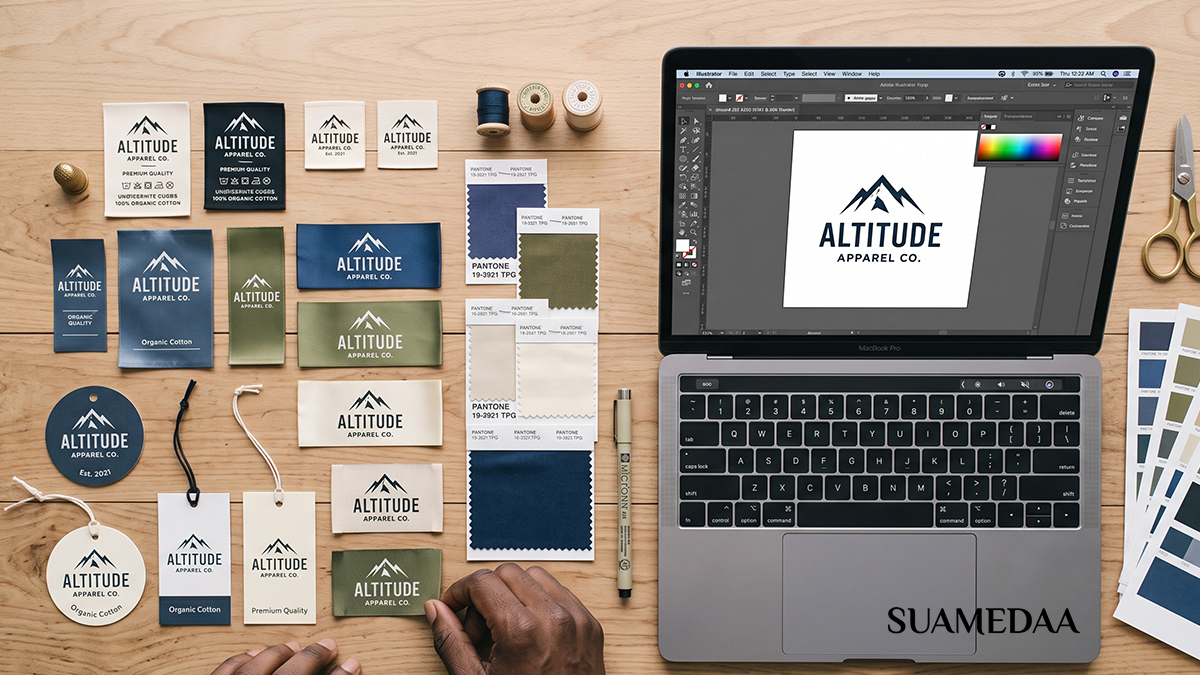
Your label should be an expression of your brand’s visual identity, not an afterthought. Before you design a label, be clear on your brand’s color palette, your typeface choices, the tone you want to convey, and the customer you are designing for. A luxury brand should have labels that feel considered and restrained. A streetwear brand might want bold, graphic, irreverent labels. A sustainable clothing brand might prioritize organic label materials and natural dye colors. The label should feel like it belongs to the same world as the garment it is attached to.
Keep It Legible
Labels are small. Whatever design you create needs to work at scale. Text that looks crisp on a computer screen can become illegible at 2cm high in woven thread. As a rule, keep primary text at a minimum of 6 to 8 points for printed labels and even larger for woven labels where thread count limits resolution. Avoid very thin typefaces for woven applications.
Use Vector Files
Always provide your label manufacturer with vector artwork, saved as an .ai, .eps, or .svg file. Vector files are resolution-independent, meaning they can be scaled to any size without losing sharpness. Providing a low-resolution JPG or PNG will result in poor reproduction, and no reputable manufacturer will be able to guarantee quality from raster files alone.
Specify Pantone Colors
If color accuracy matters to your brand, specify your colors using Pantone Matching System (PMS) references rather than relying on RGB or CMYK values alone. Screen colors and print colors differ significantly. Pantone references give both you and the manufacturer a shared, unambiguous standard for what a color should look like.
Consider Finish
For woven labels, specify whether you want a merrowed edge (a decorative stitched border running around the label’s perimeter), a folded edge, a center fold (where the label is folded in half and sewn in at the fold), or an end fold (where the top and bottom of the label are folded under before sewing). Each finish looks different on the inside of a garment. Center fold labels are the most common for main neck labels. End fold labels sit flat and are often used for side seam labels.
Working with Label Manufacturers
Once your design is ready, you need a manufacturer. Here is what to know before you approach one.
Understand Minimum Order Quantities
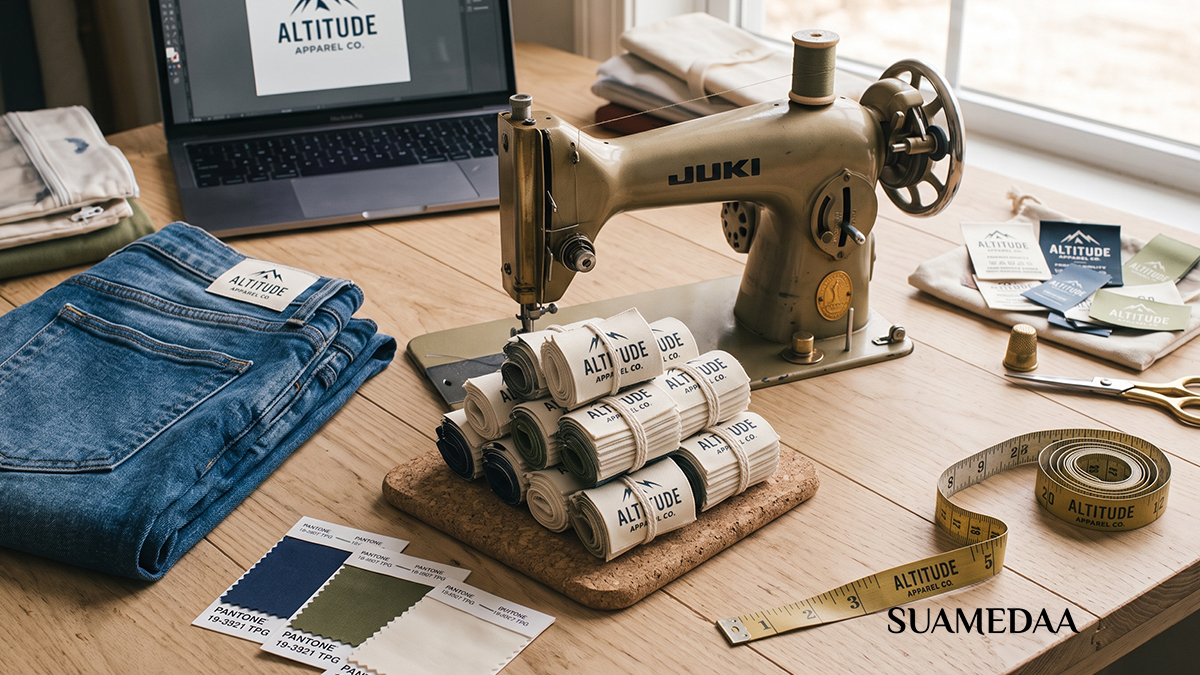
Most label manufacturers work with minimum order quantities, often starting at 100 pieces per design for woven labels and sometimes lower for printed labels. If you are producing a small capsule collection, confirm the minimums before requesting a quote. Some manufacturers cater specifically to small-batch orders and will work with lower quantities at a higher per-unit cost, which is often worth it for a first collection.
Request a Sample
Never approve a full production run without first requesting a physical sample or pre-production proof. What looks correct on screen can feel wrong in hand, in terms of color, weight, texture, or legibility. Most reputable manufacturers offer a sample stage before bulk production, sometimes at a small extra cost. It is money well spent.
Lead Times
Woven labels typically take longer to produce than printed ones due to the loom setup involved. Budget two to four weeks for standard woven label production, and longer if you are ordering from overseas manufacturers. If your collection launch has a fixed date, work backward from that date to ensure your labels arrive in time for your production finishing process.
Domestic vs. Overseas Manufacturers
Local and regional manufacturers offer faster turnaround, easier communication, lower minimum orders for small batches, and the ability to visit and inspect production. Overseas manufacturers, particularly from China, India, South Korea, and Turkey, often offer lower per-unit costs at scale but require more lead time, more careful quality specification, and careful management of shipping logistics and import duties. For a first collection or a brand building a locally made narrative, starting with a domestic manufacturer is often the wiser choice even if the unit cost is higher.
Placement: Where Labels Go
The placement of each label type is governed partly by industry convention and partly by aesthetic judgment.
The main brand label goes into the center back neckline on tops, shirts, jackets, hoodies, and dresses. On trousers, shorts, and skirts, it sits at the center back inner waistband. On knitwear, it is typically sewn into the left side seam to avoid bulk at the neckline.
The size label is sewn directly below the main label in the center back, or alongside it if the two are combined into one label.
The care and content label goes into the left side seam, approximately 15 to 20 cm from the hemline on most garments. Some brands place it at the center back below the size label, particularly on garments where a side seam label placement would be uncomfortable against the skin. Keeping care labels in the side seam reduces irritation for the wearer.
The country of origin information can be incorporated into the care label or placed on a separate label in the same seam. It should always be clearly legible and not hidden in a way that suggests it is being obscured.
Quality Control Before Your Collection Goes Out
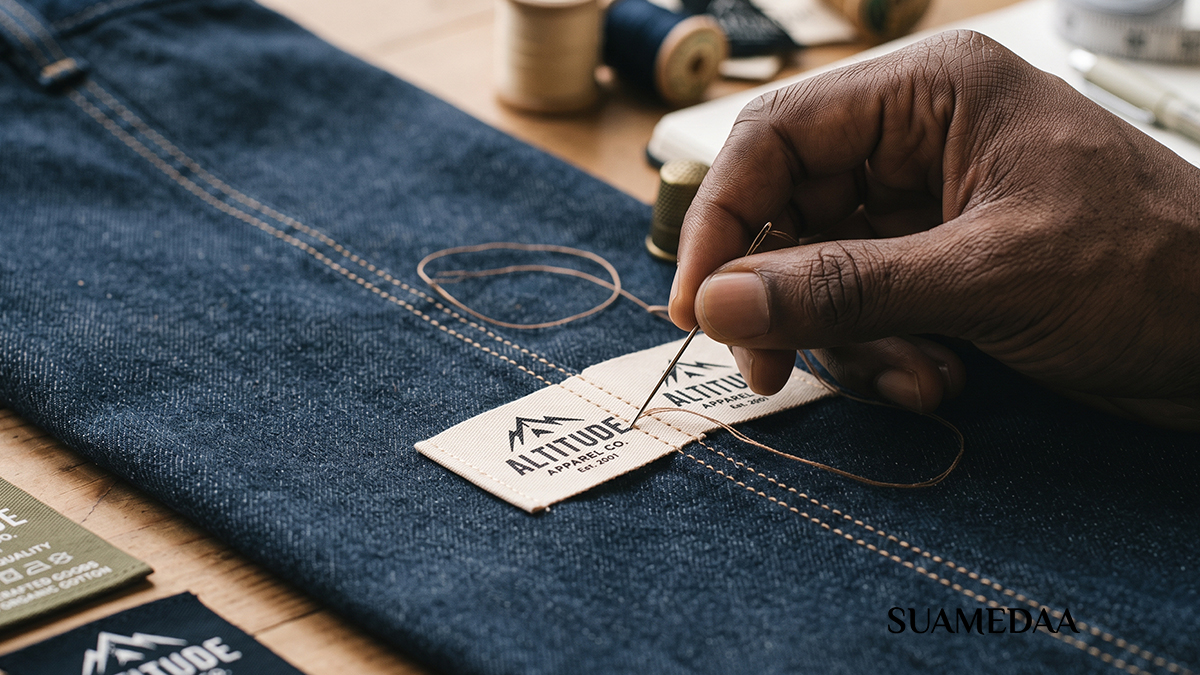
Before your first collection ships or goes on sale, do a label audit on a representative sample of your garments. Check that every label is straight and correctly positioned. Confirm that the stitching holding each label is secure and will not pull away after washing. Wash one or two sample pieces using the care instructions on your label and verify that the garment actually behaves as the label says it should. Check that all care symbols are accurate and legible after washing. A label that fades or peels after two washes reflects directly on your brand’s quality standards, even if the garment itself holds up perfectly.
Building Toward the Label Your Brand Deserves
Your first collection’s labels do not have to be perfect. They have to be deliberate. Choose a material that suits your garment and your price point. Design something that genuinely represents your brand identity. Work with a manufacturer who takes your order seriously regardless of size. Place your labels correctly and consistently across the collection.
As your brand grows and your order volumes increase, you will have the budget and leverage to refine further: to experiment with more complex woven designs, to add foil stamping or embossed leather patches, to develop custom hang tag experiences, or to invest in heat-transfer finishes for a cleaner interior aesthetic.
But none of that refinement is possible if the foundation is not in place from the start. The label is the last thing you add to a garment and the first thing your customer sees. Treat it accordingly.