From Gutenberg to Gigabytes – The Evolution of Printing Technology
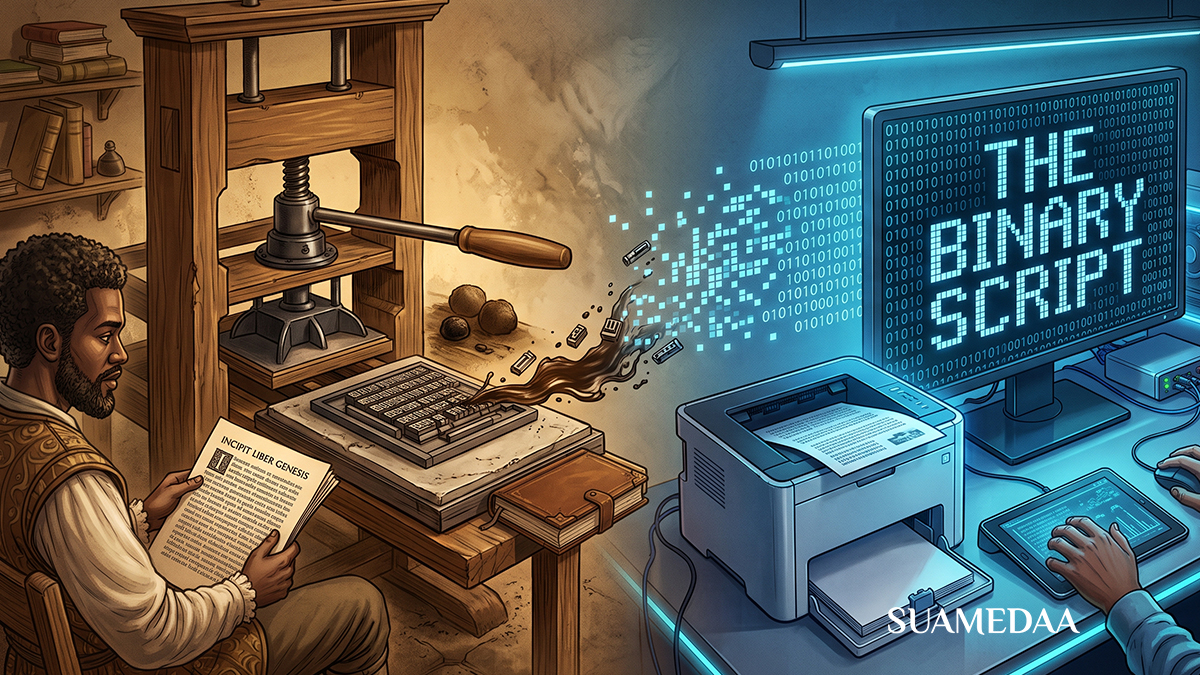
Few inventions have reshaped human civilization as thoroughly as printing. Before it, knowledge moved at the speed of a scribe’s hand, painstaking, expensive, and accessible to almost no one outside the wealthy and the clergy. What followed was a five and a half century relay race of innovation, each generation of technology tearing down the bottlenecks of the last, until the entire concept of a “printing press” gave way to files that travel at the speed of light and printers that build objects layer by layer rather than pressing ink onto paper at all.
Before Gutenberg: The World of the Scribe
For most of recorded history, reproducing a written text meant copying it by hand, one letter at a time. Monastic scriptoriums across medieval worlds employed teams of monks to hand copy manuscripts, a process that could take months or even years to produce a single book. Woodblock printing, developed centuries earlier in China, offered a partial solution, carving an entire page of text and images into a wooden block that could then be inked and pressed onto paper repeatedly. This method, along with early experiments with movable clay and metal type in the acient world of Africans, China and Korea, predates European printing by centuries, but it never achieved the same explosive, continent spanning impact that Europe’s printing revolution would soon produce.
Gutenberg and the Movable Type Revolution
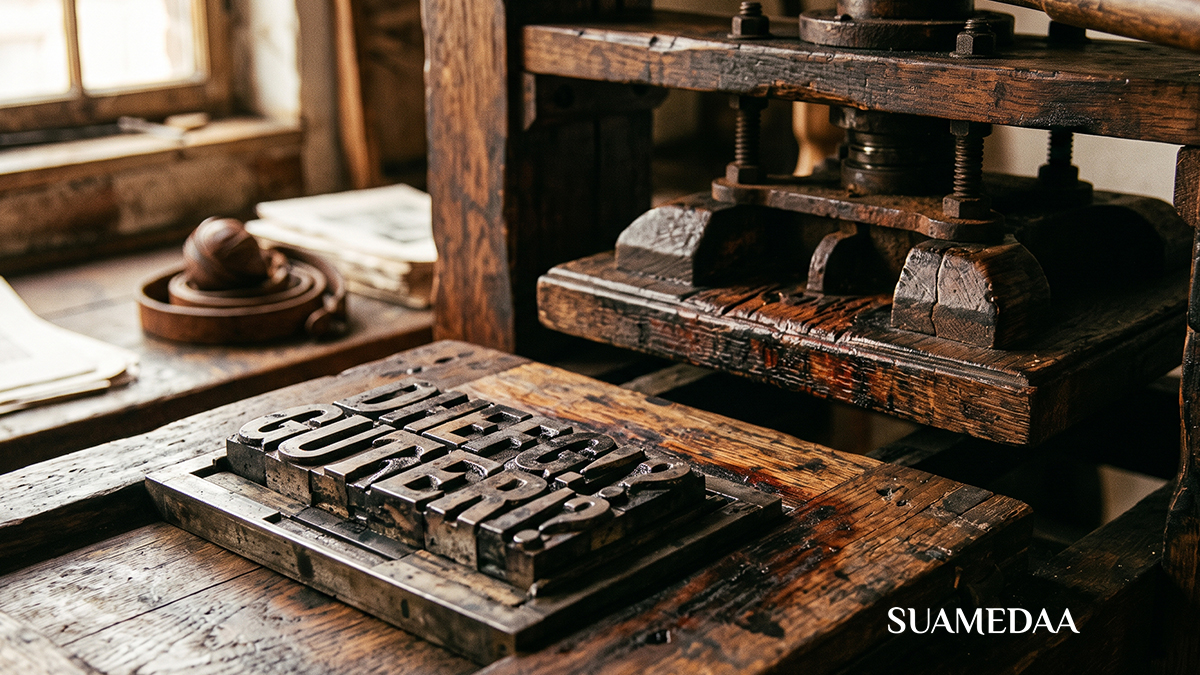
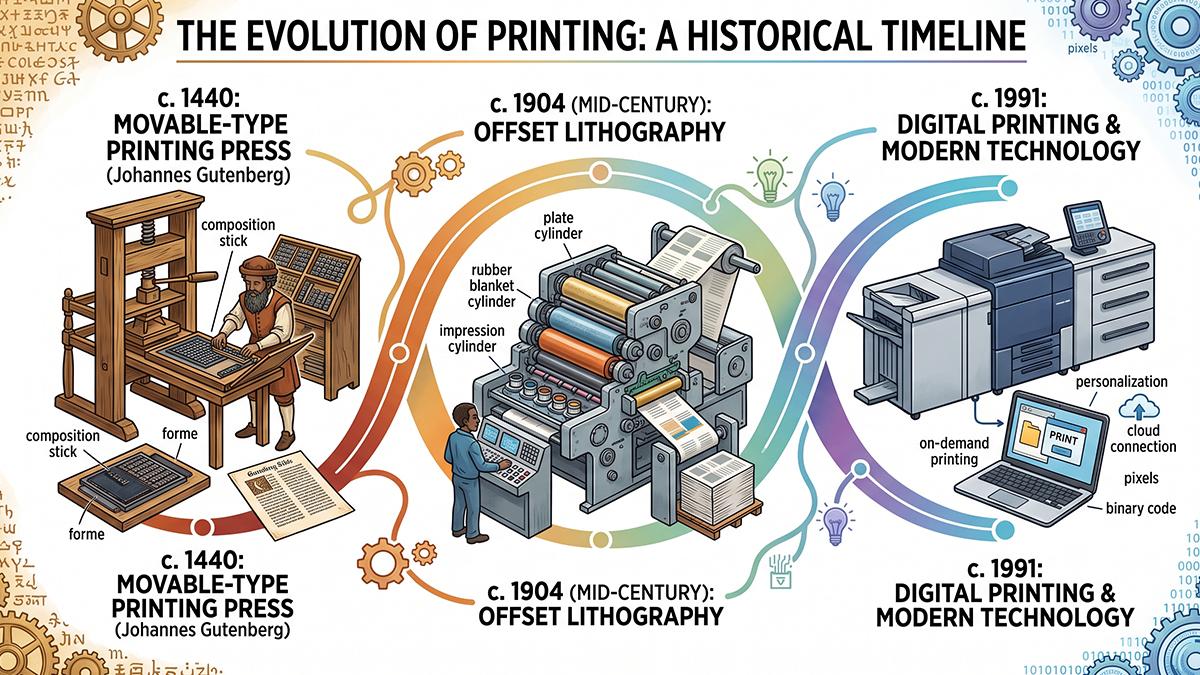
Around 1450, Johannes Gutenberg, a goldsmith from Mainz, Germany, introduced a printing system that would change the world: cast metal movable type, combined with an oil based ink and a modified wine press. Unlike woodblock printing, where an entire page had to be carved fresh for every new text, Gutenberg’s individual metal letters could be arranged, disassembled, and rearranged endlessly, making it dramatically faster and cheaper to print new material. His most famous production, the Gutenberg Bible, demonstrated the technology’s capability at a level of quality that rivaled hand copied manuscripts.



The impact was immediate and staggering. Within fifty years of Gutenberg’s invention, printing presses had spread across Europe, and the number of books in circulation exploded from a relative trickle to an estimated twenty million copies by the year 1500. This sudden abundance of printed material fueled the spread of literacy, accelerated the Protestant Reformation by making religious texts widely accessible outside the control of the Catholic Church, and laid essential groundwork for the Renaissance and the Scientific Revolution that followed.
Refining the Press: The Centuries After Gutenberg
For roughly three hundred years after Gutenberg, printing technology improved incrementally rather than radically, with better inks, sturdier presses, and refined typefaces, but the fundamental process, hand set metal type pressed manually onto paper, remained largely unchanged. That began to shift dramatically in the early nineteenth century with the introduction of the steam powered printing press, pioneered by Friedrich Koenig in the early 1800s. Steam power allowed presses to print far faster than any human operated mechanism could manage, and the technology was quickly adopted by newspapers, most famously The Times of London, which used a Koenig steam press to dramatically increase its print run.
The nineteenth century also brought rotary printing, in which curved plates mounted on rotating cylinders replaced the flat plates of earlier presses, allowing continuous rolls of paper to be printed at even greater speed. Combined with the mechanization of typesetting through inventions like the Linotype machine in the 1880s, which could cast an entire line of type at once rather than requiring individual letters to be set by hand, these advances turned printing from a craft measured in pages per hour into an industrial process measured in thousands of pages per hour, fueling the rise of mass circulation newspapers, affordable books, and widespread literacy across the industrialized world.
The Offset Lithography Era
The early twentieth century introduced offset lithography, a technique based on the principle that oil and water do not mix. An image is transferred, or offset, from a printing plate to a rubber blanket and then onto paper, rather than printing directly from a hard plate. This indirect transfer produced sharper, more consistent image quality and allowed for faster, cheaper production runs than earlier direct printing methods. Offset lithography became the dominant commercial printing method for most of the twentieth century, used for everything from newspapers and magazines to packaging and books, and remains a major printing method today for high volume commercial jobs where its cost efficiency at scale is difficult to beat.
The Digital Disruption
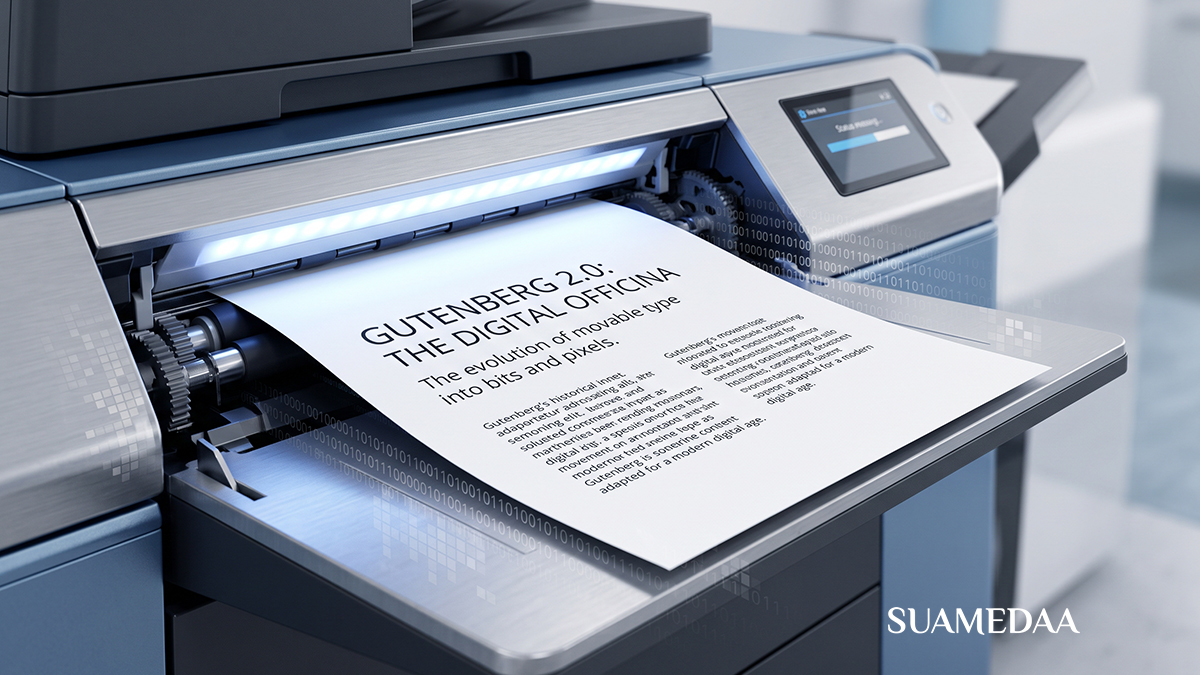
The most dramatic shift in printing’s long history arrived in the final decades of the twentieth century, as digital technology began to replace physical type and plates altogether. Laser printing, developed at Xerox in the 1970s and commercialized through the 1980s, used a laser to create an electrostatic image on a drum that then transferred toner onto paper, eliminating the need for physical printing plates entirely for many applications. Inkjet printing, developed around the same period, offered an even more accessible alternative for home and small office use, spraying microscopic droplets of ink directly onto paper based on digital instructions.



This digital shift did more than change the mechanics of printing, it fundamentally changed who could print. Desktop publishing software in the 1980s, paired with increasingly affordable laser and inkjet printers, put typesetting and page design tools that once required specialized professional equipment into the hands of ordinary consumers and small businesses. The printing press, once a massive industrial machine requiring significant capital investment, had been compressed into a device that could sit on an office desk.
Print on Demand and the New Publishing Landscape
Digital printing’s flexibility gave rise to an entirely new business model: print on demand. Rather than printing large runs of books or materials in advance and hoping they sell, digital presses made it economically viable to print a single copy only after an order was placed, eliminating warehousing costs and unsold inventory risk almost entirely. This shift has been transformative for independent authors, small publishers, and niche content that would never have justified a traditional print run, democratizing publishing in a way that echoes, on a smaller and more individual scale, the disruption Gutenberg himself set in motion five centuries earlier.
Variable data printing, a further digital innovation, allows each printed piece in a run to be customized automatically, inserting a different name, image, or offer into each copy of a mailer or marketing piece without slowing down the press. This level of personalization at scale was simply impossible under any earlier printing technology, where every copy in a run was, by necessity, identical.
Printing in Three Dimensions
Perhaps the most radical departure from Gutenberg’s original vision is the emergence of 3D printing, a technology that abandons the idea of printing onto a flat surface altogether. Rather than depositing ink onto paper, 3D printers build physical objects layer by layer from materials like plastic, resin, or metal powder, guided entirely by a digital design file. What began as an expensive prototyping tool used primarily by engineers and industrial designers has since expanded into medical device manufacturing, architectural modeling, aerospace component production, and even experimental home construction, stretching the definition of “printing” far beyond anything Gutenberg could have imagined, while still relying on the same core concept he pioneered: a repeatable, mechanized process for turning an idea into a physical object.
What Hasn’t Changed
For all the technological distance between a hand operated wooden press in fifteenth century Mainz and a laser guided 3D printer building a titanium aerospace part today, the underlying goal has remained remarkably constant: taking an idea that exists in someone’s mind and turning it into something physical, reproducible, and shareable with others. Gutenberg’s innovation was not really about ink and metal type, it was about breaking the bottleneck between an idea and its distribution. Every subsequent leap in printing technology, from steam power to lasers to 3D printing, has been another attempt to solve that same fundamental problem, each time removing another layer of cost, time, or specialized skill standing between creation and access.



The story of printing technology is, in many ways, the story of information itself becoming progressively more accessible, faster to produce, and cheaper to distribute. From a single German goldsmith’s workshop to laser printers on office desks to machines that print physical objects rather than pages, each era of printing has expanded who gets to create, publish, and share ideas with the world. Five and a half centuries after Gutenberg pressed his first page, the underlying revolution he started, putting the power to reproduce and distribute ideas into more and more hands, is still very much underway.