Accra Diplomatic Shops – Inside the City’s Exclusive Retail World
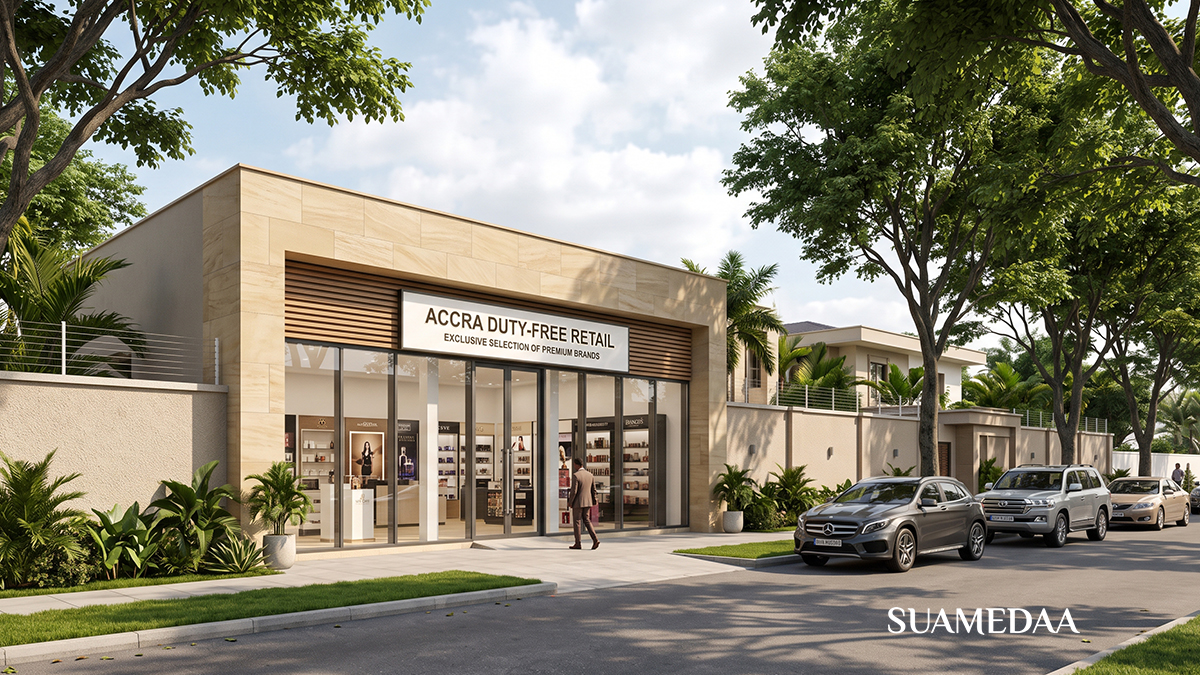
Tucked into the leafy streets of Airport Residential Area, Cantonments, and Roman Ridge, a parallel retail universe operates quietly alongside the bustling markets and shopping centres that most Accra residents know. This is the world of the diplomatic shop, a network of duty-free establishments that has served Accra’s international community for decades and continues to evolve as the city’s diplomatic footprint grows.
To step into a diplomatic shop in Accra is to encounter a retail experience unlike anything found elsewhere in the city. The shelves carry internationally recognised spirits brands at prices that reflect none of the import duties and levies that push similar products to premium pricing in ordinary retail. Perfumes from Paris, cosmetics from New York, wines from France and Chile, and chocolates from Belgium sit alongside outdoor equipment, home accessories, and travel goods in well-organised, air-conditioned spaces that feel closer to a European travel retail outlet than a typical West African retail environment.
For the diplomats, UN officials, and accredited international organisation staff who have access to these shops, they represent one of the practical privileges of the post. For the rest of Accra, they remain a largely invisible institution, operating behind a legal framework that most residents encounter only when they learn that a colleague at an embassy or high commission can shop somewhere they cannot.
The Legal Foundation: What Makes a Shop Diplomatic
The existence of diplomatic shops in Accra rests on a foundation built from international law and domestic legislation. The Vienna Convention on Diplomatic Relations, to which Ghana is a signatory, establishes the principle that diplomatic missions and their staff are entitled to exemption from customs duties and taxes on goods imported for official use and for the personal use of diplomats and their households.
Ghana gives this principle domestic legal form through the Exemptions Act, 2022 (Act 1083), which sets out precisely who qualifies for duty-free privileges and under what conditions. Section 9 of the Act specifies that goods and vehicles imported for the official use of United Nations bodies, the African Union, the Economic Community of West African States, the Commonwealth, and accredited diplomatic missions and consulates are exempt from customs duties and applicable taxes.
The Act also establishes a reciprocity requirement. A diplomat or diplomatic mission is granted duty-free status in Ghana where a similar exemption is granted to a Ghanaian diplomat or diplomatic mission in the country of that diplomat. This bilateral principle means that the privileges flow in both directions, and Ghana’s Ministry of Foreign Affairs submits an annual list of qualifying diplomats and missions to the Finance Minister for the purposes of determining exemption status.
For staff arriving for the first time, the Act provides specific first-arrival privileges, allowing household and personal effects to be imported duty-free as part of the transition into the country. Permanent members of qualifying international organisations benefit from ongoing exemption status throughout their posting.
The practical effect of this framework is that accredited diplomatic and international organisation staff can access goods through designated channels without paying the duties, VAT, and levies that would otherwise apply. Diplomatic shops exist precisely to serve this demand, providing a dedicated retail environment where eligible buyers can make purchases under their duty-free entitlement.


Accra’s Diplomatic Scale: Why These Shops Exist
The scale of diplomatic activity in Accra helps explain why the city can sustain dedicated duty-free retail operations for the international community. Accra hosts 70 embassies and high commissions, making it one of the more diplomatically active capital cities in sub-Saharan Africa. This figure does not include the offices of the United Nations agencies, the African Development Bank, the European Union delegation, the African Union offices, or the network of international NGOs and multilateral development organisations that have established presences in the city.
The full count of individuals holding diplomatic or equivalent accreditation in Accra at any given time runs into the thousands. Each of these individuals, together with dependants in their households, represents a potential customer for duty-free retail. When the staffing of major missions is considered, the numbers become significant. The United States Embassy in Accra is among the largest American diplomatic missions in Africa. The British High Commission, the French Embassy, the Chinese Embassy, and major regional players such as the Nigerian High Commission all maintain substantial staffing levels. Add the UNDP, UNICEF, WHO, World Bank, IMF, and the dozens of other international organisations operating from Accra, and the picture of a sustained and sizeable consumer base comes into focus.
Countries represented in Accra include the United Kingdom, France, Germany, the United States, Canada, Australia, China, India, Japan, South Korea, Brazil, Saudi Arabia, Qatar, the UAE, and the full complement of African Union member states with missions in the city. European nations from Ireland to Romania maintain presences. Caribbean states, Pacific nations, and Latin American countries round out a remarkably comprehensive diplomatic community for a West African city.
The Operators: Flemingo, Dufry, GTDC, and the Retail Infrastructure
The diplomatic retail space in Accra has been shaped primarily by two commercial operators working in partnership with Ghanaian state and private entities: Flemingo International and Dufry, which has since been rebranded as Avolta.
Flemingo International
Flemingo International, a global travel retail company with a presence across Africa, Asia, and Europe, established its Ghanaian operations approximately from the late 2000s, and by 2013 was operating three outlets in the country. The company’s business model spans airports, seaports, UN missions, border stores, and diplomatic communities across 25 countries, with more than 120 outlets globally.


The flagship of Flemingo’s Accra diplomatic retail operation is its Roman Ridge location, situated directly opposite the Indian Embassy on what is one of the more architecturally varied streets in Accra’s embassy quarter. When it opened its third Ghanaian outlet on this site, Flemingo described it as its largest by product range in Ghana, stocking approximately 4,000 individual product lines across more than 800 square metres of retail floor space.
The Roman Ridge store’s product range covers liquor, perfumes and cosmetics, confectionery, toys, outdoor and camping equipment, travel accessories, and glassware and home decor. The breadth of this range reflects the reality that the diplomatic community represents a particular consumer profile: internationally mobile, accustomed to certain product standards from their home countries, and seeking goods that may not be reliably available through ordinary retail in the Ghanaian market.
Flemingo’s retail manager characterised the company’s aim as meeting “the increasing demand of diplomats in the country and providing a unique world-class shopping experience.” The expansion to a third Accra location in 2013 was framed by company management as a signal of confidence in Ghana’s economic trajectory and in the sustained demand from a growing international community.
Dufry/Avolta and GTDC
The other major operator in Accra’s diplomatic retail space is the joint entity known as Dufry and GTDC, operating from the Airport Residential Area on Agostinho Neto Road. This operation brings together Dufry, the Swiss-headquartered global travel retail giant that rebranded as Avolta in November 2023 following its acquisition of Autogrill, and the Ghana Tourism Development Company, the state entity whose mandate covers tourism investments and infrastructure.
Dufry’s own history stretches back to 1865, when it operated as Weitnauer, a Swiss retailer. The company pivoted to duty-free wholesale in 1948 and opened the first duty-free shop in continental Europe in Paris in 1952. By the time it refocused as Dufry in 2003, it had built a global travel retail empire. The Ghana partnership with GTDC brought this international expertise into the local diplomatic retail market, operating under the Ghana Free Zones Authority framework.
The Dufry and GTDC diplomatic shop on Agostinho Neto Road stocks cosmetics, perfumes, liquor, and local crafts, with an operating schedule from Monday to Saturday. Its airport-adjacent location serves both the diplomatic community and travellers, with the duty-free proposition made accessible under the qualifying conditions for each customer category.
The Ghana Tourism Development Company’s involvement in this enterprise reflects a broader mandate that includes vehicle rentals, tour operations, management of tourist sites, event management, and hospitality, all under the objective of leading in tourism investments and infrastructure for sustainable development. The partnership with Dufry represents the commercial dimension of this mandate, bringing international retail standards to a niche but important segment of the consumer market.
What Fills the Shelves: The Product Universe
The product categories stocked by Accra’s diplomatic shops reflect both universal duty-free retail conventions and the specific needs of a professional international community living and working far from their home markets.
Spirits and Wine
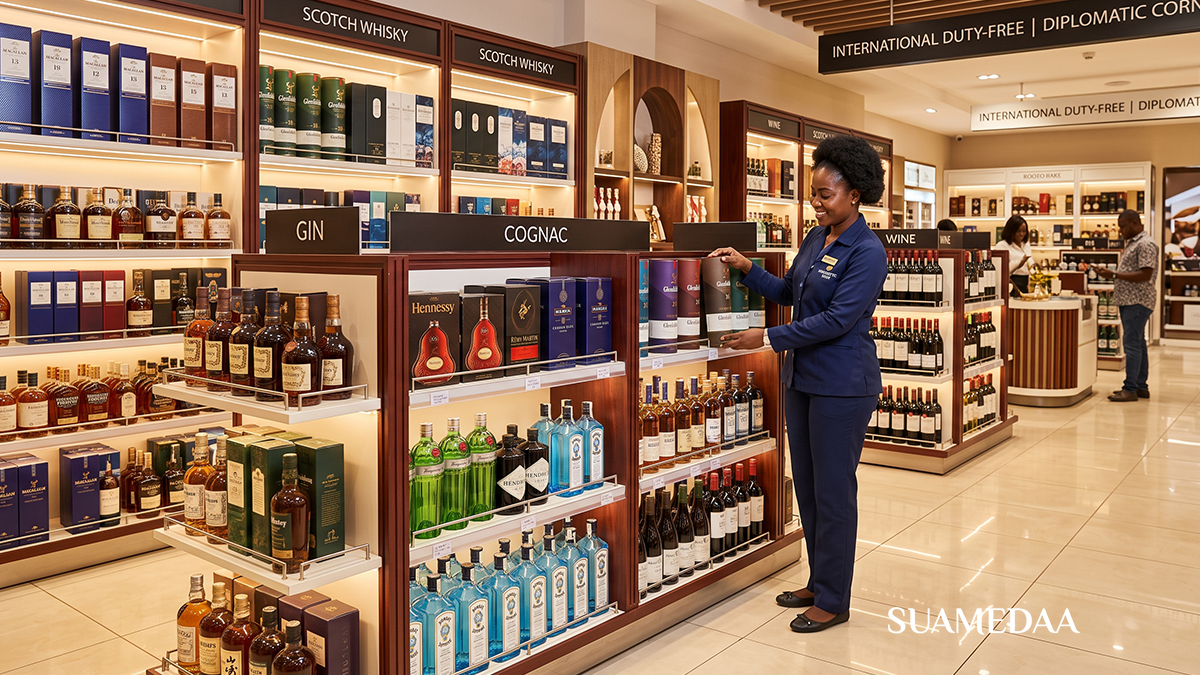
The spirits and wine category is typically the centrepiece of duty-free retail anywhere in the world, and Accra’s diplomatic shops are no exception. The duty-free pricing differential on international spirits brands is significant in a country where import duties and levies on alcohol are substantial. Scotch whiskies, French cognacs, international vodkas, gins, rums, and premium liqueurs are available at prices that reflect the absence of the levy stack that applies in ordinary retail.
Wine is an equally important category, drawing on European appellations across France, Italy, Spain, and Portugal, alongside new-world producers from South Africa, Chile, Argentina, and Australia. The diplomatic community represents consumers with sophisticated expectations from wine retail, and the shops maintain selections that would be difficult or expensive to source through other Accra channels.
Perfumes and Cosmetics
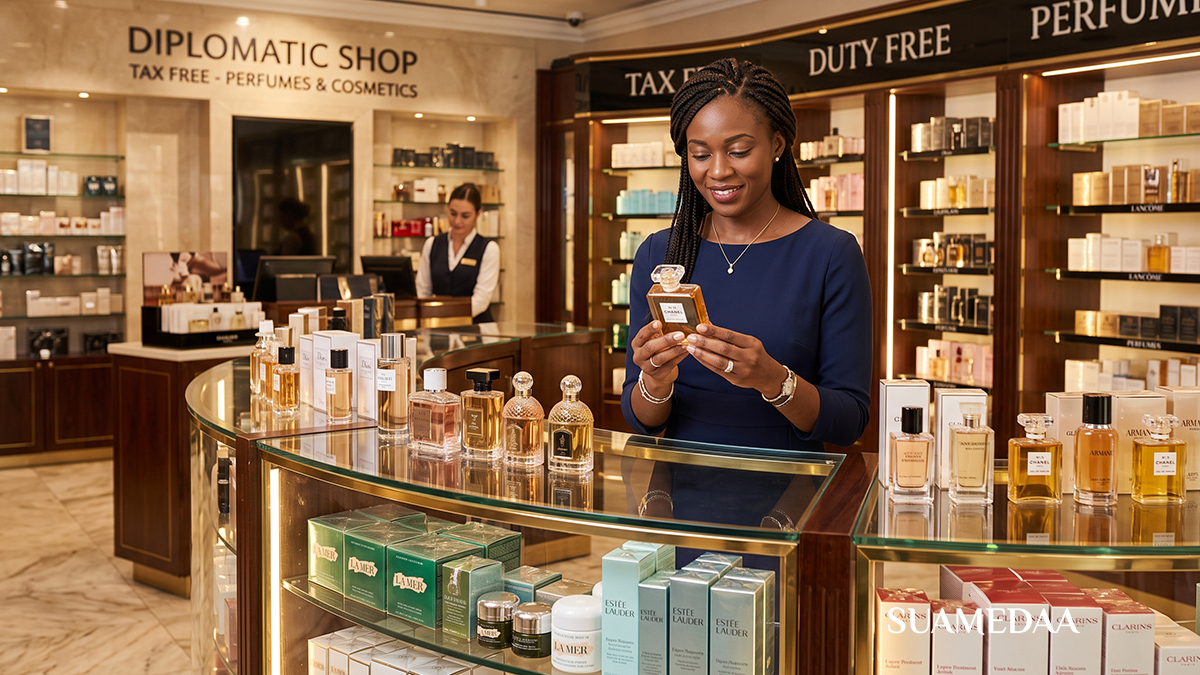
The fragrance and cosmetics category is consistently among the strongest performers in diplomatic duty-free retail globally, and the Accra outlets reflect this. International fragrance houses represented include the major French luxury names and their equivalents from across Europe, alongside premium cosmetics brands from global beauty groups. For diplomats’ spouses and partners who may have fewer professional outlets in a posting city than at home, access to international beauty and fragrance brands at duty-free pricing represents a practical benefit of considerable value.
Confectionery and Food
Imported confectionery from Belgium, Switzerland, the United Kingdom, and beyond provides another layer of international retail access. Premium chocolates, biscuits, and specialty food items that are either unavailable or steeply priced in ordinary Accra retail sit alongside seasonal offerings on the confectionery shelves. For the diplomatic household hosting dinners and receptions, access to reliably sourced imported food items through a duty-free channel carries real practical utility.
Home and Lifestyle
Glassware, home decor accessories, outdoor and camping equipment, and travel accessories round out the product universe in Accra’s larger diplomatic stores. The outdoor and camping category reflects the reality that diplomats posted to Ghana often take advantage of the country’s natural assets, including national parks, coastal resorts, and the wider West African travel circuit, and equipment for these activities is in demand.
Local Crafts and Cultural Products
Some of the Accra diplomatic shops incorporate Ghanaian cultural products, local crafts, and souvenirs into their offerings. This dimension of the product range serves a different function from the duty-free imports: it provides a curated access point to Ghanaian artisanal production for a community that may rotate staff frequently and for whom finding quality local crafts to take home as gifts and mementos is a recurring need.
The Geography of Diplomacy: Where the Shops Are
The positioning of Accra’s diplomatic shops is not accidental. Roman Ridge, Airport Residential Area, and Cantonments constitute the core of Accra’s embassy quarter, the cluster of neighbourhoods where the majority of the city’s diplomatic missions are concentrated. The streets of these areas are lined with embassies, high commissions, consular offices, UN agency headquarters, and the residences of senior diplomatic staff. The proximity of duty-free retail to this concentration of customers is a fundamental element of the business model.
Roman Ridge, where Flemingo’s flagship diplomatic outlet is positioned, sits directly in the heart of this diplomatic zone. The Indian Embassy, which stands opposite the Flemingo store, is one of dozens of missions within walking or short-driving distance. The neighbourhood’s mix of diplomatic and residential properties creates a steady flow of potential customers throughout the working week.
The Airport Residential Area, where the Dufry and GTDC operation is located on Agostinho Neto Road, takes its name from its proximity to Accra International Airport. This positioning serves a dual constituency: the diplomatic and international organisation community that populates the area’s residential and office buildings, and the airport-adjacent traveller demographic that passes through on international journeys.
Cantonments, another of Accra’s established diplomatic residential neighbourhoods, completes the triangle of key locations. The area’s combination of mission offices and staff accommodation makes it a natural catchment for diplomatic retail.
Who Can Shop: Navigating Eligibility
The eligibility rules for shopping at Accra’s diplomatic shops are tied directly to the duty-free status granted under Ghana’s Exemptions Act and the underlying Vienna Convention framework. In practical terms, the eligible customer base includes accredited ambassadors, high commissioners, and their immediate diplomatic staff; spouses and dependants registered as part of the diplomatic household; permanent members of UN agencies and other international bodies with formal accreditation in Ghana; and accredited staff of the African Union, ECOWAS, the Commonwealth, and equivalent international organisations.
Eligibility documentation matters. Accredited staff are typically required to present valid diplomatic identity documents issued by the Ministry of Foreign Affairs as the basis for accessing duty-free purchasing. The shops operate within the framework of the exemptions regime, and purchases made through these channels are intended for the personal or household use of the eligible individuals, not for resale.
The community of eligible shoppers in Accra is larger than it might appear. When diplomatic dependants are counted alongside the primary accredited staff, and when the full breadth of international organisations with qualifying status is considered, the potential customer base extends well beyond the immediate embassy and high commission staffing lists.
The Shopping Experience: A Separate Accra
For those with access, the experience of shopping at one of Accra’s diplomatic outlets differs materially from the rest of the city’s retail landscape. The stores are air-conditioned, well-stocked with consistently sourced international brands, and offer a degree of predictability that reflects their integration into global supply chains rather than dependence on locally sourced imports that may be subject to supply variability.
Pricing in the diplomatic shop channel reflects the removal of the import duty, VAT, and levy stack that applies to similar goods in ordinary retail. On premium spirits, the difference can be substantial. On cosmetics and fragrances, the comparison with duty-paid retail reinforces the financial significance of the access privilege. The result is that the duty-free entitlement represents a meaningful component of the overall compensation and benefits package for someone on a diplomatic or international organisation posting in Accra.
The stores also provide a degree of cultural familiarity for an internationally mobile community. Encountering a familiar whisky label, a trusted cosmetics brand, or a type of chocolate not otherwise available in the local market is a small but genuine comfort in a posting that, for many, represents significant personal dislocation from home. Diplomatic shops in Accra, as in capital cities around the world, serve a social and psychological function alongside the commercial one.
Duty-Free at the Airport: The Traveller Dimension
The diplomatic shop network in Accra sits alongside, but is distinct from, the duty-free retail available to all international travellers at Accra International Airport. The airport duty-free stores, also operated under the Avolta and associated frameworks, are accessible to any traveller on production of a boarding pass and passport, without the accreditation requirements that govern access to the city-based diplomatic shops.
The airport stores serve a different consumer moment: the traveller departing for or arriving from an international journey, buying perfume for a gift, picking up spirits to take home, or browsing luxury goods in the transition time between clearing security and boarding. The city-based diplomatic shops serve a resident community with ongoing needs rather than a transient traveller moment.
Together, these two channels compose Accra’s duty-free retail ecosystem: one serving the city’s permanent international community through year-round access, the other serving the traveller population in the specific context of air travel.
The Role of the Ghana Free Zones Authority
The Dufry and GTDC operation is registered under the Ghana Free Zones Authority, a regulatory body that administers the country’s free zone programme, under which businesses can operate with exemption from certain taxes and duties as a means of promoting export trade and investment. The free zone status of the diplomatic retail operation provides additional regulatory clarity to the commercial arrangements that underpin duty-free retail within the city rather than at a port of entry.
The Ghana Free Zones Authority’s inclusion of the Dufry and GTDC joint venture in its enterprise register reflects the formal institutional status of this type of operation and its place within Ghana’s broader economic and trade framework.
The Market’s Evolution
The diplomatic retail market in Accra has evolved alongside the city’s growth as a regional hub for international organisations, development finance institutions, and multinational headquarters. As Accra’s international community has expanded, so has the commercial infrastructure that serves it.
Flemingo’s progression from an initial Ghana presence in the late 2000s to a three-outlet operation by 2013 reflects this trajectory. The opening of what was then Ghana’s largest diplomatic duty-free store at Roman Ridge was driven explicitly by the operator’s assessment that demand from the diplomatic community warranted an expanded offer. The global company, operating across Africa from Kenya and Rwanda to South Africa and Cape Verde, identified Ghana and Accra specifically as a market where investment in diplomatic retail was commercially justified.
The Dufry partnership with the Ghana Tourism Development Company represents a different model, one that embeds the international travel retail expertise of a Swiss multinational within a joint venture with a Ghanaian state entity. This structure balances international commercial capability with local institutional partnership in a way that reflects a broader pattern in how global companies enter the Ghanaian market.
Beyond the Transaction: Community and Function
The diplomatic shop in Accra is more than a retail outlet. It functions as an informal gathering point for members of a community that shares certain practical circumstances: geographic dislocation from home, professional immersion in international affairs, and a set of shared needs that the broader consumer market does not fully address.
The regular rhythms of shopping trips, the encounters with colleagues from other missions, and the shared experience of navigating life in a posting city create an informal social texture around these commercial spaces. Diplomatic communities in capital cities around the world have long used their commissaries, duty-free outlets, and club facilities as sites of informal community life, and Accra’s diplomatic shops participate in this function.
For the institutions themselves, the existence of well-stocked and competitively priced duty-free retail in the city rather than only at the airport is a meaningful component of the posting package they offer to staff. Postings to capitals with strong local diplomatic retail infrastructure are, in the informal calculus of international service careers, more attractive than those without it. In this sense, the quality of Accra’s diplomatic shop network has a marginal but real effect on the city’s ability to attract senior international organisation presence.
An Accra Institution, Quietly Operating
The diplomatic shops of Accra do not advertise to the general public. They do not feature in the city’s tourism brochures or shopping guides. They occupy a discreet institutional role, operating within a legal framework that makes their existence possible, serving a community with specific entitlements and needs, and contributing to the commercial infrastructure of a city that has built itself into a significant node in the network of African and global diplomacy.
For the vast majority of Accra’s residents, these shops remain invisible or at most a curiosity, a reminder that the diplomatic quarter that gives neighbourhoods like Roman Ridge, Cantonments, and Airport Residential Area their character is also a place where a specific kind of commerce plays out beyond the reach of ordinary retail convention.
For the thousands of diplomats, UN staff, and international organisation employees who call Accra home for their posting period, stepping through the door of one of these shops is an unremarkable routine, a practical transaction in the management of household needs. It is, in that ordinariness, a measure of how thoroughly these institutions have embedded themselves in the fabric of the city’s international life.