Introduction to Swahili
Swahili, known to its own speakers as Kiswahili, is one of the most widely spoken languages in Africa and one of the few African languages to have achieved international recognition as an official language of the African Union. Spoken by over 100 million people across East Africa, it serves as a bridge language connecting dozens of ethnic groups, nations, and cultures that would otherwise have no common tongue.
Origins and History
Swahili developed along the East African coast, in what is now Kenya, Tanzania, and neighboring areas, through centuries of contact between Bantu speaking peoples and Arab traders who sailed the Indian Ocean trade routes. The word “Swahili” itself comes from the Arabic word “sawahil,” meaning “coasts,” reflecting the language’s origins as the tongue of coastal trading communities.
At its core, Swahili is a Bantu language, sharing its grammatical structure and much of its basic vocabulary with other Bantu languages spoken throughout central and southern Africa. However, centuries of trade, cultural exchange, and religious influence introduced a substantial number of loanwords from Arabic, and later from Portuguese, Persian, Hindi, German, and English. This blend gives Swahili a distinctive character: a Bantu skeleton dressed in vocabulary borrowed from across the Indian Ocean world.



Where Swahili Is Spoken
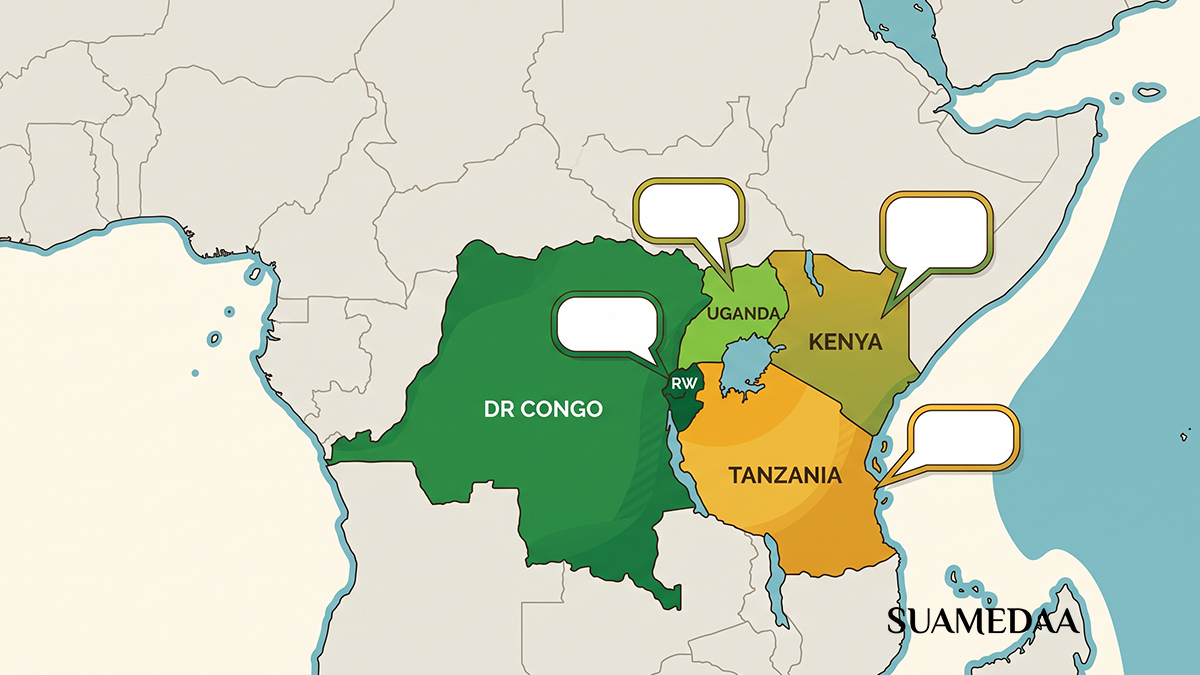
Swahili is the national and official language of Tanzania and Kenya, and it holds official status in Uganda, the Democratic Republic of the Congo, and Rwanda. It is also spoken as a trade language or second language in Burundi, Mozambique, Zambia, Malawi, Somalia, and the Comoro Islands. In Tanzania in particular, Swahili functions as a true unifying force, used in schools, government, media, and daily life alongside more than 100 local languages.
Because of its reach, Swahili has become a symbol of Pan-African identity. It is taught in universities around the world and used in international broadcasts by outlets such as the BBC, Voice of America, and China Radio International.
Basic Features of the Language
Swahili grammar is organized around noun classes rather than gender, a hallmark feature of Bantu languages. Nouns are grouped into classes that determine how verbs, adjectives, and other words in a sentence must agree with them. For example, the class prefix “m-” often marks singular people, as in “mtu,” meaning person, while “wa-” marks the plural, as in “watu,” meaning people.
Verbs in Swahili are built by adding prefixes and suffixes to a root to indicate tense, subject, and object. For instance, the root “-penda” means “to love.” Adding the appropriate markers produces “ninapenda,” meaning “I love,” or “alipenda,” meaning “he or she loved.” This agglutinative structure allows a single Swahili word to convey what might take an entire phrase in English.
Pronunciation is generally considered approachable for new learners. Swahili is written in the Latin alphabet, and its spelling is largely phonetic, meaning words are pronounced much as they are written. There are no tones to master, unlike many other African languages, which makes Swahili somewhat easier to pick up for English speakers.



Everyday Words and Phrases
A few common expressions offer a glimpse into the language:
- Jambo or Habari – Hello or greetings
- Asante – Thank you
- Karibu – Welcome or you are welcome
- Rafiki – Friend
- Hakuna matata – No worries or no problem
- Kwaheri – Goodbye
Many of these words have entered global popular culture, most famously “hakuna matata,” which was popularized worldwide through the film The Lion King.
Why Learn Swahili
For travelers, businesspeople, and students of African studies, Swahili opens doors across a region of growing economic and cultural importance. East Africa is home to major economic hubs such as Nairobi and Dar es Salaam, and Swahili proficiency is increasingly valuable in fields ranging from diplomacy and international development to tourism and journalism.
Beyond practicality, learning Swahili offers insight into a rich literary and oral tradition. Swahili poetry, known as “ushairi,” has a history stretching back centuries, and modern Swahili literature continues to flourish through novelists, poets, and playwrights across the region.
Swahili stands as a remarkable example of a language shaped by trade, migration, and cultural exchange, yet rooted firmly in its African Bantu heritage. As a unifying force across national borders and a growing presence on the world stage, Swahili offers both practical value and a window into the diverse cultures of East Africa. Whether for travel, study, or simple curiosity, learning even a few words of Kiswahili is a meaningful step toward understanding one of Africa’s most vibrant linguistic traditions.