The Ancient Tradition of Curtains and Why Every Home Should Take Them Seriously
There is a particular quality of morning light that every Ghanaian knows: the way the sun arrives not gradually but decisively, flooding a room with a heat and brightness that announce the day has started whether you are ready or not. In a bedroom without curtains, the conversation between the occupant and the sun is entirely one-sided. The sun speaks, and you comply. In a room with the right curtain, that conversation is on your terms. You choose how much light enters, when, and at what angle. That simple act of control, repeated across millions of homes in dozens of variations, is the quiet daily expression of one of the oldest traditions in human domestic life.
Curtains are so commonplace that most people stop seeing them. They hang at windows and doorways, they gather dust along their lower hems, and they are replaced when they look tired, chosen according to price and what happens to match the walls. The seriousness with which curtains deserve to be approached, their history, their function, and their power to transform a space, is rarely part of the conversation when someone walks into a fabric market or a home furnishings shop. That is a gap worth closing, because understanding where curtains come from and what they actually do turns what most people treat as an afterthought into something that earns its place at the front of the home improvement list.
Where It All Began: Five Thousand Years of Window Covering
The history of curtains is, at its root, a history of human ingenuity in the face of two persistent problems: too much sun and too little privacy. Those two problems predate recorded history, and so, in some form, does the solution.


The earliest evidence of deliberate window and doorway coverings traces back to ancient Egypt, with evidence reaching as far as 3100 BC. The Egyptians were not working with woven fabric at first. The initial solution was practical to the point of bluntness: animal hides hung across doorways, keeping out wind, insects, and unwanted eyes. What they lacked in elegance they made up for in effectiveness. As Egyptian civilisation developed its extraordinary textile traditions, linen replaced hides, and those linen panels were hung not only in doorways but across the openings in mudbrick walls that served as windows, blocking the fierce North African sun while allowing some movement of air. For a people who built their entire agricultural civilisation around the management of a single river, controlling what entered and exited a living space was never purely decorative. It was part of the same ordering instinct that built irrigation channels and granaries.
In Mesopotamia, the civilisations of the Tigris and Euphrates valleys were doing something similar. Here, woven reeds and animal hides served dual purposes, not only covering openings to the outside but dividing interior living spaces. The concept of the curtain as a room divider, as a way of creating spatial boundaries within a single structure without the permanence of a wall, has its roots in this ancient Near Eastern tradition. It is a function that remains relevant today in open-plan apartments and studio spaces across Accra, Lagos, and Nairobi.
Ancient China brought its characteristic material genius to the problem. Silk, which Chinese craftspeople had mastered centuries before anyone else understood the process, became the fabric of choice for the curtains of emperors and nobles. These were not simple panels hung for utility. They were embroidered works, dense with symbolic imagery, gold thread worked into their weave, their colours chosen to reflect rank and occasion. A curtain in an imperial Chinese court was as much a statement of power as a throne, and the craftspeople who produced them occupied positions of genuine social prestige.
Ancient Greece and Rome each developed their own curtain traditions, and in doing so, they handed the Mediterranean world a vocabulary of drapery that would shape European interior design for the next two millennia. Greek theatres used curtains for dramatic effect, raising or dropping fabric as a device for staging revelation. This theatrical inheritance matters because it establishes something that remains true of curtains in a living room today: they are inherently dramatic. They frame. They reveal. They conceal. They set the scene. The Romans, characteristically practical in their excess, decorated the homes of the wealthy with velvet and brocade curtains in deep colours, often patterned. Roman curtains served warmth, status, and aesthetic pleasure simultaneously, and the Romans had no particular interest in keeping those motives separate.
The Middle Ages: Warmth, Wealth, and the Tapestry
If the ancient world used curtains primarily for sun control and privacy, the medieval world rediscovered their thermal function with some urgency. Castle architecture is not, by design, cosy. Stone walls that are several feet thick, windows designed as narrow defensive openings rather than sources of light and air, enormous great halls that funnel cold air from every direction: the medieval European home, at almost every level of society above the very poorest, was a cold place for a significant portion of the year. Curtains and their heavier cousins, tapestries, became essential to making those spaces liveable.



In the great halls of medieval Europe, tapestries were hung along the walls not primarily as decoration, though they served that purpose too, but as insulation. A large woollen tapestry could meaningfully reduce the rate at which a stone wall shed its cold into a room. It broke the wind that crept through gaps in the stonework. It softened the acoustic hardness of a room where voices and music otherwise echoed without mercy. And it displayed, through the scenes woven into it, the wealth and Christian piety of the household. Tapestries of the medieval period depicting biblical narratives, hunting scenes, or the legends of chivalry were among the most expensive objects a noble family could own, and they travelled with the household, rolled and transported, when the family moved between residences.
For curtains in the more conventional sense, fabric hung over or around beds became a central domestic technology. The four-poster bed with its surrounding curtain enclosure was not a luxury novelty but a practical solution to the problem of sleeping in a cold, draughty room. The bed curtains, drawn closed at night, created a small, human-warmed microclimate within the larger cold of the chamber. The wealthier the household, the finer the fabric of those curtains and the more elaborate their embroidery. The bed curtain is therefore, in the truest historical sense, one of the most important pieces of domestic technology in the pre-industrial world.
The Renaissance and the Arrival of the Window
The Renaissance changed the curtain’s story in a fundamental way by changing the window’s story. As European architecture moved away from the defensive narrow slit toward the proper glazed window, the dynamics of domestic privacy shifted entirely. A solid stone wall offers complete visual privacy. A large glass window, whatever its other virtues, does not. Homes that suddenly had windows through which their interiors could be observed from the street needed something to manage that visibility, and curtains became the answer.
This is the moment at which the curtain’s decorative function came fully into its own, because the fabric that covered a window now also faced inward into a room that was increasingly conceived as a designed space. Renaissance interior sensibility, emerging in the courts and wealthy merchant households of Italy and spreading across Europe, treated the room as something to be composed, with colour, proportion, and material in considered relationship to one another. A curtain hanging at a window in a Florentine palazzo was part of that composition as surely as the painted panels on the walls or the inlaid marble floor.
The fabrics available for this new decorative role were extraordinary. The silk-weaving skills that the Silk Road had carried from China through Persia and into the Mediterranean world had, by the Renaissance, produced workshops in Venice, Florence, Genoa, and Lyon that could produce brocade, damask, velvet, and satin of a quality and elaborateness that remain astonishing to look at today. These were the fabrics that dressed the windows of the powerful, and their use in curtains was as deliberate a display of wealth and taste as anything in the domestic environment.


The Industrial Revolution: Curtains for Everyone
For most of human history, a good curtain was a luxury. The fabric that went into one was expensive because fabric itself was expensive, the product of skilled hand labour in every stage from raw fibre to finished cloth. A household with curtains on every window was a household of means. A household with bare windows was a household that could not afford otherwise.
The Industrial Revolution changed this relationship between fabric and cost more dramatically than any other development in the history of textiles. The mechanised looms that began operating in the mills of the English Midlands and Lancashire in the late eighteenth and early nineteenth centuries could produce cotton and linen cloth at a fraction of the cost and in vastly greater quantities than any hand weaver. New chemical dyeing techniques produced a palette of colours that had previously been available only to the very wealthy, and the sewing machine, introduced in the mid-nineteenth century, dramatically reduced the labour required to turn raw fabric into a finished curtain.
The result was democratisation. Curtains moved from the great houses to the terraced houses, from the aristocrat’s drawing room to the factory worker’s parlour. The Victorian era, which had a very particular sensitivity to the management of appearances, to the visible expression of respectability through domestic arrangement, made the curtain a standard feature of any home that aspired to social standing. The idea that bare windows signalled poverty or carelessness, while dressed windows signalled a household in proper order, became a cultural assumption that persisted well into the twentieth century.
“For most of human history, a good curtain was a luxury. The Industrial Revolution democratised it, putting fabric at every window and transforming the curtain from a marker of aristocratic wealth into a standard of domestic respectability.”
Victorian curtains tended toward the heavy, the layered, and the elaborate. Multiple layers, an outer curtain, an inner lining, sheer undercurtains, all hung in deeply pleated arrangements with pelmets and valances covering the top of the window, were the standard of the period. This density had a functional logic: it was effective insulation in houses that had no central heating and whose windows, though larger than their medieval predecessors, were often single-paned and cold. It also had a social logic: the more curtaining a window displayed, the more prosperous the household appeared from the street. The window, in Victorian domestic culture, was a stage for the household to present itself, and the curtain was its backdrop.
The Twentieth Century: Modernism, Minimalism, and the Smart Curtain
The twentieth century brought a sharp reaction against the layered excess of the Victorian window. The Modernist movement in architecture and design, which shaped the aesthetic of the 1920s through the 1960s, valued simplicity, functionalism, and the honest exposure of structure and material. In a truly Modernist interior, the ideal was often no curtain at all, with the window understood as a direct connection between interior and exterior, light flooding in without mediation, the view preserved in its entirety.
This was fine as a design philosophy, and it produced some extraordinary buildings and interiors. It was rather less comfortable to live in. A floor-to-ceiling glass wall, beautiful in an architectural photograph, produces a room that bakes in summer, freezes in winter, offers no visual privacy, and makes sleep impossible unless the site happens to face a direction that the occupant cannot choose. The Modernist curtain, when it existed, tended toward the simple and the sheer: a single layer of linen or voile, chosen for the quality of the filtered light it produced rather than for any decorative exuberance.
Synthetic fabrics entered the market in the mid-twentieth century, offering curtains that were cheaper, more durable, more colourfast, and easier to wash than natural fibres, though often lacking the aesthetic quality of linen, cotton, or silk. Polyester, in particular, became a standard curtain material because of its wrinkle resistance and affordability. The trade-off was a certain flatness of drape, a tendency to look synthetic in a way that the best natural fabrics do not.
Blackout curtains, lined with a dense opaque layer, became essential as modern life extended more activities into hours of artificial light. The shift worker sleeping during the day, the infant whose sleep schedule requires darkness at noon, the home cinema that demands a truly dark room: these needs produced a category of curtain whose entire purpose is the complete elimination of light, and they represent the curtain’s functional logic taken to its logical extreme.
The twenty-first century has added one further development: the smart curtain, motorised and connected to home automation systems, controlled by a smartphone, a voice command, or a timer. The curtain that opens itself gradually at dawn to allow a natural light alarm, that closes itself automatically as the sun swings to the west and would otherwise heat a room uncomfortably, that can be operated remotely when the occupant is away from home: these capabilities represent the latest iteration of a tradition that began with an Egyptian hanging a strip of linen in a doorway five thousand years ago. The problem being solved is the same. The sophistication of the solution has advanced considerably.
What a Curtain Actually Does: The Science Behind the Fabric
Understanding the history of curtains is one thing. Understanding what they actually do, in physical and experiential terms, is what makes the case for taking them seriously in any home. A curtain is not merely decoration. It is a building component with measurable effects on comfort, energy consumption, privacy, acoustics, and wellbeing.
The window is, in thermal engineering terms, the weakest point in any building’s envelope. Glass conducts heat far more efficiently than a wall, which means that in a hot climate, an unshaded glass window allows the sun’s radiant energy to enter a room and warm it, raising the indoor temperature and increasing the load on whatever cooling system the occupant uses. In a cool climate, the same glass that lets heat in during the day allows the warmth generated inside the room to escape through it at night. A well-fitted curtain, particularly one with a lining, adds a layer of still air between the glass and the room, significantly reducing this heat exchange. Studies have shown that lined curtains can reduce heat loss through windows by between twenty-five and forty percent, a figure that translates directly into lower electricity bills for homes that rely on air conditioning or heating.
In West Africa, the solar heat gain argument is particularly compelling. A room that faces west and has unshaded glass windows will absorb intense direct sunlight from midday through to evening, creating uncomfortable indoor temperatures that air conditioning must work hard and expensively to counteract. A heavy curtain, or even a well-chosen sheer with a good degree of weave density, reduces the amount of solar radiation entering the room. This is not an aesthetic choice. It is a thermal management strategy with a direct economic consequence.
Privacy is the curtain’s oldest function, and in the dense urban environments of Accra, Kumasi, Tema, and Takoradi, it remains among its most important. Modern residential construction frequently places buildings close together, with windows that face directly across to neighbouring structures or onto busy streets. The assumption that what happens inside a home is the occupants’ own affair, that cooking, dressing, resting, arguing, and celebrating are activities that belong to the household and not to the street, depends entirely on the material barrier that separates the interior from the exterior gaze. A home without curtains in an urban setting is, in a practical sense, a home that has surrendered that assumption.
The acoustic function of curtains is less well understood but genuinely significant. A room with bare floors, bare walls, and bare windows is an acoustic environment that reflects sound rather than absorbing it, producing echo and reverberation that can make conversation tiring and music listening frustrating. Heavy fabric at windows, particularly when it is generously gathered rather than hung flat, absorbs and diffuses sound waves, reducing echo and softening the room’s acoustic signature. For a bedroom in a neighbourhood with street noise, the curtain is not only blocking light and protecting privacy. It is also taking the edge off the sound of traffic, generators, and passing conversation, contributing to the quality of sleep in a way that most people attribute to other factors without recognising the curtain’s role.
“A window without a curtain is not simply undecorated. It is a thermal leak, a privacy gap, an acoustic reflector, and a sleep disruptor. The curtain addresses all four of these problems simultaneously.”
Psychological comfort, though harder to measure than heat loss or sound absorption, is real. The sensation of enclosure, of an interior space that is fully defined and protected from the outside world, is associated with feelings of security and relaxation. Open-plan spaces with floor-to-ceiling glass and no soft furnishings tend to produce a certain edginess in the people who occupy them, a subliminal sense of exposure that the body reads as stress. Curtains, by softening the boundary between interior and exterior, contribute to the sense that a room is a refuge rather than a display case.
The Aesthetic Argument: Why Curtains Define a Room
Beyond function, curtains are one of the most powerful tools available in interior design, and they are regularly underused by people who have invested considerably more thought into furniture, paint colour, and flooring than into their windows.
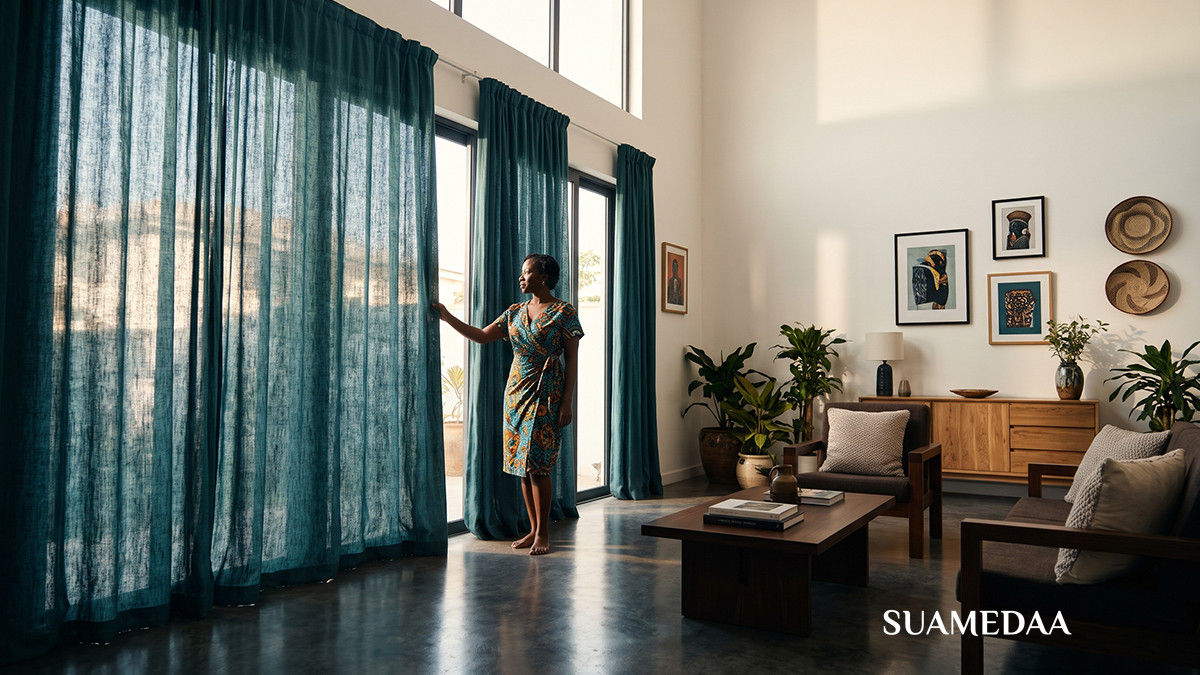
Curtain height is the single most impactful decision in this category. A curtain hung from just above the window frame looks like an afterthought. A curtain hung from ceiling height, even in a room with low ceilings, draws the eye upward, creates the visual impression of a taller space, and gives the room a sense of proportion and intention that the same fabric hung lower cannot achieve. This is a designer’s secret that costs nothing beyond the purchase of a few extra metres of fabric and the installation of a track or pole in the right position.
Colour and texture in curtains have an outsized effect on the room’s overall character because curtains typically occupy a significant portion of a wall’s visible surface. A fabric that is rich in texture, linen with its natural irregularity, velvet with its pile and depth, silk with its liquid movement, adds dimension to a room in a way that paint alone cannot. A curtain in a deep colour, anchoring a room with a visual weight that balances lighter furniture and walls, can transform a space from pleasant to compelling. A sheer curtain in white or ivory, flooding the room with diffused light, produces a quality of atmosphere that is difficult to achieve by any other means.
The question of whether a curtain should match, contrast, or complement the other elements of a room is one that interior designers have been answering, variously, for centuries. The honest answer is that all three approaches can work, and the choice should be driven by what the room needs, not by a rule. A room that is busy with pattern needs a curtain that is quiet. A room that is quiet and uniform needs a curtain that provides interest. A room that lacks warmth needs a fabric with warmth in it. A room that feels too heavy needs something that lightens it.
Curtains in the African Home: A Specific Conversation
For Ghanaian and West African homes, the curtain question comes with specific contextual considerations that general interior design advice from temperate climates does not always address.
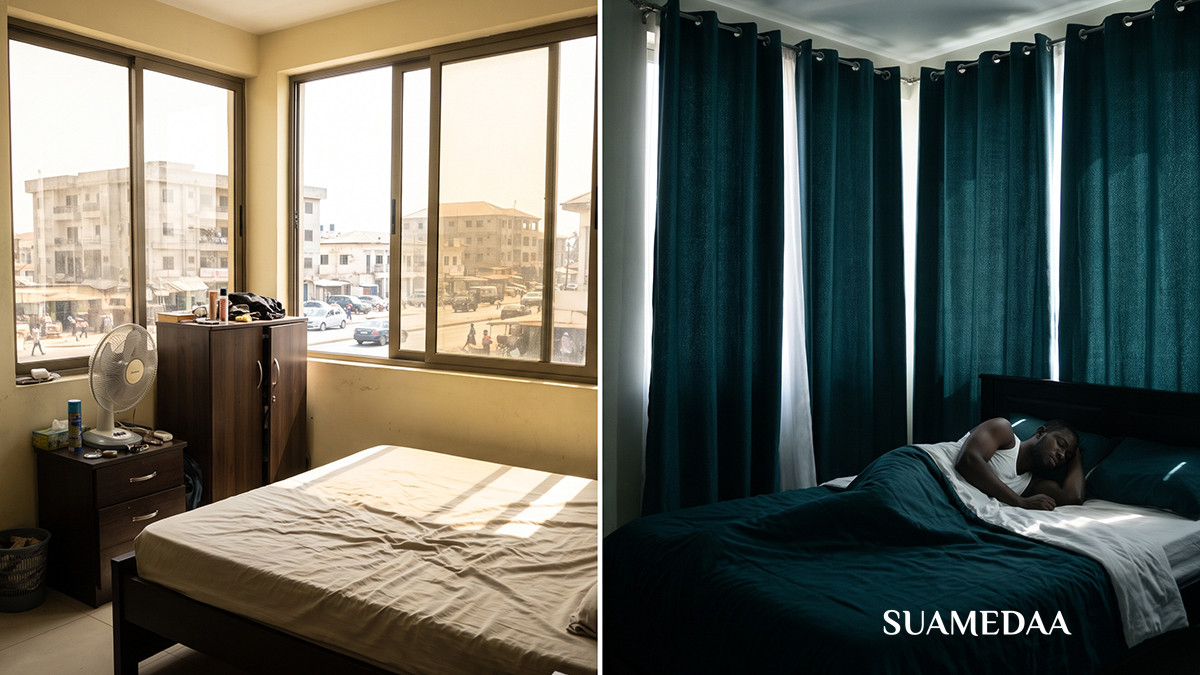
The tropical light of the West African day is intense in a way that European or North American design discourse rarely accounts for. Direct sunlight in Accra from mid-morning through late afternoon is not the gentle golden quality that European countries use their curtains to preserve. It is aggressive, bleaching, and hot. A sheer curtain that might provide adequate light filtering in London will not do the same job in Accra. Homes in the tropics need fabrics with more substance, lining, or density to genuinely manage what the sun brings through the glass.
The question of colour fading is also more pressing. Fabrics in constant strong sunlight fade, often unevenly, producing curtains that look tired and discoloured long before they are structurally worn out. UV-resistant fabrics and lining materials significantly extend the life of curtains in tropical settings and represent a worthwhile additional investment.
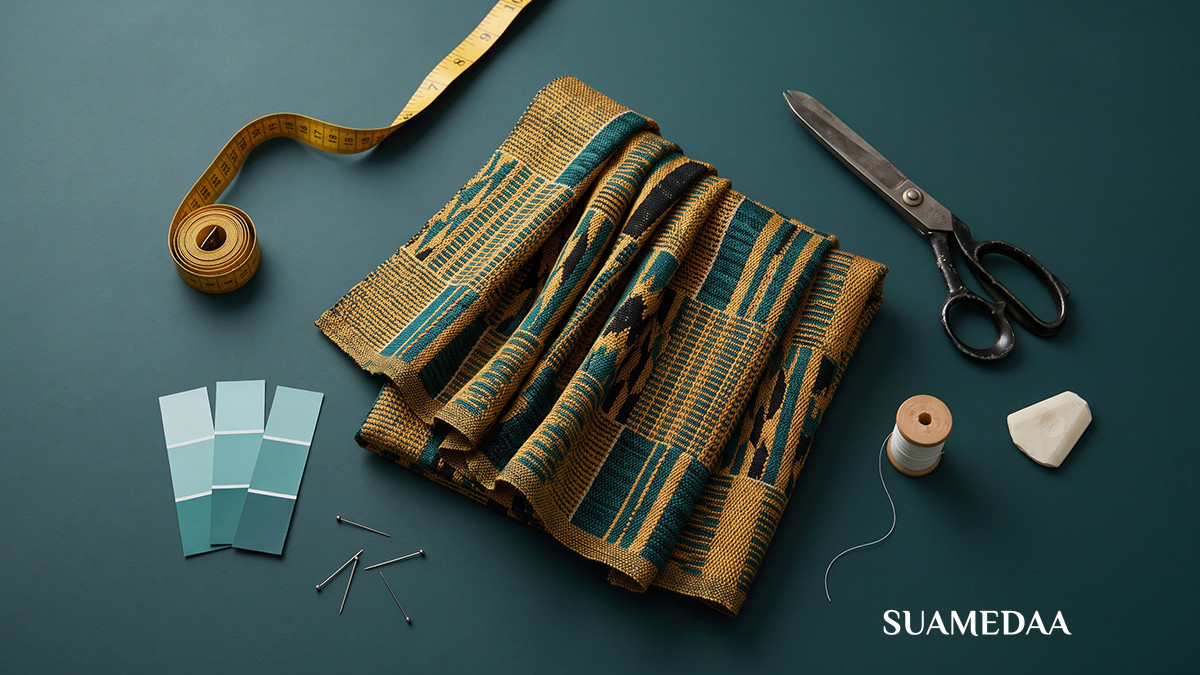
African interior aesthetics, increasingly asserting themselves in a design world that once defaulted entirely to European and American reference points, offer a rich vocabulary for curtain design that many homeowners have not yet fully explored. Kente cloth patterns, translated into curtain fabric, bring colour and cultural resonance to a room in a way that imported fabrics cannot. The use of Ankara prints, bold geometric and floral patterns in vivid colours, as curtain material is a practice that connects the home to a specific visual tradition and makes the space distinctly and confidently African. The growing market in locally produced fabric, in Ghana, Nigeria, Côte d’Ivoire, and across the continent, means that it is increasingly possible to dress windows with materials that are beautiful, meaningful, and produced at home rather than imported.
Why You Should Prioritise Curtains
The argument for taking curtains seriously is not an aesthetic argument alone, though the aesthetic argument is real and substantial. It is an argument rooted in function, in comfort, in energy economy, and in the quality of daily life inside a home.
A well-chosen curtain earns its place in a household budget in ways that are measurable. The reduction in solar heat gain translates into lower air conditioning costs in a tropical climate where electricity prices are significant and reliable power supply is not guaranteed. The improvement in sleep quality, through light control and modest sound dampening, is not a luxury. Sleep affects health, productivity, mood, and cognitive function in ways that every piece of relevant research confirms. A blackout curtain in a bedroom in a neighbourhood with streetlights or early-rising sun is not a nicety. It is a health investment.
The privacy that curtains provide, particularly in the dense urban fabric of Ghanaian cities, is a form of dignity. It is the material expression of the principle that a home is a person’s private domain, that what happens inside it belongs to the household and not to the neighbourhood. That principle is worth investing in.
The aesthetic quality of a room with well-chosen, properly hung curtains is markedly different from the same room without them. The difference is not subtle. It is the difference between a space that feels finished, considered, and inhabitable and a space that feels incomplete. Interior designers consistently identify the lack of curtains, or poorly chosen ones, as among the most common reasons that homes that have good furniture, fresh paint, and decent flooring still feel like something is missing. The window is literally the frame through which light enters and the view is shaped. Leaving it unaddressed is like painting a picture and leaving the frame off.
The tradition of dressing windows and doorways with fabric has persisted for five thousand years across every major human civilisation. It persisted not because it was required by law or enforced by convention, though at various points social convention made it effectively mandatory. It persisted because it works. Because people who hang good curtains in their homes are more comfortable, more private, better rested, and living in spaces that more fully express who they are and what they value.
Five thousand years of accumulated human experience with the question of what to put at a window is not a tradition to be dismissed. It is one to be understood, taken seriously, and applied with intelligence and intention to the specific conditions and aesthetics of your own home.