Swahili for Absolute Beginners – Where to Start and What to Expect
Maybe you heard it in a Bongo Flava song. Maybe you’re planning a trip to Zanzibar, Nairobi or Arusha. Or maybe you simply want to learn an African language that opens doors across a huge part of the continent. Whatever brought you here, Swahili is one of the most rewarding languages a beginner can pick.
This guide explains why Swahili is worth your time, what makes it easy (and what doesn’t), and exactly how to take your first steps.
Why Swahili?
Swahili, or Kiswahili as speakers call it, is a genuinely big language. The United Nations describes it as one of the most widely spoken languages in Africa and the world, with over 200 million speakers, and it serves as an official language of the African Union, SADC and the East African Community. Its global profile keeps rising: in November 2025, Kiswahili became the seventh official language of the UNESCO General Conference, alongside Arabic, Chinese, English, French, Russian and Spanish.



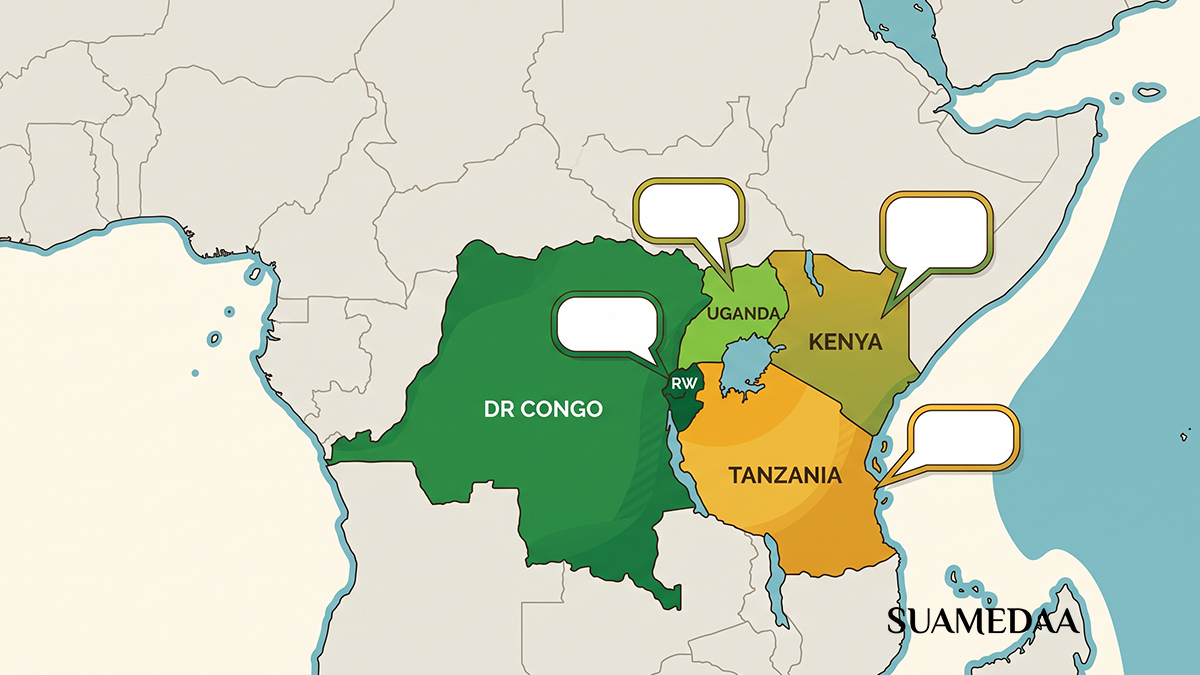
It is an official or national language in Tanzania, Kenya, Uganda, Rwanda and the DR Congo, and it’s heard across the wider Great Lakes region. One honest note: speaker counts vary a lot depending on who is counting. Estimates including both native and second-language speakers range from 40 million to 200 million. What everyone agrees on is that most people who speak Swahili learned it as a second language, which means you’ll be joining millions of fellow learners.
There’s even a day to celebrate it. World Kiswahili Language Day falls on 7 July, marking the date Julius Nyerere adopted Swahili as a unifying language for Tanganyika’s independence struggle.
What to Expect: The Good News
Swahili has a reputation as one of the friendlier languages for beginners, and it’s well earned.
It uses the Latin alphabet. No new script to learn. If you can read this article, you can read Swahili.
It’s written the way it sounds. Each letter has a consistent sound, so once you learn the rules, you can pronounce almost any word you see. The UN notes that Kiswahili’s logical and phonetic structure makes it one of the easiest African languages to learn for beginners.



Five clear vowels. A, E, I, O, U always sound the same:
- a as in father
- e as in bed
- i as in machine
- o as in more
- u as in rule
Predictable stress. The stress almost always falls on the second-to-last syllable: ha-BA-ri, ta-fa-DHA-li, a-SAN-te.
No tones. Unlike many African languages, Swahili is not tonal. Pitch won’t change a word’s meaning, which removes a big hurdle.
Familiar words. Swahili has absorbed vocabulary from Arabic, English and other languages over centuries of trade. You’ll spot words like shule (school), basi (bus), hoteli (hotel) and kompyuta (computer) right away. And you already know a few Swahili words without realising it: safari means “journey,” and hakuna matata really does mean “no worries.”
What to Expect: The Challenges
Every language has its puzzles. Swahili’s are logical, but they take practice.



Noun classes. Swahili groups nouns into classes, each with its own prefixes for singular and plural. For example:
| Singular | Plural | Meaning |
|---|---|---|
| mtoto | watoto | child / children |
| kitabu | vitabu | book / books |
| mti | miti | tree / trees |
The tricky part is that these prefixes also affect adjectives and verbs linked to the noun. Don’t panic. Beginners can go a long way by learning the two most common classes (people, and “ki/vi” things) and picking up the rest gradually.
Verbs are built like LEGO. Swahili verbs stack small pieces together. Once you see the pattern, it’s actually satisfying:
- ni (I) + na (present) + penda (like) = ninapenda, “I like”
- u (you) + na + penda = unapenda, “you like”
- ni + li (past) + penda = nilipenda, “I liked”
- ni + ta (future) + penda = nitapenda, “I will like”
Learn a handful of these building blocks and you can create hundreds of sentences.
Negatives change the pattern. “I like” is ninapenda, but “I don’t like” is sipendi. Negatives have their own forms, so give yourself time with them.
Regional variety. Standard Swahili is based on the dialect of Zanzibar, and Tanzania is often seen as its heartland. In Kenya, especially Nairobi, you’ll hear a lot of Sheng, a lively street mix of Swahili and English. Learn standard Swahili first; it’s understood everywhere.
Your First 15 Words and Phrases
| Swahili | English | Notes |
|---|---|---|
| Jambo | Hello | Friendly, often used with visitors |
| Hujambo? | How are you? (lit. “You have no problem?”) | More natural than Jambo |
| Sijambo | I’m fine | The reply to Hujambo? |
| Habari? | What’s the news? / How are you? | Very common everyday greeting |
| Nzuri | Good / Fine | The usual answer to Habari? |
| Mambo? | What’s up? | Casual, among peers |
| Poa | Cool / Fine | The reply to Mambo? |
| Shikamoo | Respectful greeting to an elder | Especially common in Tanzania |
| Marahaba | Reply to Shikamoo | Said by the elder |
| Asante | Thank you | Asante sana = thank you very much |
| Karibu | Welcome / You’re welcome | You’ll hear this everywhere |
| Tafadhali | Please | |
| Ndiyo / Hapana | Yes / No | |
| Samahani | Sorry / Excuse me | |
| Kwa heri | Goodbye | Kwa herini to a group |
A small cultural tip: Greetings in East Africa are rarely a single word. People commonly exchange two or three lines (“Habari za asubuhi?” How is the morning? “Nzuri.“) before getting to business. Take your time, just as you would in Ghana.
Where to Start: A Simple 90-Day Plan
Days 1 to 14: Sounds and greetings
Learn the five vowels and how syllables work. Master the greeting pairs above and practise them out loud daily. Aim to recognise them by ear, not just on paper.
Days 15 to 30: Everyday essentials
Add numbers 1 to 10 (moja, mbili, tatu, nne, tano, sita, saba, nane, tisa, kumi), days of the week, food words and simple questions like Ni bei gani? (How much is it?) and Choo kiko wapi? (Where is the toilet?).
Days 31 to 60: Verb building
Learn the personal prefixes (ni, u, a, tu, m, wa) and the three tense markers (na, li, ta). Pick ten useful verbs such as kula (eat), kunywa (drink), kwenda (go), kutaka (want) and kusema (speak), and build sentences with them every day.
Days 61 to 90: Noun classes and real conversation
Start with the m/wa and ki/vi classes. At the same time, find a conversation partner, online or in your community, and try short chats about your day, family and food.
Tools and Habits That Help
- Listen to music. East African music is a joyful classroom. Taarab and Bongo Flava are both rooted in Swahili, and song lyrics help you absorb rhythm and everyday vocabulary.
- Watch and listen daily. News broadcasts, YouTube channels, podcasts and East African films give you real speech at natural speed.
- Use a beginner app or course for structure, then supplement it with real conversation.
- Keep a phrase notebook. Write down phrases you actually hear, not just textbook ones.
- Speak early. Don’t wait until you feel “ready.” East Africans are famously encouraging toward learners, and a simple Habari? often earns a delighted Karibu!
Common Beginner Mistakes to Avoid
- Relying only on “Jambo.” It’s fine, but locals more often use Habari?, Hujambo? or Mambo?
- Skipping elder greetings. In Tanzania especially, greeting an older person with Shikamoo shows real respect.
- Mixing up the vowel sounds. Keep them clean and consistent, and your pronunciation will sound good from day one.
- Fearing the noun classes. Treat them as patterns to notice, not rules to memorise all at once.
- Learning only from apps. Real voices and real conversations are what make the language stick.
How Long Will It Take?
Realistically, with 20 to 30 minutes a day, you can handle greetings, introductions and simple shopping within two or three months. Holding comfortable everyday conversations usually takes closer to a year of steady practice. The US Foreign Service Institute places Swahili in a moderate difficulty group for English speakers, somewhat more demanding than Spanish or French but much more approachable than languages with tones or new scripts.
The most important thing to expect? Progress that feels fast at the start. Because Swahili is so regular, the first few weeks tend to be encouraging, and that early confidence is exactly what keeps learners going. Karibu kwenye safari yako ya Kiswahili! Welcome to your Swahili journey!