
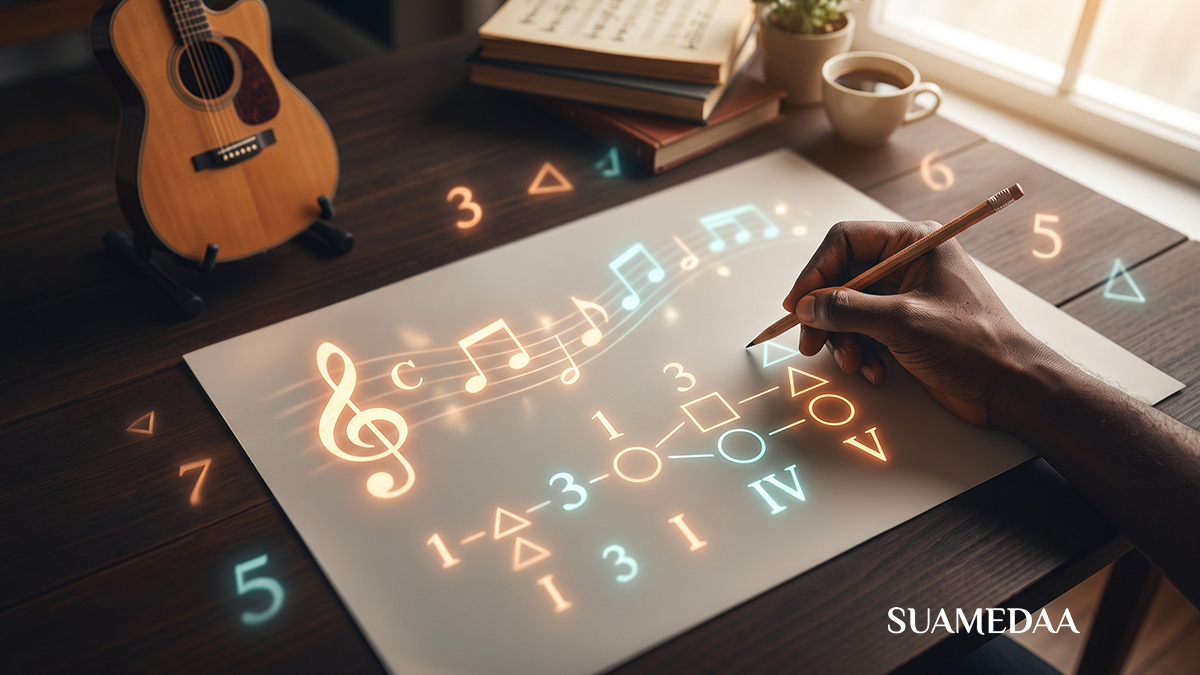
Music Theory Made Simple – What Every Musician Should Understand
Ask a room full of musicians whether they know music theory and watch how many of them flinch. For a lot of players, especially self-taught ones, theory feels like the academic part of music: the dry, rule-heavy system that belongs in a conservatory classroom and has little to do with the experience of actually playing and feeling music. Many great musicians have built remarkable careers without formally studying it, and that fact gets cited regularly as proof that theory is unnecessary.
But that argument misunderstands what music theory actually is. Theory is not a set of rules that tells you what you are allowed to play. It is a language for describing what is already happening in music. When you learn why a chord progression feels tense or resolved, why a particular melody line sounds hopeful or mournful, why one key feels bright and another feels heavy, you are not learning restrictions. You are learning to read a map of territory you have already been walking through by instinct.
Every musician, regardless of genre, instrument, or level of formal training, benefits from understanding the fundamentals. This guide presents those fundamentals in plain language, building from the most basic building blocks up through harmony, rhythm, and musical form, so that by the end you have a working understanding of the system underlying all of the music you already love.



The Basics: Sound, Pitch, and the Musical Alphabet
Music begins with sound, which is vibration. When a guitar string vibrates, when a vocalist pushes air through their vocal cords, when a drum skin is struck and resonates, the resulting air pressure waves reach your ear and your brain interprets them as sound. The frequency of those vibrations, measured in hertz, determines what we perceive as pitch: how high or low a note sounds.
Western music organizes pitch into a system of twelve distinct notes. These twelve notes repeat in cycles up and down the frequency spectrum, with each repetition doubling or halving the frequency and producing what we call an octave, a word derived from the Latin for eight, reflecting how the scale is counted.
The musical alphabet uses only seven letter names: A, B, C, D, E, F, and G. After G, the sequence returns to A, but at a higher pitch. In addition to these seven natural notes, there are five sharps and flats that sit between certain natural notes, giving the total of twelve. On a piano keyboard, the white keys are the natural notes and the black keys are the sharps and flats.
A sharp, indicated by the symbol #, raises a note by a half step, the smallest interval available in Western music. A flat, indicated by the symbol b, lowers a note by a half step. The note between C and D can be called either C# or Db, depending on context. Notes that share the same pitch but carry different names are called enharmonic equivalents.
Understanding these twelve notes and how they are named is the entry point into everything that follows.



Intervals: The Distance Between Notes
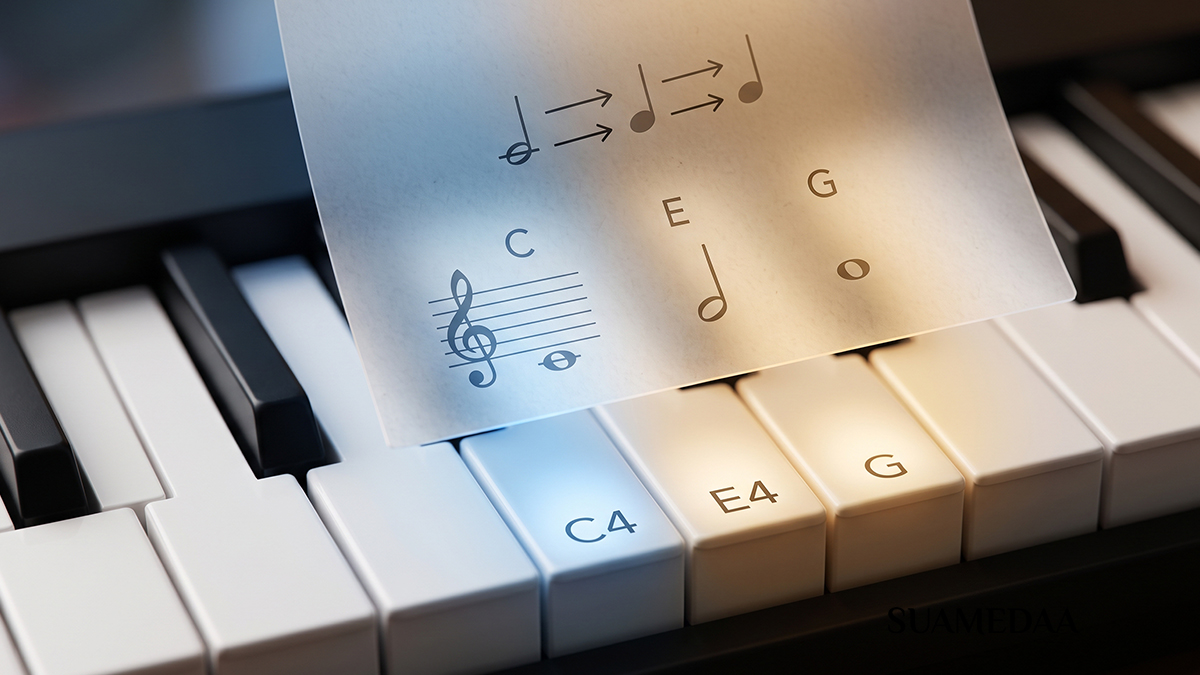
An interval is the distance between two notes. Intervals are the building blocks of melodies and chords, and developing an ear for them is one of the most practical skills a musician can build.
The smallest interval in Western music is the half step, also called a semitone. On a piano, moving from any key to the very next key, white or black, up or down, is a half step. Two half steps make a whole step, also called a tone.
Intervals are named by counting the number of letter names they span, including the starting note. From C to D is a second. From C to E is a third. From C to F is a fourth. From C to G is a fifth. From C to A is a sixth. From C to B is a seventh. From C to the C above is an octave.
But intervals are also qualified by their quality: major, minor, perfect, augmented, or diminished. A major third spans four half steps. A minor third spans three half steps. A perfect fifth spans seven half steps. These qualities give intervals their character and emotional color.
Learning to hear intervals is enormously useful. When you can identify a major sixth by ear you can transcribe melodies faster. When you recognize a tritone, the most dissonant interval in Western music spanning six half steps and sitting exactly halfway through the octave, you start understanding why certain chord transitions create tension and why others resolve it.



Musicians use simple songs as memory aids for intervals. A perfect fourth sounds like the opening of “Here Comes the Bride.” A major sixth sounds like the opening of “My Bonnie Lies Over the Ocean.” A minor third sounds like the first two notes descending in “Smoke on the Water.” These associations are not childish. They are practical ear-training tools used by professional musicians and composers at every level.
Scales: The Notes That Belong Together
A scale is a set of notes arranged in ascending or descending order that share a particular pattern of intervals and give a piece of music its tonal character. The word “scale” comes from the Latin scala, meaning ladder, and that is a useful image: a scale is a ladder of pitches from one note to its octave.
The Major Scale
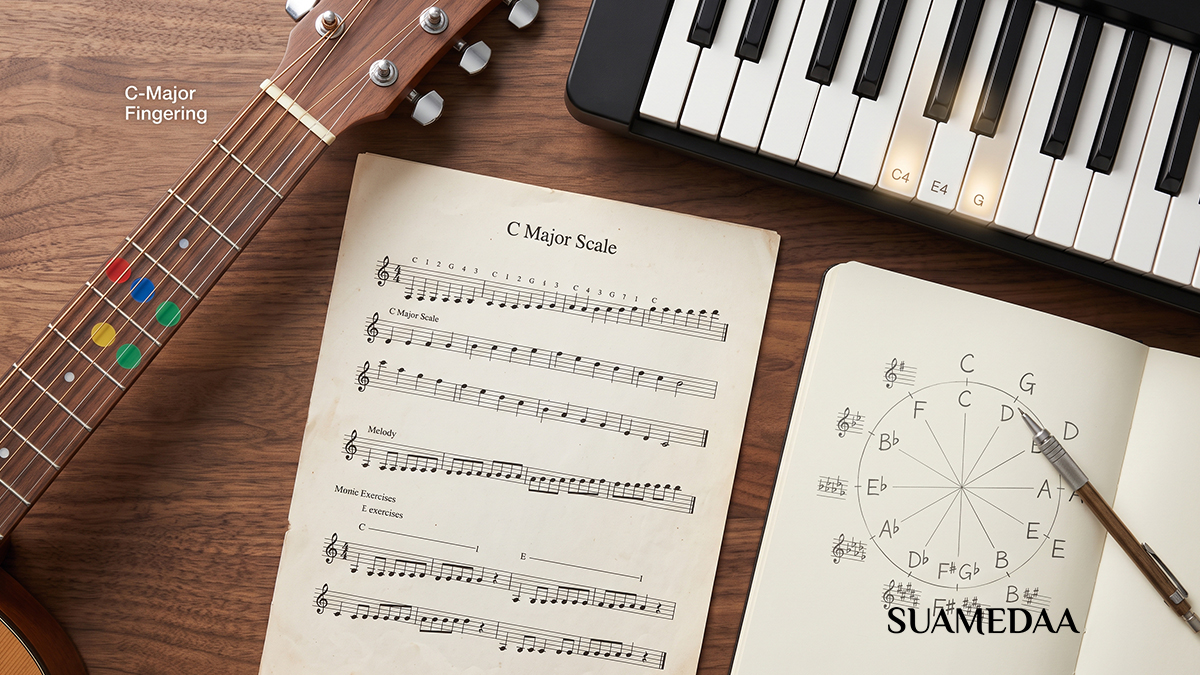
The major scale is the foundation of Western tonal music. It has a specific pattern of whole steps and half steps: W W H W W W H, where W is a whole step and H is a half step. Starting from C and applying this pattern gives you the notes C D E F G A B C, the white keys of the piano in sequence. This is called the C major scale.
The major scale has a bright, stable, resolved quality to it. When you hear a melody and it sounds happy, confident, or settled, it is very likely built on a major scale.
You can start a major scale on any of the twelve notes and get a different major key, each with its own set of sharps or flats required to maintain the W W H W W W H pattern. The key of G major has one sharp, F#. The key of D major has two sharps. The key of F major has one flat, Bb. These sharps and flats are notated at the beginning of a piece of sheet music in what is called a key signature, telling the reader which notes are consistently raised or lowered throughout the piece.
The Minor Scale
The minor scale creates a darker, more melancholic, more complex emotional quality than the major scale. Its pattern of steps is W H W W H W W. Starting from A and applying this pattern gives you A B C D E F G A, again the white keys of the piano but starting from A rather than C. This is called the A natural minor scale.
Crucially, C major and A natural minor share exactly the same notes. A natural minor is called the relative minor of C major. Every major key has a relative minor built on the sixth degree of its scale, a relationship that composers exploit constantly to shift emotional color without leaving the same tonal neighborhood.
There are actually three forms of the minor scale: natural minor as described above, harmonic minor which raises the seventh degree by a half step to create a leading tone that pulls strongly back to the tonic, and melodic minor which raises both the sixth and seventh degrees when ascending and reverts to natural minor when descending. Each has a distinct character and each is used in different contexts.
Pentatonic Scales
The pentatonic scale contains only five notes rather than seven. The major pentatonic removes the fourth and seventh degrees of the major scale. The minor pentatonic removes the second and sixth degrees of the natural minor scale.
The minor pentatonic in particular is the scale most guitarists, blues players, rock soloists, and improvisers reach for instinctively. Its five notes are forgiving: almost any combination of them sounds good over the corresponding chord, which makes it an ideal starting point for improvisation. An enormous proportion of rock, blues, soul, and funk lead guitar is built almost entirely from the minor pentatonic.
Understanding that the pentatonic scale is simply a subset of the major or minor scale, with the two most harmonically tense notes removed, helps you understand why it feels so versatile and why it sits so comfortably across so many chord progressions.
The Blues Scale
The blues scale adds one note to the minor pentatonic: the flattened fifth, also called the blue note or the tritone. That single addition gives the blues scale its characteristic tension and expressiveness, the note that sounds slightly “wrong” in the most right way possible. Blues, rock, and jazz all rely on this note to create the bending, searching quality that defines the genres.
Modes
Modes are scales derived from the major scale by starting on a different degree. There are seven modes, each named after ancient Greek regions: Ionian (identical to the major scale), Dorian (minor feel with a raised sixth, used widely in folk and rock), Phrygian (very dark, characteristic of flamenco and metal), Lydian (dreamy and floating, with a raised fourth), Mixolydian (major feel with a lowered seventh, the default mode of rock and blues), Aeolian (identical to the natural minor scale), and Locrian (extremely dissonant, rarely used in full but influential in jazz and metal).
Modes are often mystified by music teachers and dismissed as too advanced, but they are simply the major scale heard from a different starting point. Once you know the major scale pattern, you know all seven modes. The art lies in understanding which mode creates the emotional color you want and how to stay anchored in it when improvising or composing.
Chords: Notes Sounding Together
A chord is three or more notes played simultaneously. Chords are the harmonic backbone of almost all Western music, from a three-chord rock song to a complex jazz standard.
Triads
The most fundamental chord is the triad, a three-note chord built by stacking two thirds on top of each other. There are four types of triads.
A major triad consists of a root note, a major third above it, and a perfect fifth above the root. It sounds bright and stable. C major is C, E, G.
A minor triad consists of a root note, a minor third above it, and a perfect fifth above the root. It sounds darker and more emotionally complex. C minor is C, Eb, G.
A diminished triad consists of a root note, a minor third above it, and a diminished fifth above the root. It sounds tense and unstable, creating a strong desire to resolve to another chord.
An augmented triad consists of a root note, a major third above it, and an augmented fifth above the root. It sounds dreamlike and ambiguous, with no strong sense of resolution in any direction.
Seventh Chords
Add one more third on top of a triad and you get a seventh chord, named for the interval between the root and the added note. Seventh chords are richer and more colorful than triads and are the standard vocabulary of jazz, R&B, and soul.
The most important seventh chords are the major seventh, the dominant seventh, the minor seventh, the minor major seventh, the half-diminished seventh, and the fully diminished seventh. Each has a distinct sound and function. The dominant seventh chord in particular, built on the fifth degree of the major scale, is one of the most powerful harmonic forces in Western music. Its built-in tension creates an almost irresistible pull back to the tonic chord, a relationship that underlies countless songs across every genre.
Chord Inversions
A chord is in root position when its root note is the lowest note being played. But chords can also be inverted: if the third is in the bass, the chord is in first inversion. If the fifth is in the bass, it is in second inversion. Inversions do not change which notes are in a chord but they change its color and the smoothness with which it connects to surrounding chords. Bass players and keyboard players use inversions constantly to create smoother voice leading, the art of moving between chords with minimal unnecessary movement in each individual part.
Harmony: How Chords Work Together
Building chords from the notes of a scale produces a family of chords that naturally belong together. This is called harmonizing the scale, and it produces the chord progressions that underlie the vast majority of songs you know.
Roman Numeral Analysis
Chords built on the degrees of a scale are labeled with Roman numerals: I for the chord built on the first degree, II for the second, III for the third, and so on. Uppercase numerals indicate major chords. Lowercase indicate minor. In the key of C major, I is C major, ii is D minor, iii is E minor, IV is F major, V is G major, vi is A minor, and vii° is B diminished.
This system allows musicians to describe chord progressions in a way that applies to any key. A I-IV-V progression in C major is C, F, G. The same I-IV-V progression in G major is G, C, D. The relationship between the chords is identical. The sounds are transposed.
Common Chord Progressions
Certain progressions appear so frequently across so many genres that learning to recognize them by ear is one of the fastest ways to unlock the ability to play by ear and understand songs quickly.
I-IV-V is the foundation of blues, rock, country, and folk. Three chords, hundreds of thousands of songs.
I-V-vi-IV is arguably the most common progression in contemporary popular music. Play C, G, Am, F on a guitar and you have the harmonic skeleton of an extraordinary number of chart hits from the past four decades spanning multiple genres.
ii-V-I is the cornerstone of jazz harmony. The tension of the ii chord resolves to the dominant V, which resolves to the tonic I, creating one of the most satisfying harmonic journeys in Western music. Jazz musicians spend years mastering every variation and substitution built on this foundation.
I-vi-IV-V is the classic 1950s doo-wop and early rock and roll progression, familiar from countless early pop songs and still used constantly today.
vi-IV-I-V is a minor-starting version of the same family of chords, giving a darker, more melancholic quality while remaining in the same key.
The Circle of Fifths
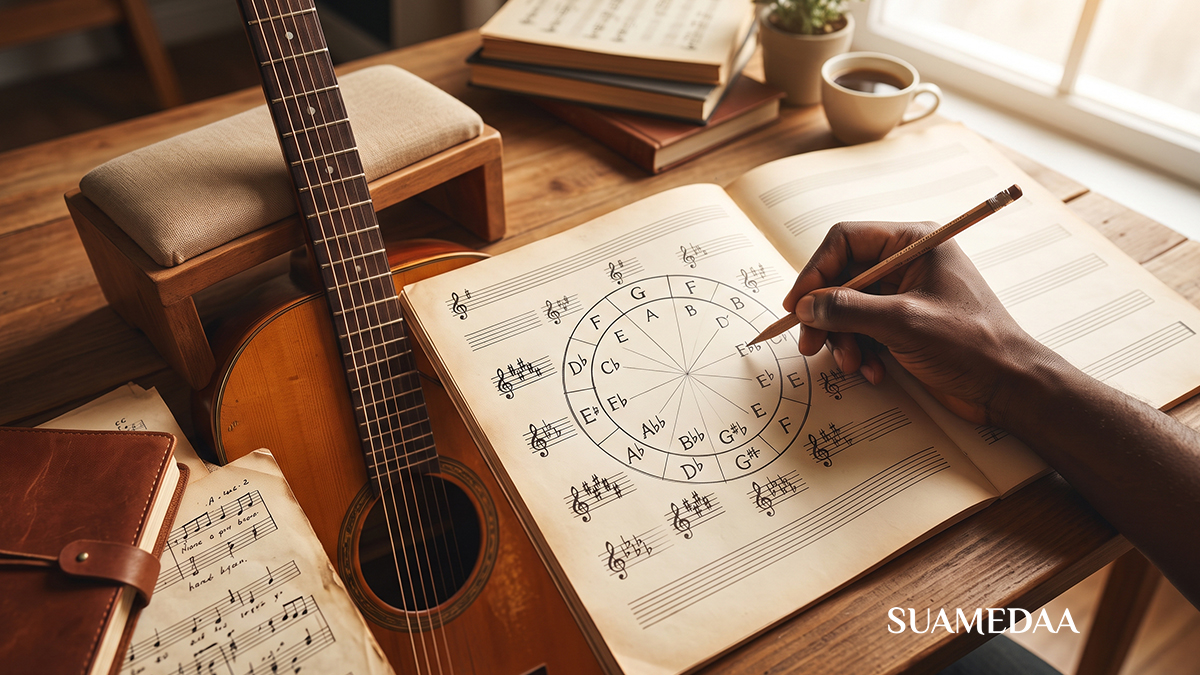
The circle of fifths is one of the most useful diagrams in all of music theory. It arranges all twelve major keys in a circle, organized by the interval of a fifth between adjacent keys. Moving clockwise around the circle adds one sharp to the key signature with each step. Moving counterclockwise adds one flat.
The circle of fifths reveals relationships between keys: adjacent keys share almost all of their notes and chords, making modulation between them smooth and natural. Keys on opposite sides of the circle share very few notes and moving between them creates maximum harmonic contrast.
It also illustrates the relationship between major keys and their relative minors, and it is an invaluable reference for understanding why certain chord movements feel close and natural while others feel jarring and dramatic.
Rhythm: The Engine of Music
Harmony and melody are what music is made of, but rhythm is what makes it move. A melody played with no rhythmic variation is as flat and lifeless as text read in a complete monotone.
Time Signatures
A time signature tells you how rhythm is organized in a piece of music. It is written as two numbers stacked on top of each other. The top number tells you how many beats are in each measure, the repeating unit of musical time. The bottom number tells you what kind of note gets one beat.
In 4/4 time, the most common time signature in popular music, there are four beats per measure and a quarter note gets one beat. In 3/4 time, used in waltzes, there are three beats per measure. In 6/8 time, there are six eighth-note beats per measure, which tends to feel as two groups of three rather than six even beats. In 5/4 time, made famous by Dave Brubeck’s “Take Five” and used in various prog rock and jazz compositions, there are five beats per measure creating an asymmetrical, slightly limping feel that is immediately distinctive.
Note Values
Notes are named by their duration relative to the whole note. A whole note lasts four beats in 4/4 time. A half note lasts two beats. A quarter note lasts one beat. An eighth note lasts half a beat. A sixteenth note lasts a quarter of a beat. A dotted note increases the note’s value by half: a dotted quarter note lasts one and a half beats.
Rests follow the same naming convention and indicate silence for the corresponding duration. Silence in music is not empty. It is as compositionally significant as any sounded note, and knowing how to use it is a mark of musical maturity.
Syncopation
Syncopation is the displacement of the expected rhythmic accent onto a beat or subdivision that is not normally stressed. In 4/4 time, the strong beats are beats one and three. A syncopated rhythm accents beats two and four, or the eighth-note subdivisions between the main beats. Syncopation is the engine of swing, funk, reggae, Afrobeats, and most of the world’s dance music. It creates a sense of propulsion, bounce, and rhythmic tension that straight, unsyncopated rhythms lack.
Tempo and Feel
Tempo is the speed of the music, measured in beats per minute (BPM). A tempo of 60 BPM means one beat per second. A slow ballad might sit around 60 to 70 BPM. A mid-tempo groove around 90 to 110. An upbeat dance track around 120 to 130. Drum and bass at 160 to 180.
But feel is distinct from tempo. Two tracks at exactly the same BPM can feel entirely different based on where within the beat the notes and accents fall. Straight eighths feel different from swung eighths. A tight, punchy pocket feels different from a loose, laid-back groove. This subdivision feel is what musicians mean when they talk about a drummer “sitting behind the beat” or a track that “pushes.” It is subtle, it is powerful, and it lives in the gap between the notation and the actual performance.
Melody: The Line That Sings
Melody is the single-note line that carries the musical idea, the part you hum in the shower, the line that makes a song recognizable the instant it begins. Understanding what makes a melody work is as much art as theory, but there are principles that apply consistently.
Contour. A strong melody has a shape: it rises and falls, creates peaks of tension and valleys of resolution. A melody that moves entirely in one direction or stays on the same pitch quickly loses interest. A melody that leaps too frequently in both directions sounds scrambled and hard to follow. The best melodies balance stepwise motion, moving between adjacent notes, with occasional larger leaps that create drama and emphasis.
Repetition and variation. The human ear loves patterns. A melodic motif repeated with small variations gives the listener something familiar to hold onto while keeping the line fresh. The most iconic melodies in music history almost all feature a core motif that returns in altered form throughout the piece.
Resolution. Melodies that end on the tonic note, the first degree of the scale, feel settled and complete. Melodies that end on other scale degrees feel open, questioning, or unresolved. Knowing this allows you to deliberately craft melodic phrases that ask a musical question and then answer it, creating the call-and-response architecture that underlies an enormous amount of Western and African musical tradition alike.
Rhythm within melody. A melody is as much rhythmic as it is pitch-based. The same sequence of pitches played with different rhythms creates a completely different melodic character. Changing the rhythm of a melodic phrase while keeping the pitches identical is a powerful compositional technique for creating variation without abandoning the core idea.
Musical Form: How Pieces Are Structured
Musical form describes the large-scale architecture of a piece of music. Understanding form helps you learn songs faster, improvise more intelligently, and compose with a clearer sense of where you are and where you are going within a piece.
Verse-Chorus form is the dominant structure of popular music. Verses carry the narrative and change lyrically each time they appear. The chorus carries the emotional peak, the hook, the line that gets stuck in your head, and typically repeats with the same lyrics each time. A bridge or middle eight section contrasts with both, providing relief before the final chorus. This structure has driven almost every hit song in the past sixty years across pop, rock, soul, country, and beyond.
12-Bar Blues is one of the most important and widely used forms in music. It is a twelve-measure cycle built on the I, IV, and V chords in a specific sequence, repeated continuously throughout a song, with a soloist or vocalist improvising over it. Blues, rock and roll, jazz standards, and country all draw from this form constantly.
AABA form is the standard form of the American songbook, the jazz standards of the 1920s through the 1950s. It consists of two A sections with the same melody and harmony, a contrasting B section called the bridge or the release, and a return to the A section. Hundreds of the most beloved jazz standards follow this form.
Rondo form appears more in classical music and is structured as ABACADA and so on, where A is a recurring theme and B, C, D are contrasting episodes. The recurring return of A gives the piece a sense of homecoming after each adventure into new material.
Through-composed describes music that has no repeated sections at all. Every section is new. This form is common in art song, film scoring, and progressive music where narrative development takes precedence over repetitive structure.
Reading Music: Why It Helps Even If You Do Not Rely On It
Sheet music notation is a system for writing down pitch, rhythm, dynamics, and articulation so that a performer who was not present when a piece was composed can still play it accurately. Learning to read it to even a basic level opens up an enormous library of learning material, makes communication with other musicians cleaner, and accelerates learning across the board.
The staff is five horizontal lines on which notes are placed. The higher a note appears on the staff, the higher its pitch. The treble clef covers higher pitches and is used for instruments like violin, guitar, and the right hand of a piano. The bass clef covers lower pitches and is used for instruments like bass guitar, cello, and the left hand of a piano.
Note heads placed on lines and spaces correspond to specific pitches. A standard memory aid for the lines of the treble clef from bottom to top is “Every Good Boy Deserves Food” giving the notes E, G, B, D, F. The spaces spell FACE from bottom to top.
If reading sheet music feels intimidating, start with rhythm reading alone, clapping or tapping the rhythmic values without worrying about pitch. Then add pitches one step at a time. Fluent music reading is a skill that builds with consistent short practice sessions rather than occasional marathon efforts.
Putting It Together: How Theory Serves Practice
Music theory is not an end in itself. It is a set of tools that serves the music and the musician. Here is how to take these concepts from the page into your actual playing.
Learn your scales in every key. Not as an exercise in memorization but as a way of internalizing the tonal landscape of your instrument. When you know where all the notes of the key of F# minor live on your instrument, you can navigate confidently during improvisation rather than hunting.
Analyze songs you love. Take a song from any genre and identify its key, its chord progression using Roman numerals, its form, and any interesting harmonic moves like borrowed chords or modulations. This connects theory to music you already have an emotional relationship with.
Train your ear alongside your hands. Theory studied only on paper remains abstract. Use ear training apps, sing intervals, learn melodies by ear, and try to identify chord qualities by sound. The goal is to close the gap between what you know intellectually and what you can hear instinctively.
Use theory to get unstuck. When a composition or improvisation feels stale, theory offers exits: try the relative minor, borrow a chord from the parallel minor, add a passing chord, shift the rhythmic feel, try the Dorian mode instead of natural minor. Theory is a toolbox for creative problem-solving.
Remember that rules describe, not prescribe. Every rule in music theory has celebrated exceptions. The point is not to obey the theory but to understand it well enough to know when breaking it creates something more interesting than following it would have.
The Only Way Through Is Forward
Music theory is not something you learn once and check off a list. It is a lifelong conversation between your analytical mind and your musical ear. The more you learn, the more you hear. The more you hear, the more you want to learn. Professional composers and musicians who have studied for decades still find new things to understand in the theory they thought they knew.
Start where you are. If you do not know what a major scale is, start there. If you know your scales but have never analyzed a chord progression, start there. If you play by ear instinctively but cannot explain what you are doing, start putting names to the things you already hear.
The language of music theory is worth learning for the same reason any language is worth learning: it lets you communicate more precisely, understand others more deeply, and express yourself with greater intention. It does not replace the feeling. It illuminates where the feeling comes from.
And once you understand where the feeling comes from, you can create it deliberately, reliably, and on your own terms.