The African Union Youth Volunteer Corps and how to Volunteer
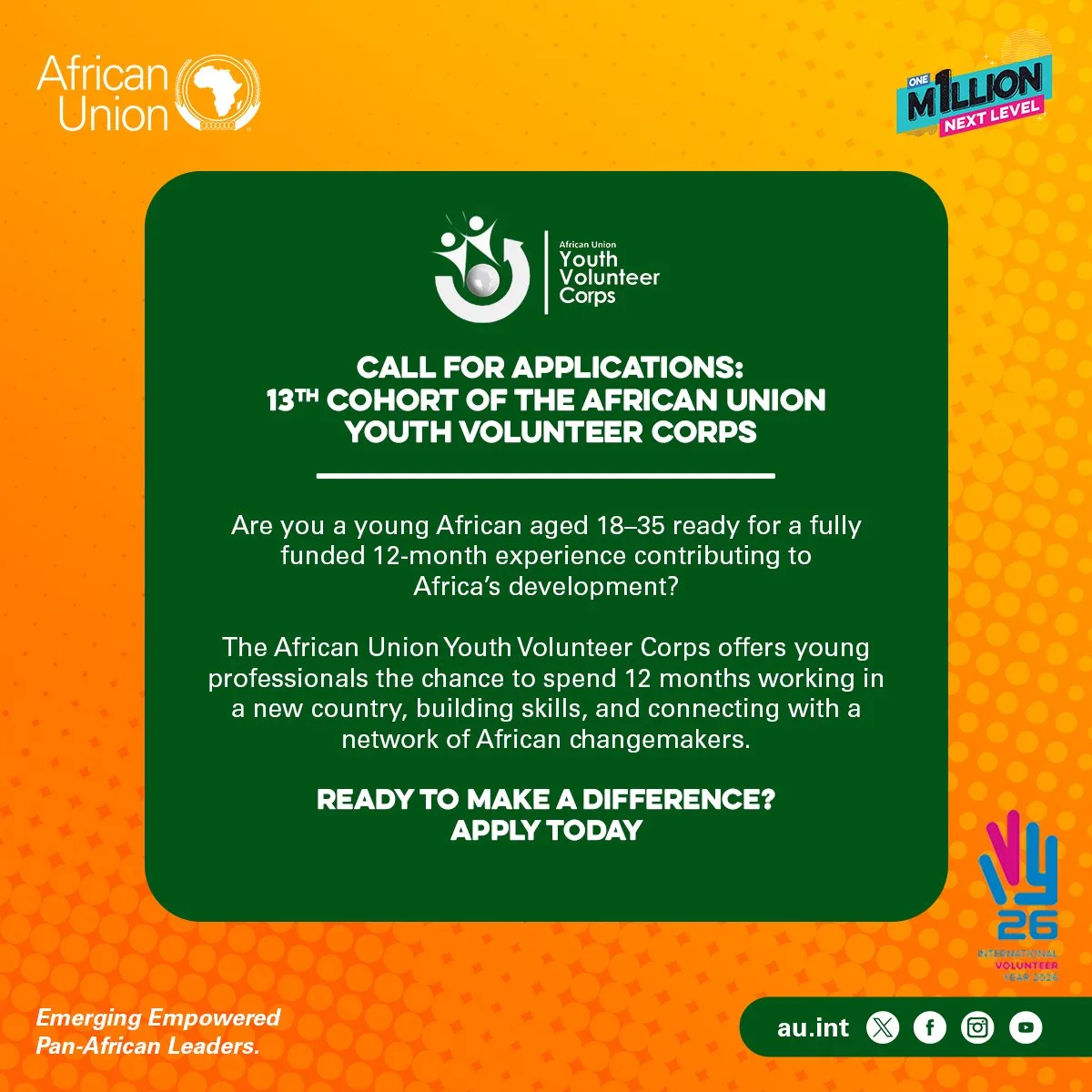
The African Union Youth Volunteer Corps (AU-YVC), established in 2010, is a flagship continental youth leadership programme that recruits, trains, and deploys young African professionals from all 55 AU Member States to serve as professional volunteers for a period of 12 months.
The programme aligns with the vision of Agenda 2063 – “The Africa We Want” – through inclusive growth, unity, and youth-driven development.
The 2026 Intake — Key Facts
The AU is currently recruiting the 2026–2027 cohort, with 50 posts available. The application deadline is 10th April , 2026 at 11:59 p.m.
Who Can Apply
To qualify, you must be a citizen of an AU Member State (living on the continent or in the diaspora), aged 18–35 (must be under 35 upon completing 12 months of service), hold a post-secondary qualification (TVET, Bachelor’s, Master’s, etc.), and have at least one year of verifiable volunteering experience and one year of professional work experience.
You must also be proficient in at least one AU working language — Arabic, English, French, Kiswahili, Portuguese, or Spanish — and be willing to live and work in another AU Member State.
What You Get
AU Youth Volunteers receive: a unique opportunity to engage at the highest continental policy level, networking with young African leaders across the continent, an economy return ticket to your place of deployment, a monthly stipend to cover living expenses, health insurance cover, an AU Service Passport, a separation allowance upon successful completion of 12 months, and training and mentorship opportunities.
The African Union Commission and partners cover the full costs of pre-deployment training and subsequent volunteer deployment for all successful candidates.
Where Volunteers Are Deployed
AU-YVC volunteers are deployed strictly in non-profit settings where their impact can fill the gap for much-needed skilled manpower — typically in education, health, agriculture, governance, and development programmes across any of the 55 AU Member States.

Why It Matters
Africa has the highest volunteering rate in the world – 58.5% of working-age Africans volunteer monthly. In Kenya alone, volunteers contributed an estimated 669 million hours in a single year, equivalent to 3.66% of GDP.
A volunteer dedicating 12 months of service delivers an average of 2,160 hours of community service – and the AU-YVC has been doing this across all 55 member states since 2010.
Importantly, the United Nations has designated 2026 as the International Volunteer Year — making this cohort especially significant on the global stage.
How to Apply
Visit jobs.au.int click “Search Jobs,” and find the AU-YVC post. Create an account if you are a new user, fill out your personal information, and attach your CV (no longer than 3 pages). The AU does not at any point charge or request facilitation fees to process applications.
AU Volunteering is not equivalent to a job offer from the AU. Be sure to not volunteer in a confused state.
- How to Rescue Your Best Outfits – A Guide to Removing tough Stains from African FabricsSpilling something on a basic cotton t-shirt is annoying, but spilling oil on a custom-tailored Adire two-piece or a vintage Kente cloth feels like a genuine crisis. Traditional African textiles rely on rich, saturated dyes and delicate weaving techniques. Because of this, standard commercial stain removers will often bleach the color right out of the fabric,… Read more: How to Rescue Your Best Outfits – A Guide to Removing tough Stains from African Fabrics
- The Six Tools of Strategic ThinkingThere is a difference between being smart and being strategic. Plenty of intelligent people make poor decisions because they think in straight lines, react to the surface of a situation, and stop analyzing the moment an answer feels good enough. Strategic thinkers operate differently. They have a set of mental habits that let them see further,… Read more: The Six Tools of Strategic Thinking
- Why Studying Abroad Can Disadvantage African StudentsDiscover how studying abroad can sometimes disadvantage African students through intentional mis-education, blocked technology access, and unfair preparation - plus how support, mentorship, and the right resources can still help students achieve high grades and thrive.
- Ghana 2025 Constitution Review – Learning, Participation, and What Comes NextThe review matters because a constitution is meant to do more than provide political procedures. It should also enable effective governance, credible accountability, and measurable development outcomes for citizens
- Intentional marginalisation of some outside Africa institutions miseducating African students but guaranteeing them top gradesIntentional marginalisation of some outside-Africa institutions can shape how African students are taught, assessed, and represented. When educational systems limit meaningful engagement, dismiss local contexts, or impose biased standards, students may be “misededucated”; not because they lack ability, but because the learning they receive does not reflect reality or equip them to think critically. At the… Read more: Intentional marginalisation of some outside Africa institutions miseducating African students but guaranteeing them top grades