
Unlike the mean, the median is not skewed by extreme values, providing a more accurate representation of the data’s center. The median is crucial in robust statistics as it remains unaffected by changes in extremely large or small values.
The median rule in statistics refers to the method of determining the middle value in a dataset. It is particularly useful when analyzing data sets with outliers that could skew the average, known as the mean. To calculate the median, the data points are first arranged in ascending or descending order. If the dataset has an odd number of observations, the middle value is selected as the median.
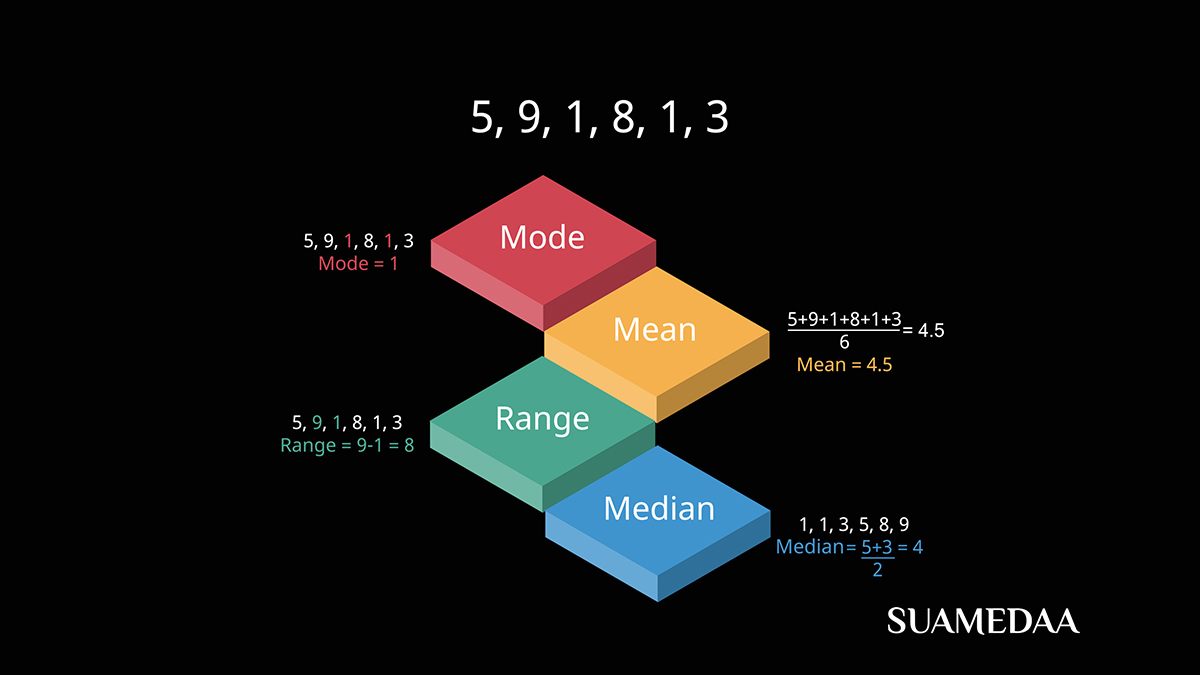
However, if there is an even number of observations, the median is defined as the arithmetic mean of the two middle values. For example, in a set of numbers like {1, 3, 5, 7, 9}, where there are five numbers (an odd count), the median would be 5, which is the middle value.
In contrast, for a set like {2, 4, 6, 8}, with four numbers (an even count), there is no distinct middle value. In this case, the median is calculated by averaging the two middle values; thus, the median would be (4 + 6) ÷ 2 = 5. The median rule provides a robust measure of central tendency that is less affected by extreme values compared to the mean. It offers a more accurate representation of the center of a dataset and is commonly used in statistics to describe data sets effectively.
When is the median a better measure of Central Tendency than the mean
The median is considered a better measure of central tendency than the mean in situations where the data set is skewed or contains outliers. Skewed distributions or datasets with extreme values can significantly impact the mean, making it less representative of the typical value in the dataset. In such cases, the median provides a more robust measure of central tendency as it is not influenced by extreme values to the same extent as the mean.

When the distribution of data is asymmetric or when outliers are present, the median is preferred over the mean. The median is less sensitive to extreme values and provides a more accurate representation of the center of the data, especially in scenarios where the mean could be misleading due to the influence of outliers.
Summarily, the median is a better choice for central tendency when dealing with skewed distributions, outliers, or situations where extreme values could distort the average, making it a more reliable measure in such circumstances.
How is the Median used in Data Analysis
In data analysis, the median is a valuable statistical measure used to describe the center of a dataset, especially when dealing with skewed distributions, outliers, or situations where extreme values could distort the average. Here is how the median is used in data analysis:
- Robust Measure of Central Tendency
The median is less affected by extreme values compared to the mean, making it a robust measure of central tendency. It provides a more accurate representation of the center of a dataset, particularly in the presence of outliers that could skew the mean. - Handling Skewed Distributions
In skewed distributions where the data points are not evenly distributed, the median offers a more reliable measure of the center. It is not influenced by extreme values and provides a better representation of the typical value in the dataset. - Outlier Resistance
The median is resistant to outliers, meaning that extreme values have less impact on the median compared to the mean. This makes the median a preferred measure when dealing with data sets that contain outliers or when the distribution is not symmetrical. - Median vs. Mean
While the mean is sensitive to outliers and extreme values, the median remains stable and provides a more accurate representation of the central value in such cases. By using the median, data analysts can mitigate the influence of outliers on the overall analysis. - Comparing Data Sets
When comparing different data sets or analyzing data with varying distributions, the median can offer a more consistent measure of central tendency. It helps in making fair comparisons between datasets by focusing on the middle value rather than the average, which could be skewed by extreme values.
The median is a powerful tool in data analysis, particularly in scenarios where the mean may not accurately represent the center of the data due to outliers or skewed distributions. It provides a more stable and reliable measure of central tendency, making it a valuable asset in statistical analysis.